



Did you know? On average, AI mentions a clinic in only 3 of every 10 answers. Is it mentioning yours? Run your free checkor see the live results
The Clinical Content System

Get found, and chosen: by Google, AI and patients

The way patients find a clinic is changing. Search is becoming a conversation, including on Google itself: people describe their problem, ask follow-up questions, and are often given a few clinics by name in the answer, instead of working through a page of links and ads.

To be one of those clinics, your website needs to make your expertise clear: what you treat, who your clinicians help, and why someone should choose you.

The Clinical Content System assesses where your website stands, combines that evidence with the priorities you set, and builds a plan of what to improve or publish next. It then researches and writes those pages with your clinicians' expertise: condition guides, treatment pages, service pages, blog posts and your clinicians' team pages. And it re-measures your website and AI visibility every four weeks.

The check is free, uses your real website, and your report arrives by email, usually within an hour, longer when we're busy. The Clinical Content System is £599 every four weeks, with no contract.
What's changed

Why your website now needs to explain your expertise

Patients still use Google, but the experience is changing. Alongside the usual results, they now meet AI-generated answers and can have a conversation about their problem. Other AI tools, such as ChatGPT, Claude and Perplexity, work the same way, from "what could this be?" to "who near me could help?".

So the question isn't just where you rank any more. It's whether your clinic's expertise can be found, understood and matched to that patient's problem. Your reputation, location and reviews still matter too; what the Clinical Content System does is make sure your expertise is part of the picture.

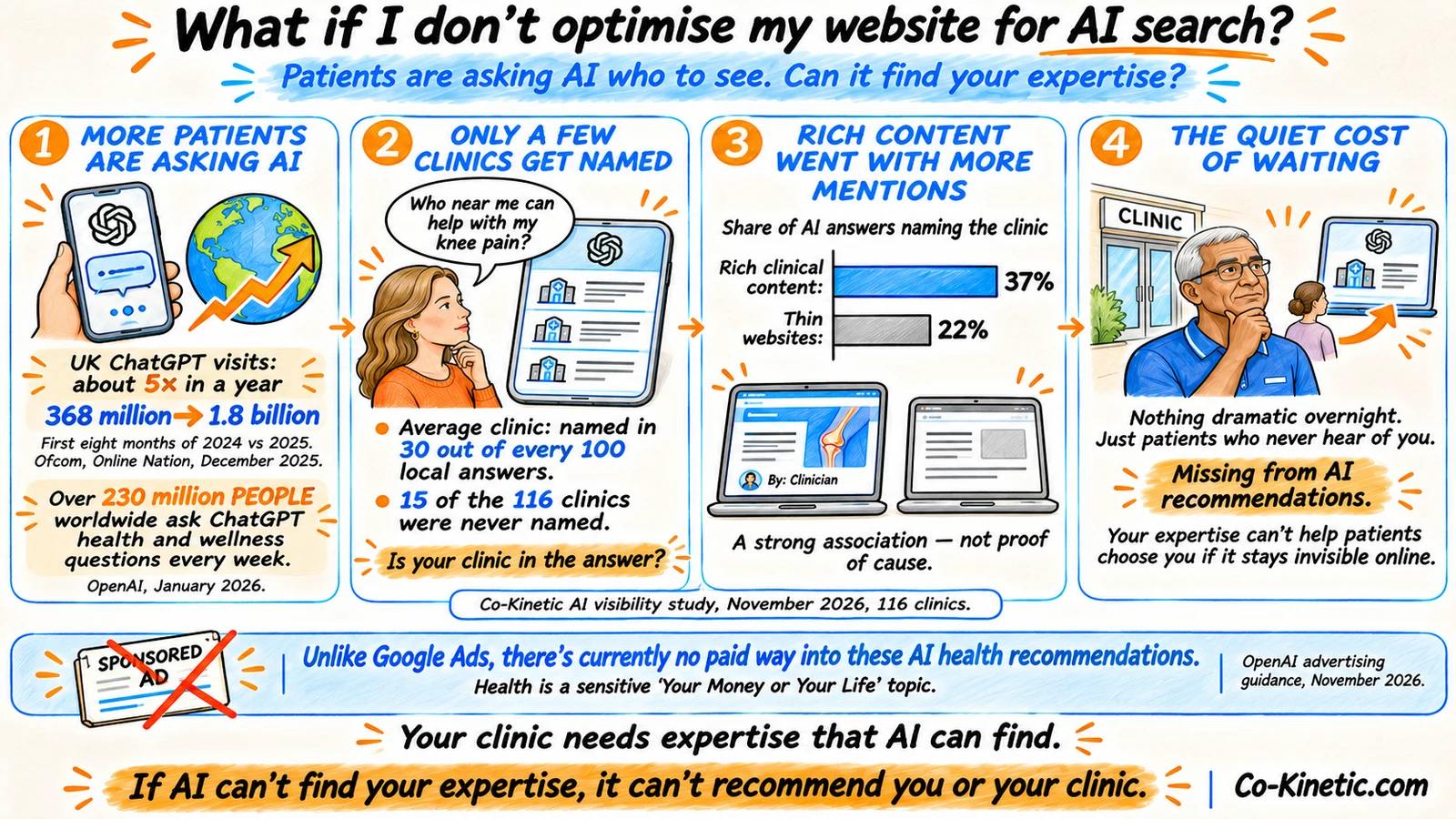
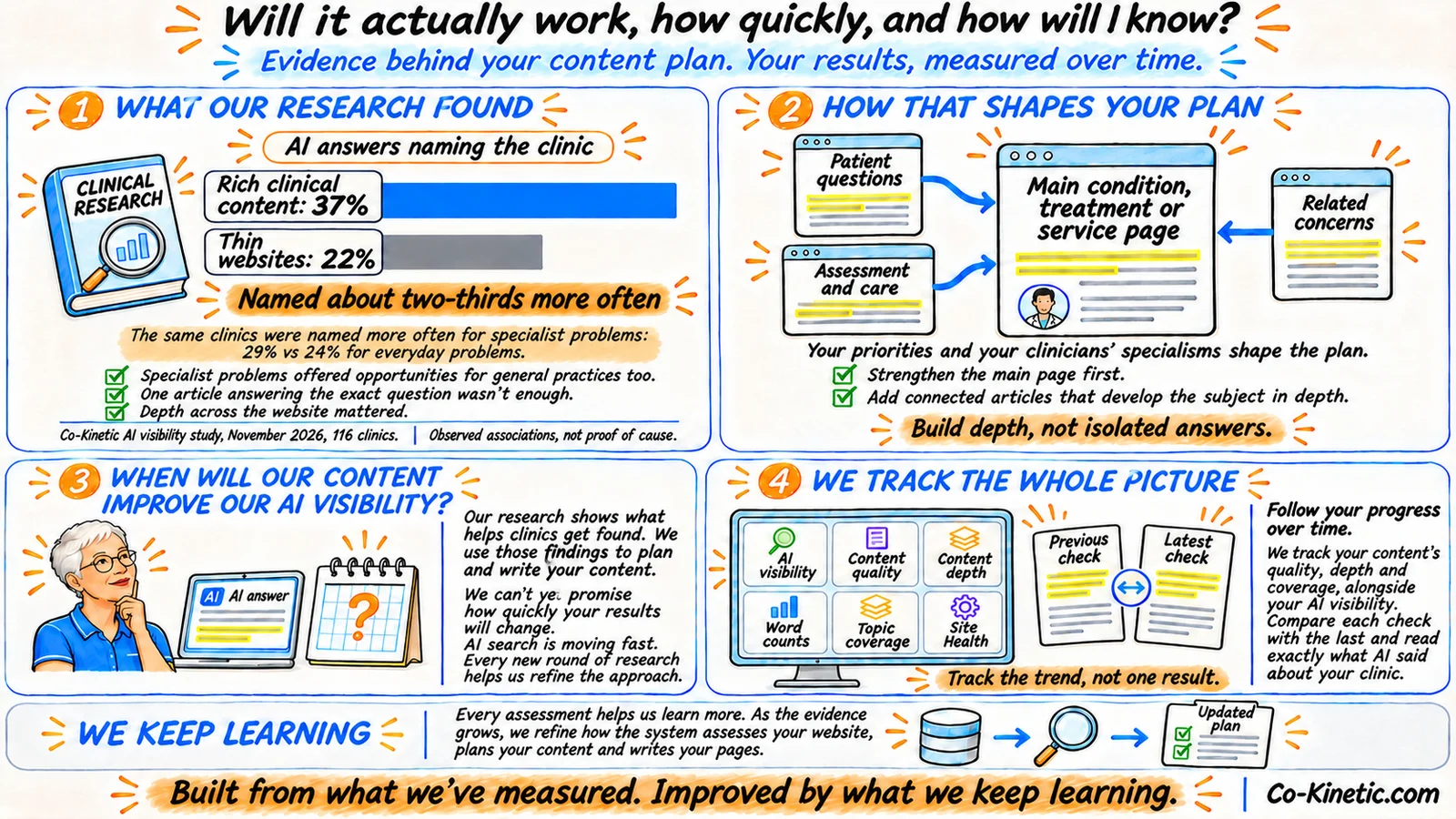
What if I don't optimise my website for AI search? More patients are asking AI, only a few clinics get named, rich content went with more mentions (37% against 22%), and the quiet cost of waiting.
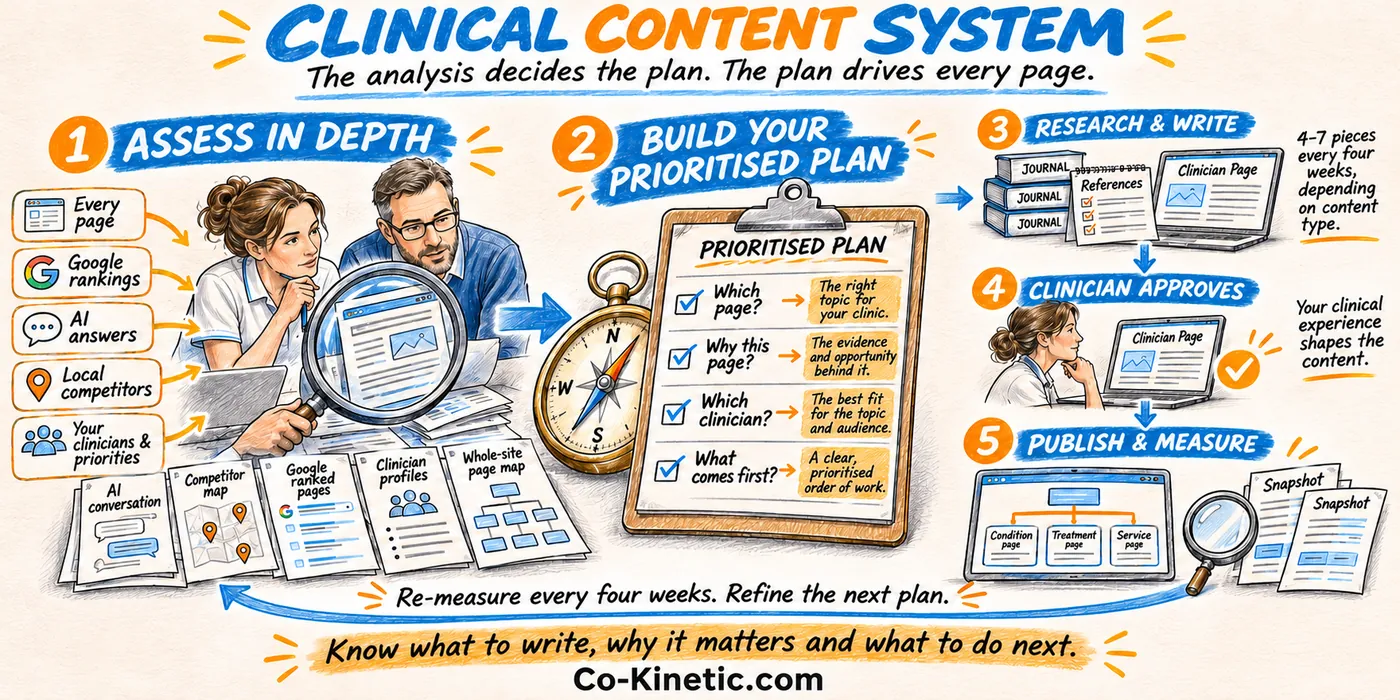
The Clinical Content System at a glance: assess in depth, build your prioritised plan, research and write, your clinician approves, then publish and measure, re-measured every four weeks. Four to seven pieces every four weeks, depending on content type.
The Clinical Content System at a glance: the analysis decides the plan, and the plan drives every page.
27
years serving MSK clinicians, since 1999
335
clinic websites assessed so far, and counting
115
five-star reviews
2026
Named Best Physical Therapy Marketing Platform, GHP Global Excellence Awards
Before we write a word

We bring together two sources of evidence: what we find, and what you tell us matters

Before we write a single word, we assess your website and the answers patients are given, and combine that with everything you tell us about your clinic and your clinicians. You choose what matters. We work out how to turn that into a plan.

What goes into the planWhat it helps decide
Your website: every page found, scored and gradedWhat's missing, underperforming or hard for Google and AI to read
Your Google positions and 64 AI answers (4 patient problems × 4 conversation steps × 4 AI tools, across 16 conversations)Where you're found, and where other clinics are recommended instead
The clinics that appear in those answersWhere the opportunities are
Your services and conditions, in your order, and your three practice prioritiesWhich opportunities matter to your clinic
Your clinicians' experience, specialisms and the conditions each treatsWhich clinician fits each topic
Your existing pagesWhat to keep, improve or connect
Your local area: parks, clubs, gyms and landmarks near youHow to make your content genuinely local
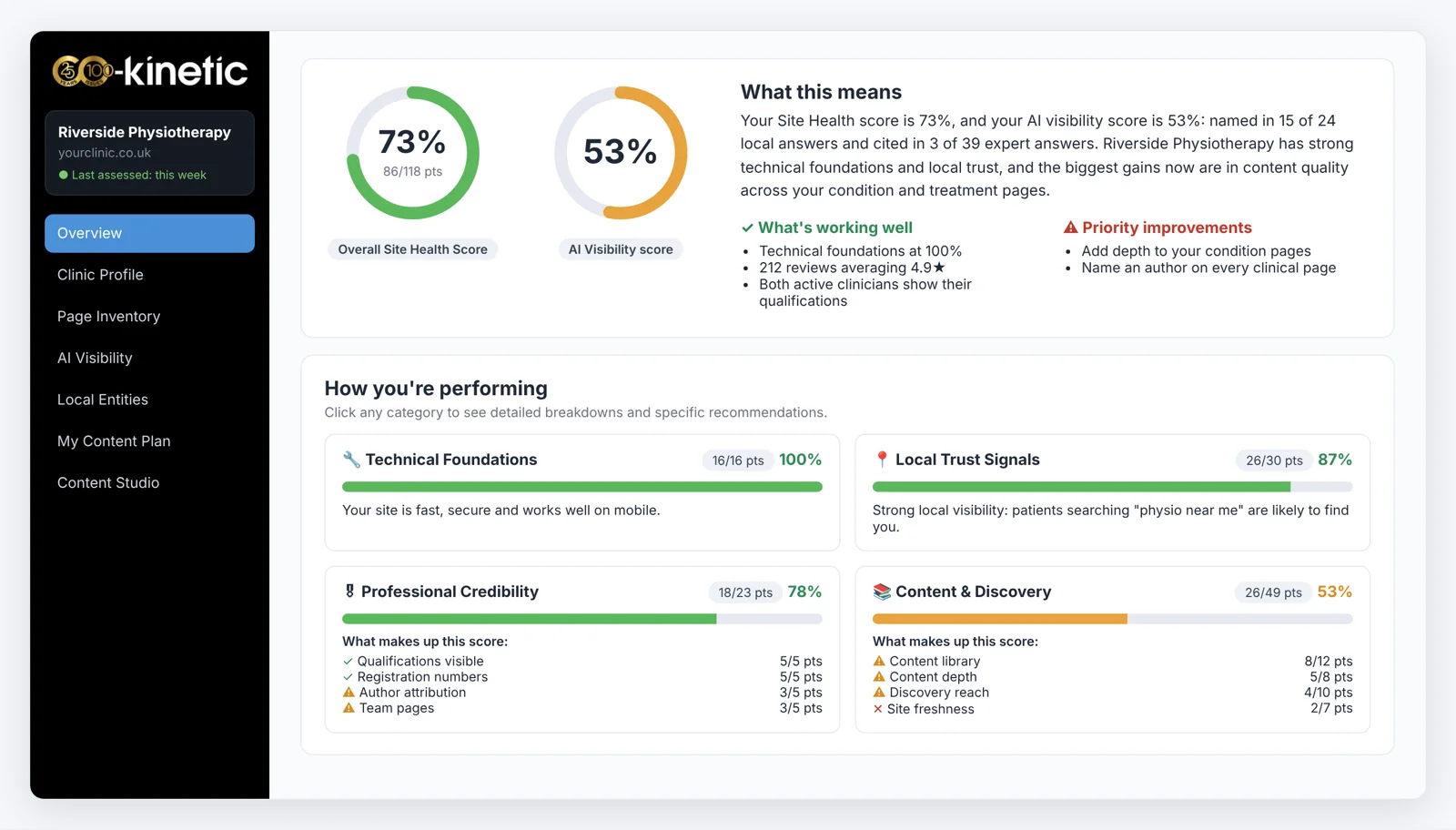
Your Overview
Your Overview: where your website stands, in plain English. (An example clinic.)
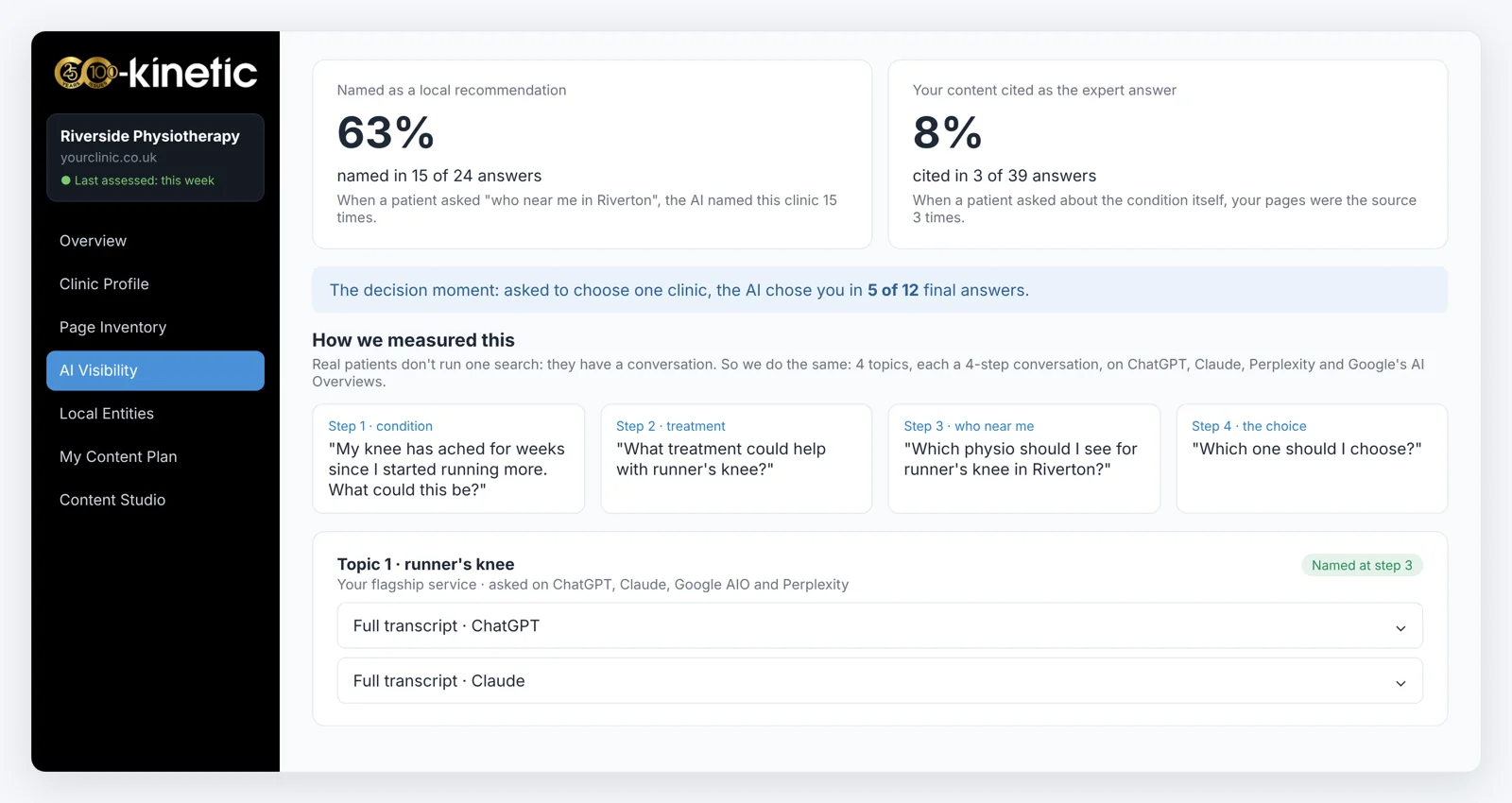
Your AI visibility
Your AI visibility: 64 answers from four AI tools, measured the way patients really ask, every answer kept for you to read. (An example clinic.)
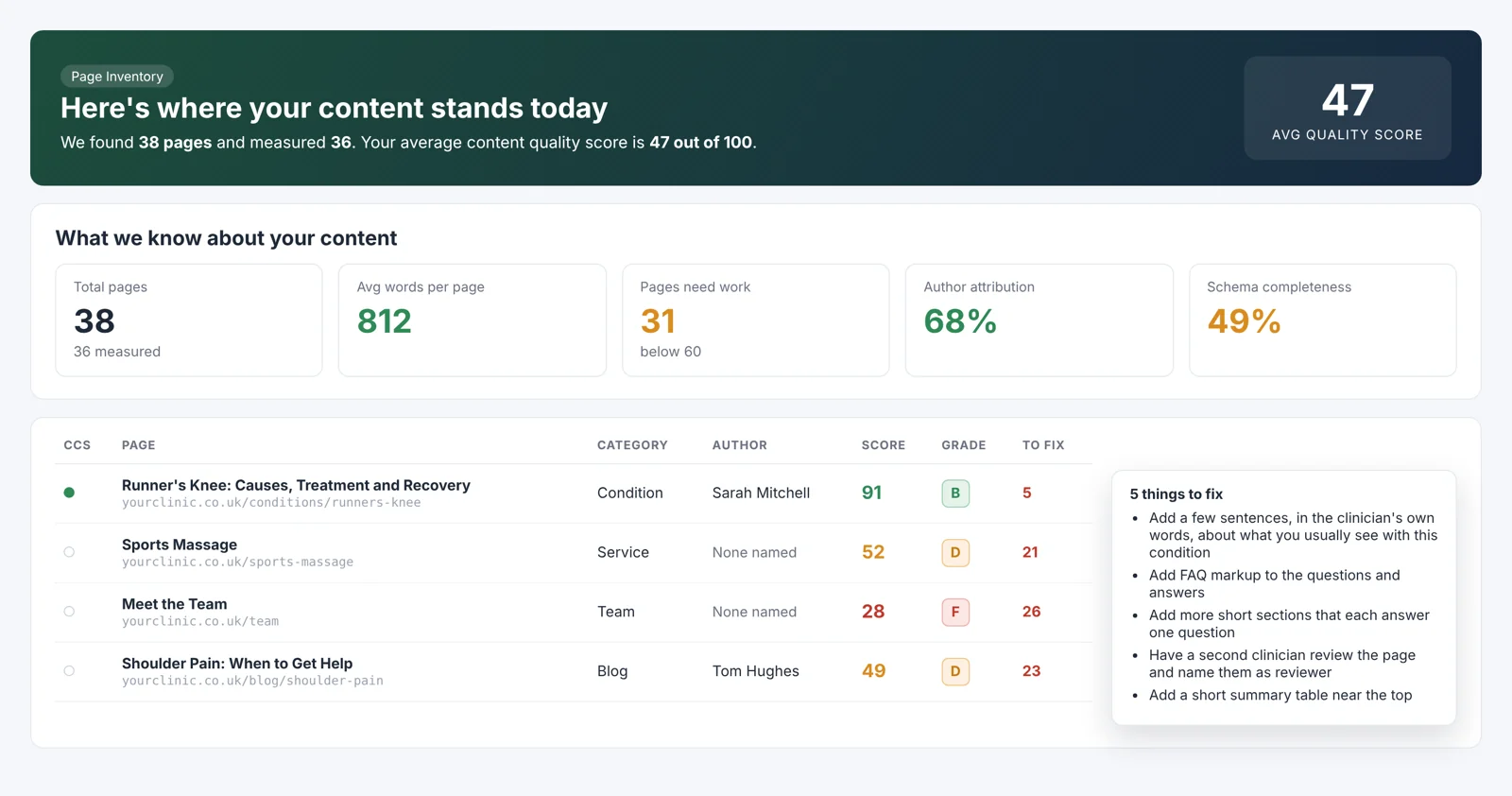
Your Page Inventory
Every page scored, graded and given a list of what to fix. These are our assessment scores, not scores from Google or the AI companies. (An example clinic.)
Is this just an automated scan?No. It's a deep dive into every page of your website and the conversations your patients actually have with AI, cross-checked against independent data, with a person checking anything that doesn't add up.

What most AI checks do. Ask an AI tool a handful of one-off questions, often about your clinic by name, and count how often it comes up. That only shows whether the AI has heard of you, not whether it would send a patient who hasn't.

What ours looks at:

  • 🗣️ 64 AI answers. We never ask about you by name. We play out 4 real patient conversations, built from the problems your own website says you treat, in your town, each in 4 steps (what could this be, how is it treated, who near me, which should I choose), on ChatGPT, Claude, Perplexity and Google's AI Overviews. You can read every answer.
  • 🏥 Who's recommended instead of you. The clinics AI names, and what they have on their websites that AI could find.
  • 📄 Every page on your website, read and scored the way an AI reads it: how well it answers patients' questions, its depth, who wrote it and why to trust them, its structured information, how fresh it is, and whether AI tools can reach and read it at all. Each page is graded A to F with a plain-English list of what to fix.
  • 📈 Google. Where your pages rank, and how many people search for your topics.
  • ⭐ Trust signals. Your reviews and Google Business Profile, and whether your clinicians' qualifications and registration are visible.
  • 🔧 Technical foundations. Speed, mobile, security, and whether your site is blocking AI tools from reading it.
  • 📍 Your local area. The parks, clubs, gyms, schools and landmarks near you, so your content can be genuinely local.

Several independent sources are cross-checked. Anything we can't verify is flagged, never guessed. And we re-run the whole assessment every four weeks while you subscribe.

Worth asking any provider: did you ask about my clinic by name, or ask patient questions? One-off questions, or a whole conversation? How many times, and on which AI tools?

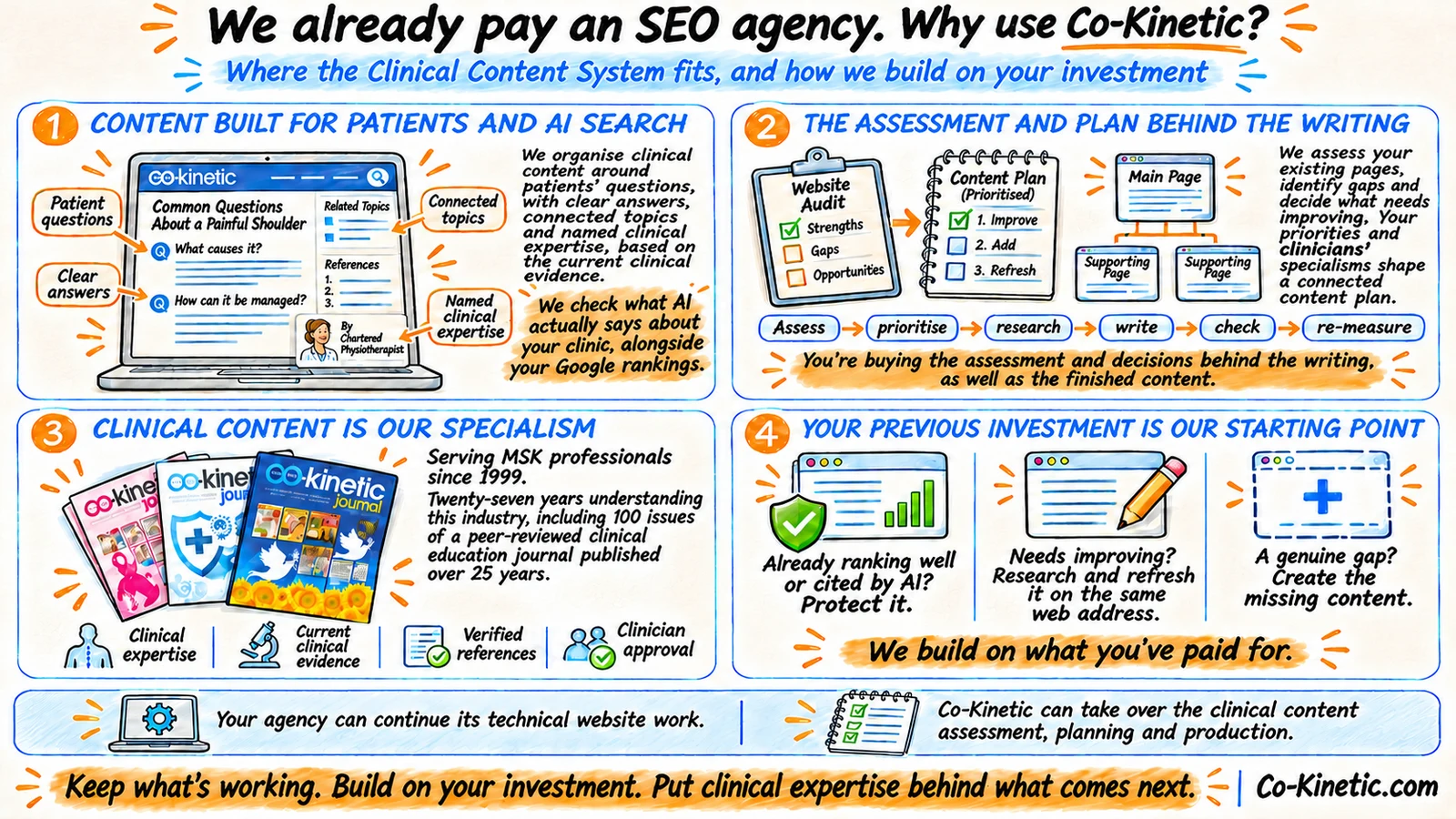
What about the content we already have?We build on it. Every existing page is scored, and your plan says which to keep, which to improve, and how to connect them, so your good pages keep working for you.
  • 🛡️ Pages that already work are protected. If ChatGPT already cites one of your pages, or it ranks well, the plan leaves it alone.
  • ⚡ Quick wins come first. Pages already on Google's first or second page are often the fastest to improve, so the plan rewrites those early.
  • ♻️ Improving a page replaces it, it doesn't duplicate it. When the plan says "Refresh existing", we write a better version for the same address on your site, so you don't end up with two pages competing with each other.
  • 🔗 Everything gets connected. Your existing pages become part of topic areas: a main page on each big subject with supporting pages around it, linked together, so Google and AI see your depth.
  • 🧩 Gaps get filled. Where a clinician's specialism, or one of your top services, has no page at all, that goes into the plan.
  • ✋ You stay in control. Any suggestion that isn't right for you, mark it "Not relevant" and it's removed.
Your clinicians are your difference

Why are our clinicians so important?

Your clinicians' experience, clinical interests and approach are what make your content yours, and what help a patient see why a particular clinician is right for their problem. We use them to shape both your plan and every piece we write.

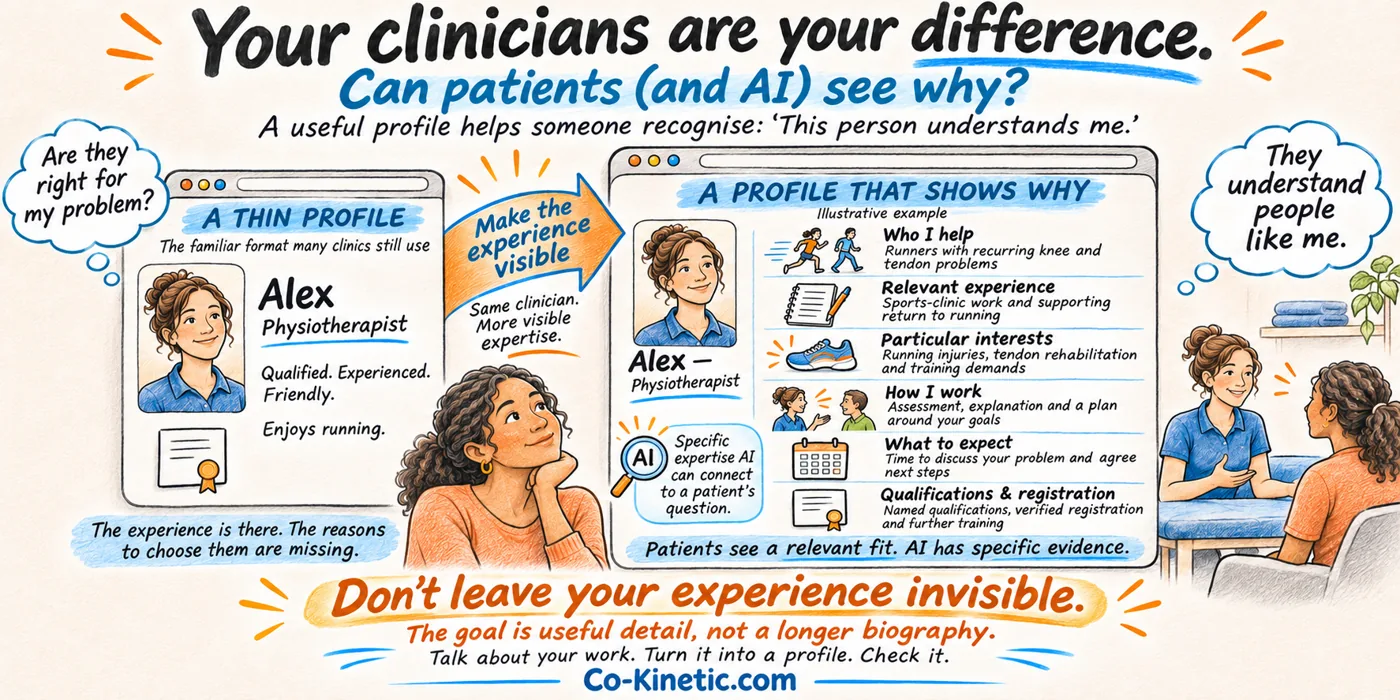
Your clinicians are your difference: a thin profile next to one that shows why
A thin profile tells patients very little. One that shows who you help, your experience and how you work gives patients, and AI, a reason to choose you.

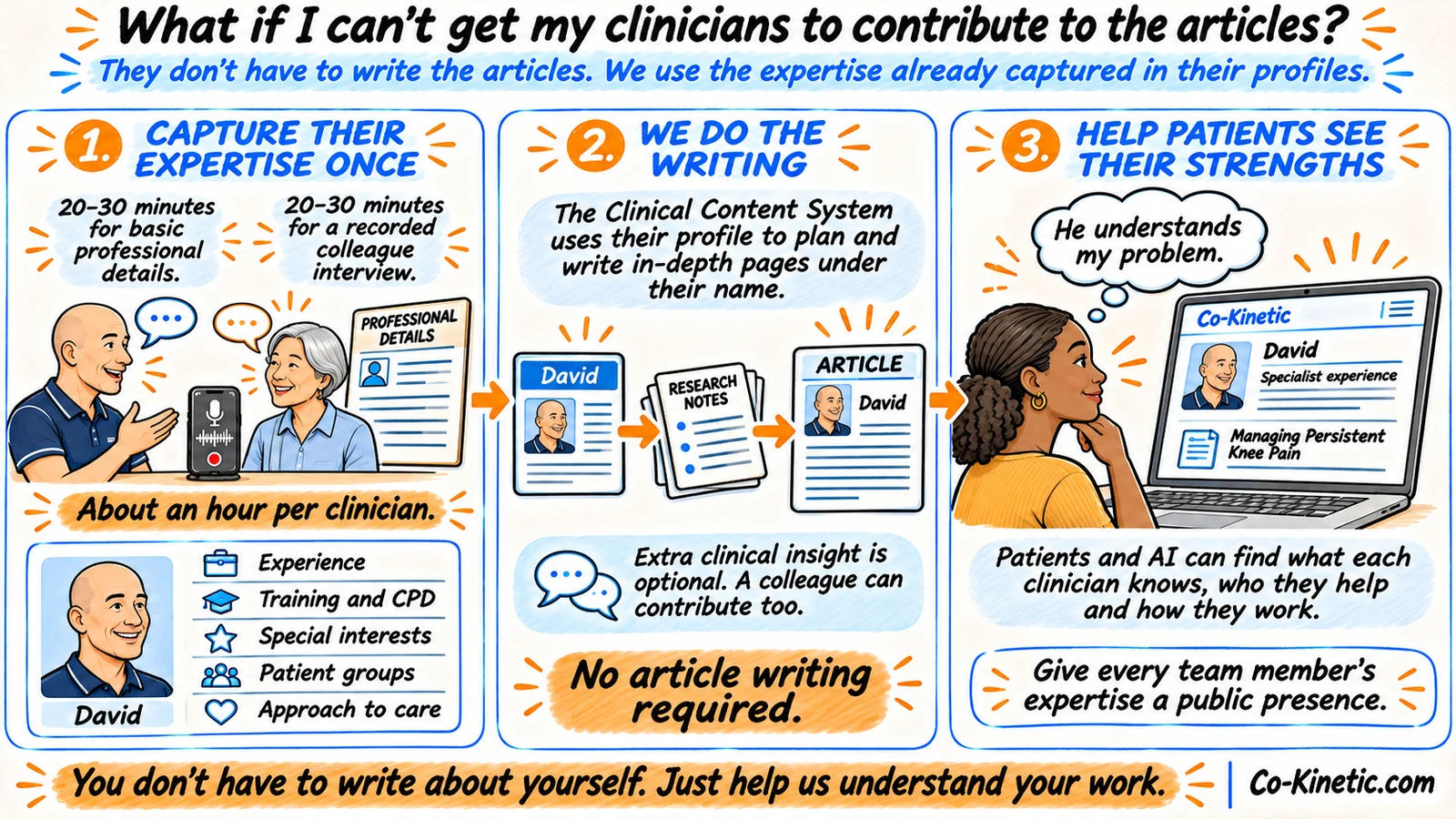
How your clinicians give us their information: a 20 to 30 minute interview with a colleague, a worksheet they fill in on their laptop, or straight into their profile online. Send us an interview recording or a worksheet and we'll put it in for you. It's done once, then kept up to date.

What if I can't get my clinicians to contribute to the articles? Capture their expertise once, in about an hour; we do the writing; patients and AI see their strengths. No article writing required.
What if my clinicians don't have time?The quickest way is a 20 to 30 minute interview with a colleague, recorded on a phone. Send us the recording and we'll put it into their profile for them.

Each clinician chooses whichever suits them:

  • 🎙️ The interview (quickest). A colleague asks the questions from our interview guide (one for experienced clinicians, one for early-career clinicians) and records it. Most people talk far more easily than they type. Send us the recording and we turn it into their profile.
  • 📝 The worksheet. A Word file they fill in on their own laptop, in their own time. Upload it, or send it to us and we'll put it in.
  • 💻 Online. Straight into their profile. They can import a CV, LinkedIn page or existing bio to fill the empty fields first, and a "Fill in the gaps" panel shows the five things worth the most points, biggest first.

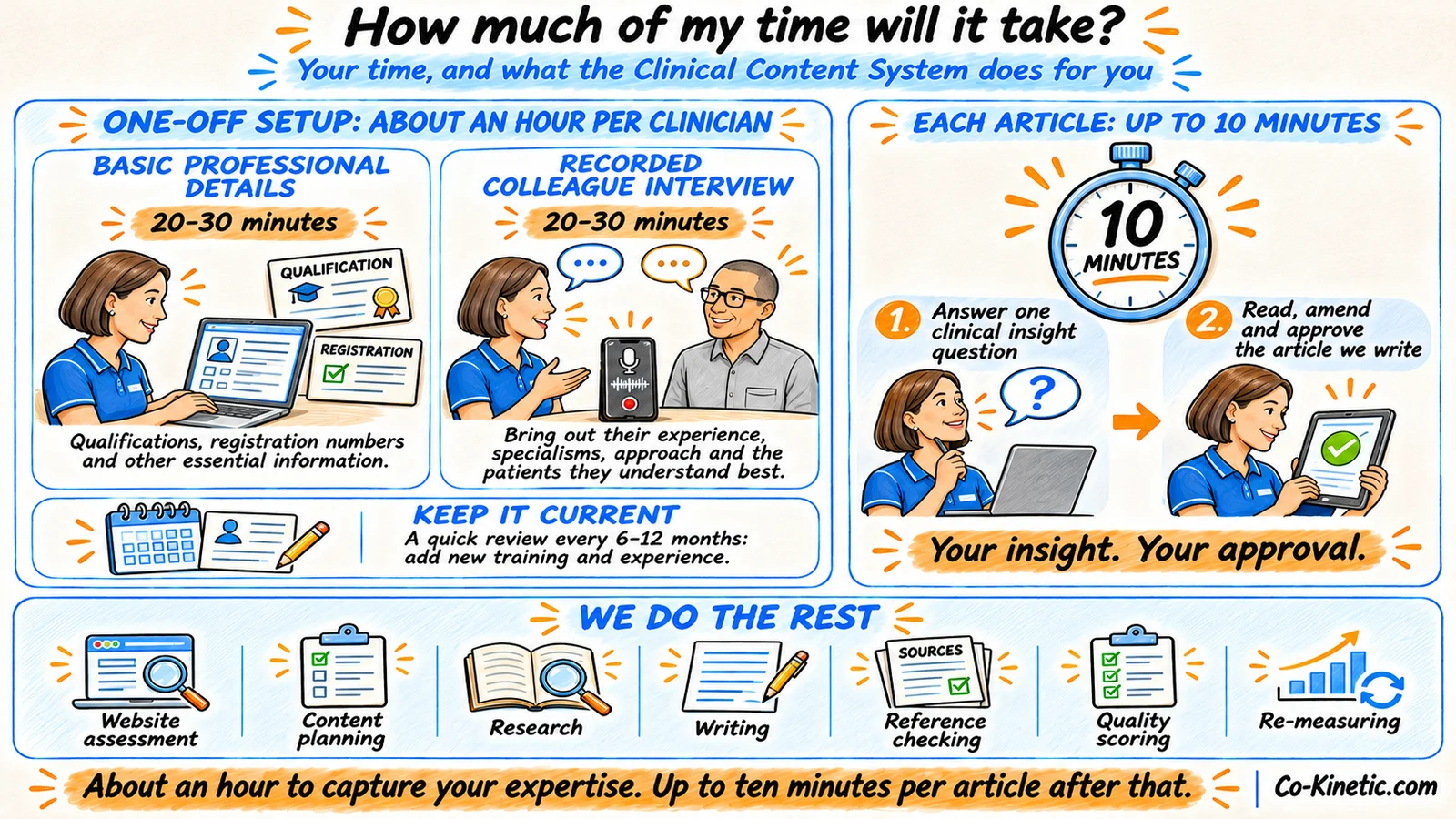
⏱️ How much time it really takes. Your plan unlocks as soon as one clinician's profile reaches 60% (the author) and another's reaches 50% (the reviewer), so you can start with two people. Practising on your own? Add a peer reviewer, such as a mentor or a colleague you respect: they don't need to work in your clinic. The first few weeks take a little more while profiles are filled in. After that it's about 10 minutes per piece: the author answers one clinical insight question, then reads and approves it.

✅ It's done once. After that, profiles just need keeping up to date: a simple habit is adding each new course when they log it for their CPD.

The plan

How do you decide what to write, for whom, and why?

Here's how it works for an example clinic, from start to finish: Riverside Physiotherapy.

  1. The clinic makes running injuries one of its practice priorities.
  2. Sarah Mitchell has years of experience helping runners, but it barely appears on the website.
  3. The assessment finds there's no proper page on runner's knee, and that other clinics are being named for it.
  4. The plan puts a condition guide on "Runner's Knee" near the top, says why, suggests Sarah as the author, and shows where it fits in the running injuries topic area.
  5. Sarah answers one clinical insight question, in her own words.
  6. The finished page combines her expertise with research and references, links to the clinic's running injury service, and local detail patients will recognise: the parkrun in the park nearby, the local running clubs, and the routes runners in the area use.
  7. Four weeks later, the re-measure shows what's changed.
Your content plan
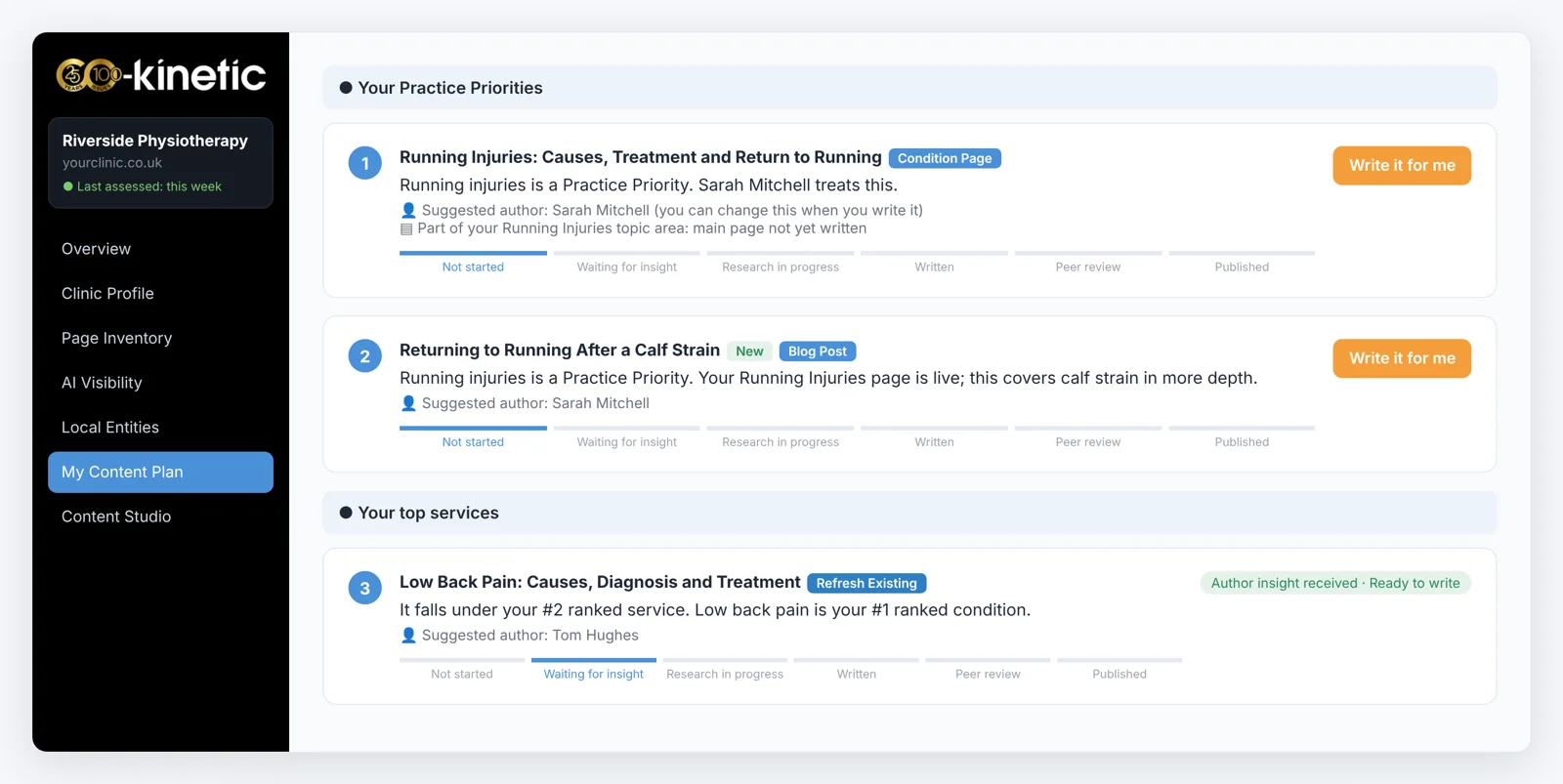
Your content plan: every piece says why it's there, who should write it, and where it fits. (An example clinic.)

Planned as topic areas, not keywords

If someone writes content for you now, it's probably planned around keywords: one page for each phrase people type into Google. That was a sound strategy when search meant a list of links. Is it still? Google and AI now look for depth: whether a clinic covers a whole subject well, with an expert behind it. One page per keyword doesn't show that.

So your plan is built as topic areas. Each one has a main page on the big subject, such as running injuries, with supporting pages around it on each condition, treatment and question. Every supporting page links back to the main page and on to your service page and your clinician's team page, so Google, AI and patients can see the whole of your expertise on that subject, not one page in isolation.

Area pages, too. Your plan can include a page for each nearby town or suburb you really draw patients from, with local detail only you can give, so patients searching from there, and the AI tools they ask, can find you. In our AI visibility research, clinics with their own pages for nearby towns were named by AI more often.

Running injuriesMain page Runner's knee Shin splints Achilles pain Plantar heel pain Running injury service Sarah Mitchell, team page

A topic area for the example clinic. Your plan shows which pages in each topic area you already have, which need improving, and which are still to write.

Research, write, verify

How do you write the content?

🔬
1. Research
  • Up to 12 research steps for each piece
  • As much as 14,000 words of source material from live clinical sources
  • What patients are asking about the topic
  • What the clinics AI recommends have published
  • Your local area
  • Your clinician's profile and their own clinical insight
✍️
2. Write
  • Your clinician named as the author, with credentials and registration
  • A clear answer to the patient's question first
  • A summary table and short sections that each answer one question
  • Linked to your services and your other pages
  • Structured the way AI search reads and quotes a page, with the structured information Google and AI look for
✅
3. Verify
  • Every reference checked to be real
  • Scored against our quality standard, and repaired if it falls short
  • Checked so it isn't a near-copy of anyone else's
  • Your clinician reads, amends and approves it
  • You can add a second clinician as reviewer, which we recommend
A finished article
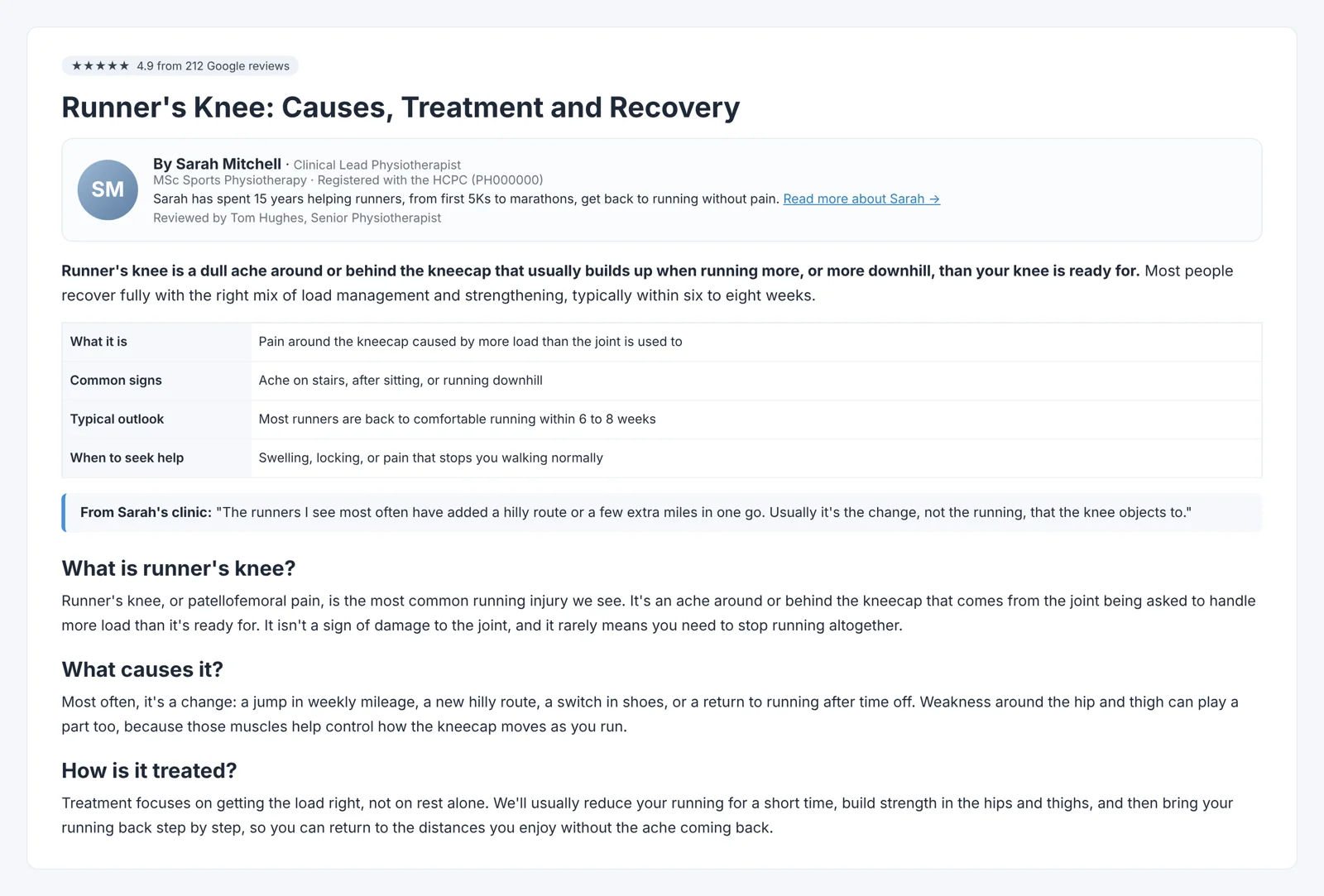
A finished piece: it names your clinician, carries their insight, and answers the patient's question first. (An example clinic.)
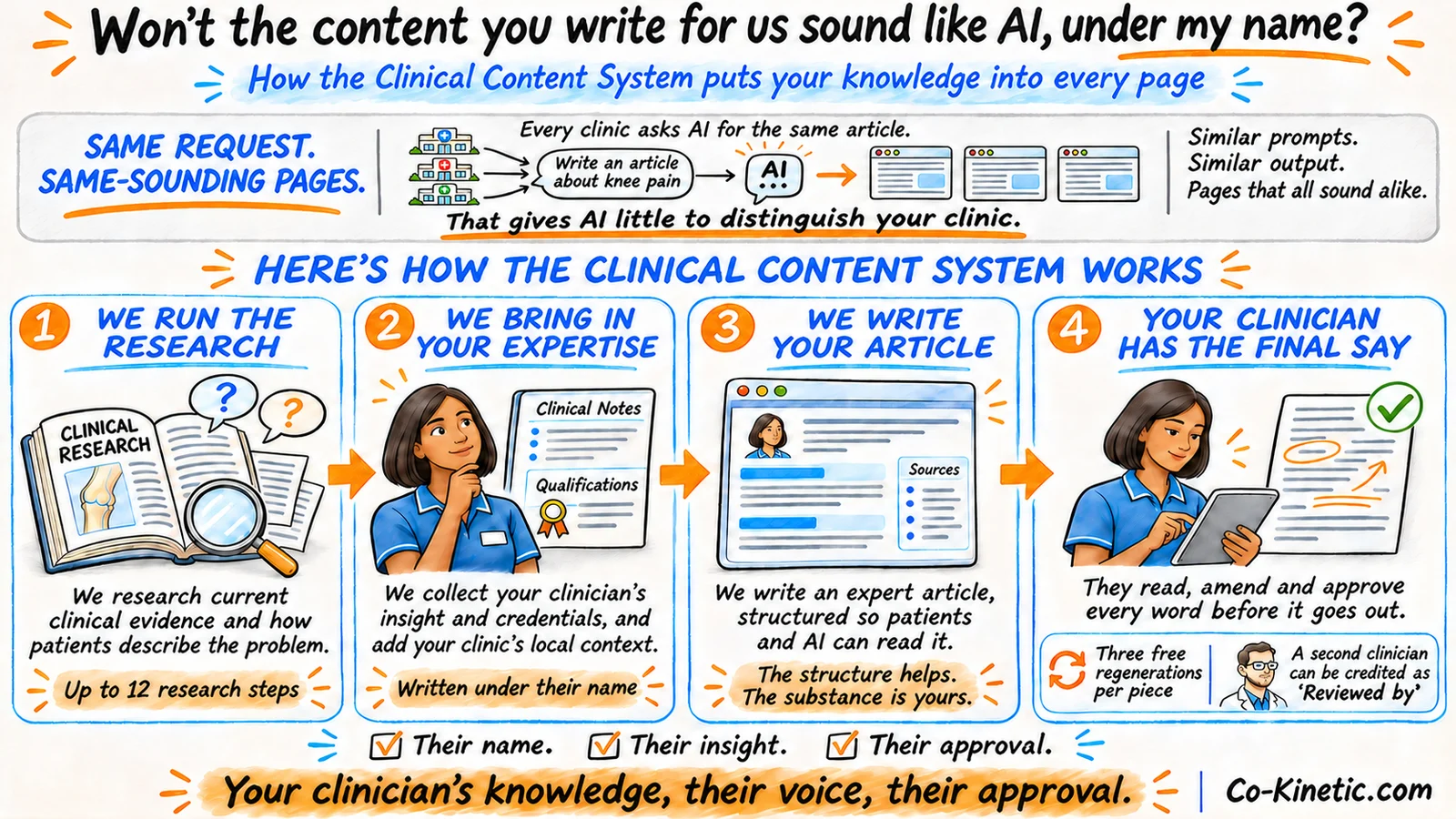
Will it sound like us?Yes. Each piece carries your clinician's own insight, names them as the author, and is specific to your local area and your services, so it reads like your clinic and no one else's. Nothing goes out until you've read, amended and approved it.
  • 💬 Their clinical insight, in their own words. Before each piece is written, the author answers one targeted question for that kind of page: what they usually see, a mistake patients often make, an anonymised example from their practice. It's the part no research can produce, and it's why two clinics using the system never get the same article.
  • 👩‍⚕️ Their profile shapes every piece. Their experience, specialisms, the patients they help and how they talk about their work.
  • 📍 Your local context. Real places near your clinic, so a running injuries page for a clinic near a well-known parkrun reads like it belongs there, because it does.
  • 🔍 Sameness is checked, not hoped for. Every new piece gets an automatic distinctiveness check as it's written, and is rewritten from your clinic's own facts if it comes out too close to anyone else's.
  • ✏️ You have the final word. Edit anything you like before you approve it.

It's structured the way AI search reads a page, but the substance is yours: real research, your clinician's insight, their credentials and your local context. It reads like a well-organised expert page, because that's what it is.

How do we know it will be accurate?Because every piece goes through up to 12 research steps from live clinical sources, every reference is checked to be real, and nothing reaches your clinician until it meets our quality standard. It's the standard we kept for 25 years and 100 issues publishing the peer-reviewed Co-Kinetic Journal.
  • 🔬 Real research, not an AI's memory. Up to 12 research steps, gathering as much as 14,000 words of source material from live clinical sources for each piece.
  • 📚 Every reference checked. Each one is checked against the global register of published research, so it's real, findable and says what the piece says it does.
  • 📏 Scored before you see it. Every piece is scored against our quality standard. If it falls short, it's repaired and re-scored automatically, at no cost to you. You see finished work, not drafts.
  • 👩‍⚕️ Your clinician approves it. The named author reads, amends and approves it. You can also add a second clinician as reviewer, which we recommend, and they're credited on the page.
  • 🔁 Checked after publishing too. Published pieces keep being checked, and anything that can't be verified goes to a person.
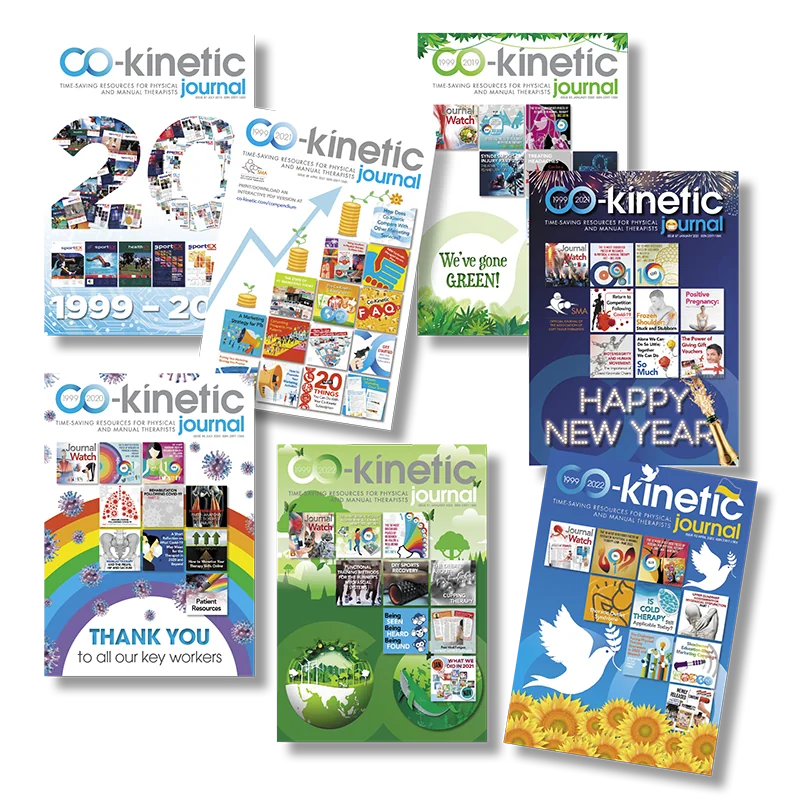
Co-Kinetic Journal covers, 1999 to 2024

Why you can trust the content we create for you: we're a clinical publisher. For 27 years Co-Kinetic has served MSK professionals: 100 issues of a peer-reviewed clinical journal, and patient resources for organisations such as the British Heart Foundation and Diabetes UK. Researching clinical content properly is what we do.

Our content has been trusted by leading health and wellbeing organisations

British Heart Foundation Diabetes UK Asthma UK YMCA Fit Physio First Register of Exercise Professionals
Who does what

How much work do we have to do?

Very little. We do the work, and your part is small.

What we do

  • 🔍 Assess your whole website and your AI visibility
  • 🗺️ Build your plan, and keep it up to date
  • 🔬 Research, write and check every piece
  • 🧑‍💻 Tell your web developer exactly what to fix
  • 📊 Re-measure everything every four weeks and find the next work

What you do

  • 🎯 Tell us your priorities
  • 💬 Your clinician adds a few sentences of insight to each piece
  • ✅ Approve it
  • 🚀 Publish it: one click on WordPress, or copy and paste

After the initial setup, about 10 minutes per piece.

How much of my time will it take? About 10 minutes per piece: your clinician gives one clinical insight, and everything else is done for you.
Will this work with our website?Yes. On WordPress, our plugin publishes each piece in one click. On any other website, you copy each approved piece in, with step-by-step instructions.
  • 🔌 WordPress. You match each kind of page we write to a section of your site once, install our plugin, and from then on each piece goes live in one click, or you schedule them to go out one a week. The plugin also carries the structured information Google and AI read.
  • 🧱 Squarespace and Wix. Each piece comes with step-by-step instructions written for your platform.
  • 🌐 Any other website. Copyable formats for whatever your site is built on.
  • 🧑‍💻 Your web developer. Give them access by adding them as an administrator on your account, so they can see what the assessment found and fix anything technical themselves.
  • 🏠 Co-Kinetic Sites. If your website is with us, publishing is handled for you.
Re-measuring every four weeks

How will we know it's working?

You'll see it for yourself. Every four weeks we measure your website and the 64 AI answers again, and every figure sits beside the last one, so nothing is taken on trust. What you'll see:

  • 📊 Your Site Health and AI visibility scores, and how they've moved.
  • 🗣️ How often AI names you as a local recommendation, how often it cites your pages as the expert answer, and how often it chooses you when the patient asks which clinic to book.
  • 📄 Every page scored and graded, with what's improved and what still needs work.
  • 📈 Your Google positions and the pages now ranking.
  • 💬 Every AI answer, word for word, with who was named instead of you, dated, so you can read the change.
  • 🗂️ Your topic areas filling out in your plan.
  • 📬 A short progress report every four weeks, plus a quick summary of your week every Friday.
Will it actually work, how quickly, and how will I know? What our research found, how it shapes your plan, and how we track your results over time.

We're honest about what the results mean: your reputation, location and the clinics around you matter too, so we show you the evidence, never a promise.

Every four weeks

What's included in our subscription?

It comes in two parts: the analysis and the plan, and the research, the writing and the verification.

  • A detailed assessment of your website and its visibility
  • A prioritised plan built around your choices and the evidence
  • The research, the writing and the verification of every piece, informed by your clinicians
  • Publishing tools or step-by-step guidance
  • Re-measuring and ongoing assessment every four weeks

What we write: condition guides, treatment pages, service pages, blog posts and team pages for your clinicians, whichever your plan says will help most. A condition guide uses 9 credits, a treatment page 7, a blog post 5, a service page 3 and a team page 2.

£599 every four weeks. Your 30 content credits each four weeks are enough for four to seven in-depth pieces for most clinics. Unused allowance credits roll over while you subscribe, and pressing Validate & earn on a published piece gives some of its credits back. No setup fee, no contract.

Price

What does it cost?

Three steps, and you can start at any of them.

Free AI visibility check Website & AI Visibility Review The Clinical Content System
PriceFree£599, one payment£599 every four weeks
What it isYour clinic tested against the questions your patients ask, on four AI toolsA full assessment of your whole website and your AI visibility, written up for your clinic as a designed report of around 30 pagesThe full assessment, an ordered plan, the content written from the evidence base under your clinicians' names and published, kept current
What you getYour score, how often you were named, one real AI conversation, who was named insteadAll 64 AI answers in a grid with six quoted in the AI's own words, who AI sends patients to instead, your whole website scanned with your weakest pages named and three quick wins, your team and reputation, a do-it-yourself list, a list for your web person, and a plain-English education in how AI choosesEverything in the Review, kept running: your competitors and Google rankings re-measured and every page re-graded every four weeks, and a plan of which pieces will move the needle. Then the work done for you: four to seven pieces of content every four weeks (30 credits), your dashboard, page tracking
Time from youSecondsNone, we send itAbout 10 minutes per piece, for four to seven pieces of content every four weeks
Next stepCheck freePurchase the ReviewSubscribe today
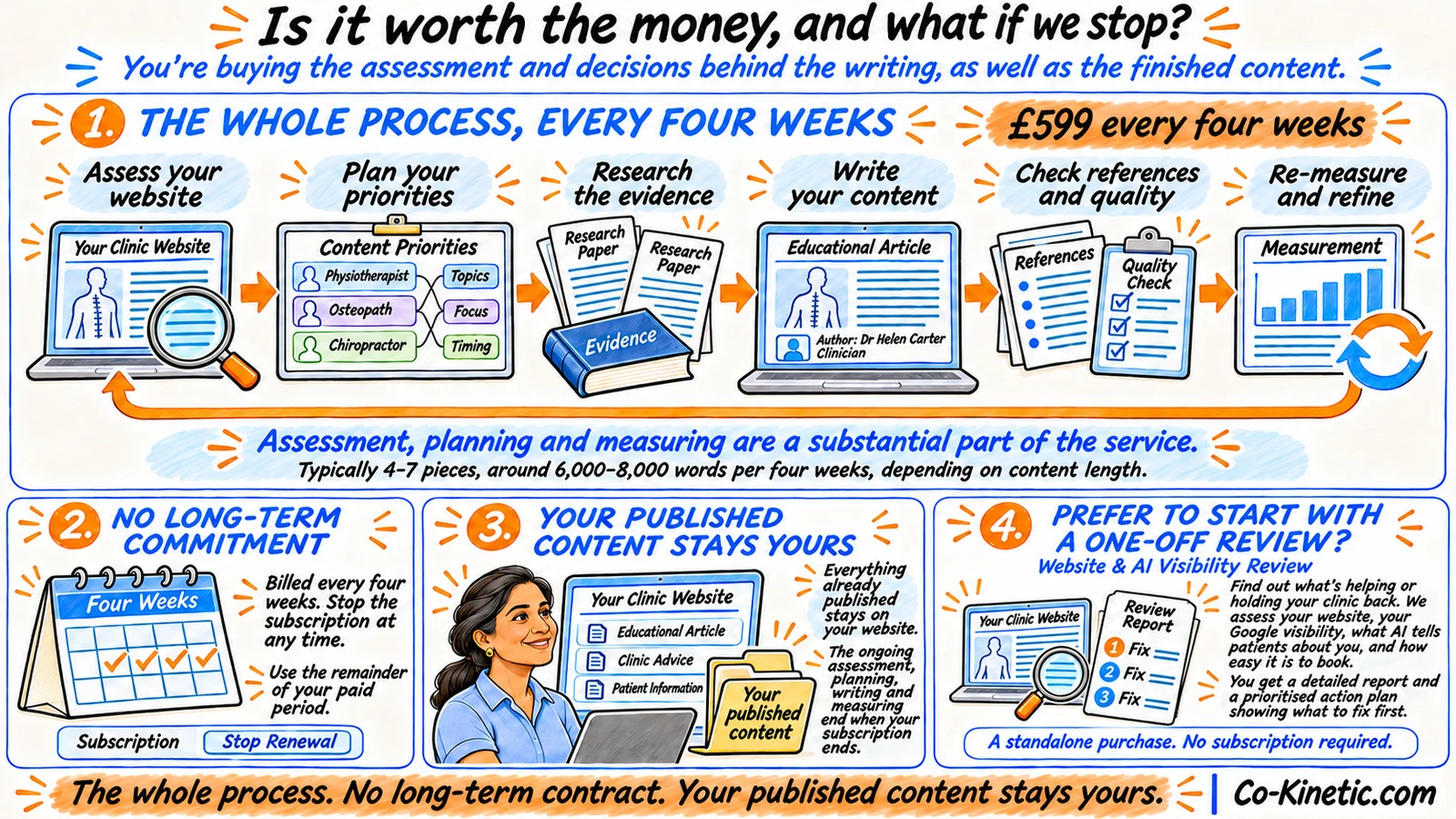
Is it worth the money, and what if we stop? The whole process every four weeks for £599, no long-term commitment, your published content stays yours, or start with a one-off Review.

Want to see how thorough it is first? Start with the Review.

The Website & AI Visibility Review is the halfway house. For one payment of £599 you get the full assessment of your website and your AI visibility, written up for your clinic as a designed report of around 30 pages:

  • 🗣️ All 64 AI answers in a grid, showing whether you were named and who was named instead, with six of them quoted in the AI's own words
  • 🩺 Your whole website scanned, with the pages that matter most looked at closely: your weakest pages named, with the reason each is held back, and three pages you already have to improve first
  • 👩‍⚕️ Your team, clinician by clinician, your reputation, and whether AI tools can read your site
  • ✅ A do-it-yourself list of what to fix first, and a separate list for whoever looks after your website
  • 🎓 A plain-English explanation of how AI tools choose which clinics to recommend

A person checks every claim against your live website before it goes out, and the report is yours to keep, whatever you decide.

💷 Then, if you decide to subscribe within 35 days of buying the Review, your first four weeks cost £99 instead of £599, with the full 30 credits. After that it's £599 every four weeks, with no setup fee and no contract.

Questions about price

Is there a contract?No. It bills every four weeks and you can stop at any time: it simply doesn't renew, and you can use the credits you've paid for until the end of that four-week period.
What happens if we stop?Everything you've published stays on your website. From the day you stop, we stop re-measuring your website and the AI answers, your plan stops updating, no new pieces are researched or written, and your tracking stops.
Is there a free trial?No, but you can start with the one-off Review, and if you subscribe within 35 days of buying the Review, your first four weeks are £99.

The reason: so much happens in your first four weeks, with your whole website assessed and your plan built before anything is written. But there's a low-risk way in:

  • 🔎 Start free: the free check shows what AI says about your clinic today.
  • 📘 Then the Review: the full assessment, written up as a designed report of around 30 pages for one payment of £599. It includes all 64 AI answers in a grid with six quoted in the AI's own words, who AI recommends instead, your weakest pages named with what's holding each back, three quick-win pages to improve first, your team and reputation, a do-it-yourself list, a list for your web person, and a plain-English explanation of how AI chooses. It's yours to keep, and it shows you exactly how thorough the assessment is.
  • 💷 Then £99: if you subscribe within 35 days of buying the Review, your first four weeks cost £99 instead of £599, with the full 30 credits.
  • 🔓 No contract: stop whenever you like.
How it compares

Already paying for content? If so, is your budget getting you all of this?

If you already pay an SEO agency, a marketing company or a freelance writer for your content, check whether you're getting the whole job: not just the writing, but the assessment, the strategy, the clinical checking and the measuring that make the writing work.

We already pay an SEO agency. Why use Co-Kinetic? Content built for patients and AI search, the assessment and plan behind the writing, clinical content as our specialism, and your previous investment as our starting point.
Are you getting this now?The Clinical Content System
Assessment
Is every page on your website scored and graded?Every page is read, scored and graded A to F, with a list of what to fix.
Are your Google rankings checked?Your Google positions, and how many people search for your topics.
Is your AI visibility measured?64 AI answers across ChatGPT, Claude, Perplexity and Google's AI Overviews, and who AI recommends instead of you.
Strategy
Is there a proper topic strategy, not just keywords?Your plan is built as topic areas: a main page on each subject with supporting pages linked around it.
Is the plan built around your priorities and your clinicians?Your services, conditions and practice priorities, and what each clinician treats.
Does every proposed page explain why it's there?Why it's in the plan, who should write it, and whether it's new or an improvement to an existing page.
The content
Is every piece structured for AI search?The answer first, a summary table, short sections, and the structured information Google and AI look for.
Is it clinically researched from live sources, not an AI's memory?Up to 12 research steps and as much as 14,000 words of source material for each piece.
Has every reference been checked to make sure it's real?Every one is checked against the global register of published research.
Does it name your clinicians and carry their insight?Your clinician is the author, with their credentials and their own clinical insight.
What does your budget cover?£599 every four weeks for the ongoing assessment, prioritised planning, clinical research, writing, verification and re-measurement. Your content allowance supports four to seven pieces, depending on the mix, with condition guides of up to 3,000 words.
Measuring
Is everything re-measured regularly?Your website, Google positions and the 64 AI answers, every four weeks.
Can you read the AI answers for yourself?Every AI answer is stored word for word and dated, so you can see the change.

All of this, plus four to seven in-depth condition guides, treatment pages, service pages, blog posts or team pages written for you, for £599 every four weeks, with no contract. Could your current agency or writer do it all for that?

SEO and Google

Does SEO still matter, or has AI replaced it?

Both. The AI tools lean on the same foundations that made a website rank well: a fast, sensibly organised site, Google reviews that keep coming, a complete Business Profile, and pages clearly about one thing. If an agency has done that work for you, it wasn't wasted.

What's changed is what goes on top. A ranking was a position on a list, and position four still got clicks. An AI answer is a direct recommendation. Without it, you're effectively invisible. To be recommended, AI has to see who you are and why you're the right choice: named clinicians, depth on the conditions you treat, and what makes you different.

Built for the ten-link page

  • Rankings and positions
  • Keywords
  • Position four still gets clicks
  • One page on everything
Fading

Foundations for both

  • A fast site, sensibly organised
  • Google reviews that keep coming
  • A complete, accurate Business Profile
  • Pages clearly about one thing
Keep this

What the new world asks on top

  • Named clinicians patients can trust
  • Depth on the conditions you treat
  • What makes you different
  • Content an AI can tell apart from everyone else's
  • Content that connects: condition to treatment to booking, so the AI can follow the patient's journey through your site
Add this

Questions about SEO and Google

How is this different from SEO?SEO was built to win a place in a list of links; AI picks a few clinics to recommend.

Good SEO foundations still matter, and we build on them, but what counts now goes further:

  • 📚 Depth: a set of connected pages on each subject you treat, not one page per keyword.
  • 🔗 Structure: topic areas, with a main page and supporting pages linked together, so Google and AI see you as the expert on the whole subject.
  • 👩‍⚕️ Visible expertise: named clinicians, with their credentials, on every piece.
  • 🗣️ Measured where patients now ask: 64 AI answers as well as your Google positions.

We also track much of what an SEO agency tracks: your Google positions, every page's score, technical issues and search demand.

Will it help us on Google too?Yes. Google now uses AI itself, so what helps you with AI tools helps you on Google.
  • 🤖 Google's AI Overviews now appear at the top of most health searches (89% of the US healthcare searches BrightEdge tracks, December 2025), and its conversational AI Mode is rolling out inside Google.
  • 📚 Both reward the same things: in-depth content, connected pages, and expertise under named clinicians.
  • 📈 We track your Google positions every four weeks, so you can see your pages move.
Is it still worth paying for Google Ads?That's your call, but you're paying for clicks that are getting rarer and more expensive.

Bear in mind what clinic owners tell us is happening with their ads right now: they're paying more to get the same number of clicks, paying the same for fewer clicks, or watching their clicks drop off altogether.

When an AI Overview appears, people click a traditional result in only 8% of visits, against 15% without one (Pew Research Center, 2025), and 69.5% of UK Google searches now end without a click (SparkToro, 2026). In the US, healthcare click-through rates on Google Ads fell 12% in a year while the cost of each click rose 6% (LocaliQ, January 2026). Ads can still play a part, but you can't buy your way into what AI recommends.

Won't there be the equivalent of Google Ads for AI?Some AI tools now sell ads, but they're keeping them away from health, so a clinic can't buy its way into the answer.

Health falls into what Google calls “Your Money or Your Life”: topics where a wrong answer could damage someone's health, finances or safety. These topics are held to the highest standard of trust, and the AI companies are treating them the same way, because a patient who suspects an answer was paid for stops trusting all of it.

You can see it in what they've done:

  • Perplexity started showing sponsored answers in November 2024 and is now winding them down because they hurt users' trust (Financial Times, February 2026).
  • ChatGPT began showing ads in 2026, now in the UK, US, Canada, Australia and New Zealand, but not near conversations about personal health, and health advertisers are excluded for now (OpenAI).
  • Google keeps healthcare ads out of its AI Overviews, apart from a small test in the US that began in 2026 (Google, May 2026).

Where ads do appear, they're labelled and kept apart from the answer itself. So for the foreseeable future, the recommendation goes to the clinic AI can find and trust, not the one with the biggest budget. That's good news for an independent clinic with real clinicians.

A question we hear a lot

Am I just too old for all this?

No, and this is the one shift you shouldn't let go. Never has experience been so valuable: Google and AI look for real, first-hand clinical expertise, and that plays straight into the hands of experienced clinicians.

You've been through social media, Google Ads and every change since, and adapted every time. Maybe you've watched younger clinics win all the attention with slick social media, while traditional clinics like yours were drowned out. It's tempting to let this one pass.

This shift turns that around. It rewards exactly what you have. A newer clinic can buy ads and post every day, but it can't manufacture years of seeing patients, the conditions you know inside out, or the judgement that comes with them.

The catch: AI can only pass on what it can find. Most experienced clinicians' expertise lives in their heads and their diaries, not on their website. The Clinical Content System gets it onto the page, under your name, in a form patients and AI can read, for about 10 minutes of a clinician's time per piece.

Your questions

The questions clinic owners ask us

Choosing who writes your clinical content is a big decision. Here are straight answers to what clinic owners ask us most, and how we make sure each one holds true.

1

How do you know where our website stands today?

We measure it properly before we write a word. Your full assessment scores and grades every page on your website for the signals AI and Google look for, finds what's stopping AI tools reading your site, and plays out real patient conversations (64 answers across 16 conversations) to see who AI recommends instead of you. Then we re-run it every four weeks, so you always know where you stand.

How we make sure

Every page, scored. We read every page of your website, sort it by type (condition, treatment, service, blog, team) and score it from 0 to 100 against a checklist grounded in published research on how AI chooses its sources: how well it answers the questions patients actually ask, its depth, who wrote it and why to trust them, and whether AI tools can reach and read it. A 147-page website gets 147 scores, each with a plain list of what to fix. Clinical pages also get a trust grade from A to F.

What AI actually says. We play out four real patient conversations, from “what could this be?” to “who should I book with?”, on ChatGPT, Claude, Perplexity and Google: 64 answers, with who is named instead of you.

Everything around it. Your Google positions, how many people search for your topics, your reviews, your clinicians and the credentials they show, your structured data, your local area, and whether your website lets AI crawlers in at all.

Several independent sources are cross-checked, and anything we can't verify is flagged, never guessed. Every result is a dated snapshot, so each new run sits beside the last.

What do we get in the first four weeks?Your full assessment, your content plan, a website guide for whoever looks after your site, and your first content allowance.

The first four weeks are deliberately front-loaded, so you see where you stand and can start publishing straight away:

  • 🔍 Your full assessment: every page on your website scored and graded, your Google positions, the 64 AI answers (4 patient problems, 4 conversation steps, 4 AI tools), the clinics recommended instead of you, and your local area.
  • 🗺️ Your content plan: built from that evidence and from your services, conditions, practice priorities and clinicians, with every piece explaining why it's there.
  • 🧑‍💻 A website guide for whoever looks after your site: the technical fixes the assessment found, in plain English, ready to hand over.
  • 💳 Your first 30 content credits, enough for four to seven in-depth pieces for most clinics, ready to use as soon as your plan unlocks.
  • 🧭 A Getting Started window that takes you through set-up one step at a time, with emails from Tor guiding you, and the Co-Kinetic Café every Tuesday if you'd like to ask questions live.

Your plan unlocks as soon as one clinician's profile reaches 60% and another's reaches 50%. Most clinics get there in the first week or two. Practising on your own? Add a peer reviewer, such as a mentor or a colleague you respect: they don't need to work in your clinic.

Is the free check the same as the full assessment?No. The free check is the first step: it shows what AI says about you. The full assessment examines every page of your website as well.

What each one covers (the full assessment runs when you subscribe):

  • 🗣️ Both: 4 of your patients' real problems, put to ChatGPT, Claude, Perplexity and Google's AI Overviews as a 4-step conversation, 64 answers in all.
  • 📄 Full assessment only: every page of your website read, scored and graded A to F, with a list of what to fix on each.
  • 🚧 Full assessment only: anything stopping AI tools reading your site.
  • 📈 Full assessment only: your Google positions and how many people search for your topics.
  • ⭐ Full assessment only: your reviews and Business Profile, and whether your clinicians' credentials are visible.
  • 📍 Full assessment only: your local area, for genuinely local content.

The full assessment is the evidence your content plan is built on, and we re-run it every four weeks while you subscribe.

Can we get the full assessment without subscribing?Yes. The Website & AI Visibility Review is the full assessment, written up for your clinic, for one payment of £599.

It's a designed report of around 30 pages, and it's yours to keep. It includes:

  • 🗣️ All 64 AI answers in a grid, showing whether you were named and who was named instead, with six of them quoted in the AI's own words.
  • 🩺 Your whole website scanned and sorted by type, with the pages that matter most looked at closely: your weakest pages named, with the reason each one is held back, and three pages you already have to improve first.
  • 👩‍⚕️ Your team, clinician by clinician, your reputation, and whether AI tools can read your site.
  • ✅ A do-it-yourself list of what to fix first.
  • 🧑‍💻 A separate list for whoever looks after your website.
  • 🎓 A plain-English explanation of how AI tools choose which clinics to recommend.

A person checks every claim against your live website before the report goes out. And if you then subscribe to the Clinical Content System within 35 days of buying the Review, your first four weeks cost £99 instead of £599, with the full 30 credits.

Isn't this just an automated site scan?No. Most AI checks are a quick, surface-level look. Ours is a deep dive into every page of your website and the conversations your patients actually have with AI.

What most checks do. Ask an AI tool a handful of one-off questions, often about your clinic by name, and count how often it comes up. That only shows whether the AI has heard of you, not whether it would send a patient who hasn't. Many free scores come from tools sold to marketing agencies to start sales conversations, and each asks different questions, so their scores can't be compared.

What ours does. We never ask about you by name. We play out four real patient conversations, from symptoms to “who should I see near me?”, in your town, on four AI tools, built from the problems your own website says you treat. Then we read and score every page of your site the way an AI reads it, and add independent Google, search-demand and review data, all cross-checked. Where sources disagree, a person checks it rather than anything being guessed.

Worth asking any provider: did you ask about my clinic by name, or ask patient questions? One-off questions, or a whole conversation? How many times, and on which AI tools?

What if our website is unusual, or very small?It's assessed just as thoroughly. Where automated checks can't reach, a deep-research step fills the gaps.
  • 🔎 Where our automated checks can't reach a page, a deep-research step fills the gaps.
  • 📏 Every page we can read is scored and graded, and anything we couldn't read is shown as "not measured", never as a zero against you.
  • 🌱 A small website is often a quick win: with fewer pages, each new condition guide or clinician page makes a bigger difference, and your plan starts from the most important gaps.
  • 🏠 If the website itself is holding you back, Co-Kinetic Sites can give you a new, AI-ready site that works hand in hand with the Clinical Content System.
See what the full Review covers

2

How do you decide what we should write, and what about the content we already have?

We only write what will move the needle: high-impact content, never content for content's sake. Your plan is built from your assessment, the topics you want to be known for, your clinicians' expertise, deep research into the questions patients actually ask about each topic, and the opportunities where AI recommends nearby clinics instead of you. It's the strategy behind every piece, and it's updated with fresh evidence each time it's refreshed.

How we make sure

Analysis most clinics never get from an agency. Software working at scale across several independent data sources, combined with careful analysis of your site and your team, decides what goes into your plan. Each new assessment feeds fresh evidence in the next time your plan is refreshed.

15 pieces, in order, each with its reason. Every item in your plan says why it's there: the AI question we asked and the nearby clinics it recommended instead of you, your Google position, how many people search for it, and which of your clinicians treats it.

Hubs and spokes. For each subject you care about, your main page comes first, then the articles that build on it. The plan also spots what's missing: plenty of treatment pages but no condition pages, for example, leaves no natural path from a patient's problem to your care, for patients or for AI.

Your quickest wins. Some of your quickest wins are pages you already have. If a page is nearly on Google's first page, has started slipping down, or is losing out to a nearby clinic in AI answers, we rewrite it and keep the same web address, so it holds on to the history it has built up with Google. Pages already working well are left alone. Where AI recommends other clinics for something one of your clinicians already treats, the plan flags it as an opportunity.

We've paid for lots of content already. Is it wasted?No. Good content is never wasted, and we build on it.

Here's how:

  • 🛡️ Pages that already work are left alone, such as pages near the top of Google or already cited by AI.
  • ♻️ Good pages that could do better are refreshed on the same web address, so they keep the history they've built up with Google. We re-research them and write a better version to replace the text, rather than creating a second page that competes with the first.
  • 🔗 Existing pages are connected into topic areas, linked to new supporting pages, so each one works harder.
  • 🧩 New pages are only suggested where there's a real gap, such as a condition you treat, or a clinician's specialism, with no page at all.

Every existing page is scored in your Page Inventory, so you can see exactly where each one stands.

Will you rewrite pages that are already doing well?No. Pages near the top of Google, or already cited by AI, are left alone.

Your plan puts the effort where it will make the biggest difference:

  • 🛡️ The plan tells you when it's leaving a page alone and why, for example: "We're not touching your physiotherapy page: ChatGPT already cites it."
  • ⚡ Pages that are close to winning, already on Google's first or second page, are often the quickest wins, so the plan may improve those early.
  • 🧩 Most of the plan goes on real gaps: conditions, treatments and services you offer with no proper page yet.

And you can mark any suggestion "Not relevant" if it isn't right for you.

Can we choose what gets written?Yes. You set the topics you most want to be known for and rank your services and conditions, and your plan follows them.

The evidence decides the order within your choices, never above them:

  • 🎯 Up to three Practice Priorities: the topics you most want to be known for. They go to the top of your plan and each is guaranteed a place.
  • 📋 Your services and conditions, ranked: your top five of each are guaranteed a place, in the order you set.
  • ⭐ Your clinicians: starring a clinician lifts everything they treat, and their specialisms count too.
  • ⏫ Boost and push up: lift a particular condition or technique, or push a topic up your plan.
  • ✋ Not relevant: mark any suggestion that isn't right for you, and it's removed.

Within a topic, the evidence decides what comes first: the main page before the pages that support it, quick wins before harder ones.

Why is every clinic's plan different?Because it's built from your clinic: your priorities, your clinicians, your site and your local competitors.

What goes into it:

  • 🎯 Your practice priorities, and your services and conditions in your order.
  • 👩‍⚕️ Your clinicians: what each of them treats, their specialisms, and who you've starred. The plan only suggests content someone on your team is qualified to write.
  • 📄 Your website: which pages you already have, how well they score, and where the gaps are.
  • 🏥 Your local competitors: which clinics AI and Google recommend near you, and what they've published.
  • 📍 Your area and your country: local places, and your country's healthcare system and advertising rules.

And you can mark any suggestion "Not relevant", so it keeps fitting you as it updates.

3

How will your content help Google and AI see us?

By structuring it so Google and AI can see your authority and expertise. Every article is built the way AI search reads a page, every page is linked into hubs and spokes so the whole is greater than the sum of its parts, and each one carries your clinicians' own expertise: the detail no other clinic can copy.

How we make sure

Each article. The answer comes first, with clear headings, an at-a-glance facts table, an FAQ section answering the questions patients ask, real references, and a byline with your clinician's photo, credentials and registration number.

Each topic. A main page explains the condition end to end. Supporting pages each answer one patient question (symptoms, treatment, recovery, when to see someone) and lead to the service patients book. Every page links to the others, and new pages link to your existing ones from day one. A single page, or a pile of unconnected blog posts, can't show that depth.

Your clinicians. We ask each clinician what makes them stand out: their specialisms, the patients they see most, their training, even what they do outside the clinic, plus one short insight question for each piece. That's why two clinics asking for “a knee pain page” get very different ones.

A condition page connected to treatment, service and blog pages, each linking back up Condition page: Knee pain TREATMENT PAGEACL rehabilitation TREATMENT PAGEPatellar tendinopathy SERVICE PAGERunning clinic Blog postBlog postBlog postBlog postBlog postShould I run on it?Brace or no brace?Why does it click?What is a gait check?Return to sport CONNECTED, NOT SCATTERED: EVERY PIECE STRENGTHENS THE OTHERS
Isn't this just blogging?No. Most of what we write are in-depth condition, treatment and service pages, with blog posts answering the detailed questions in between.

Why structure matters. AI tools look for sources that show real depth on a topic: not one page, but a set of connected pages covering the questions patients ask. A clinic with one short page on neck pain is easy to overlook next to one with a full guide to the condition, pages on the treatments that help, the service patients book, and articles answering the questions in between.

How we build it. For each condition, a main page explains it end to end. Supporting pages each answer one question patients actually ask (symptoms, causes, recovery time, exercises, when to see someone) and link back to the main page and on to your service. It follows the patient's journey, from “what's wrong with me?” to “what helps?” to “who do I book?”

Answers first, in patients' words. Every page puts the key answer in its first paragraph, uses the words patients use (from our research into how real patients describe the problem), and answers the questions they ask next, so the answer is quick to find, for patients and for AI. Short, isolated blog posts rarely do any of that.

Will it work with our existing website?Yes. If you can publish pages to your website, it works.
  • 🔌 WordPress: our plugin publishes straight from the system in one click, or on a schedule of one a week, and carries the structured information Google and AI read. You match each kind of page to a section of your site once.
  • 🧱 Squarespace and Wix: step-by-step instructions written for your platform with each piece.
  • 🌐 Anything else: copy and paste each approved piece, with copyable formats for any platform.
  • 🧑‍💻 Your web developer: give them access by adding them as an administrator on your account, so they can see what the assessment found and fix anything technical themselves.
  • 🏠 If your website is the problem: Co-Kinetic Sites is a bolt-on that gives you a brand-new, AI-ready website, tightly integrated with the Clinical Content System.
4

How do we know your content will be accurate and evidence-based?

Because before a word is written, every piece goes through up to 12 research steps, gathering as much as 14,000 words of source material from live clinical sources, never an AI's memory. Every reference is checked to be real, the finished piece is scored against our quality standard and repaired if it falls short, and only then does it reach your clinician for approval.

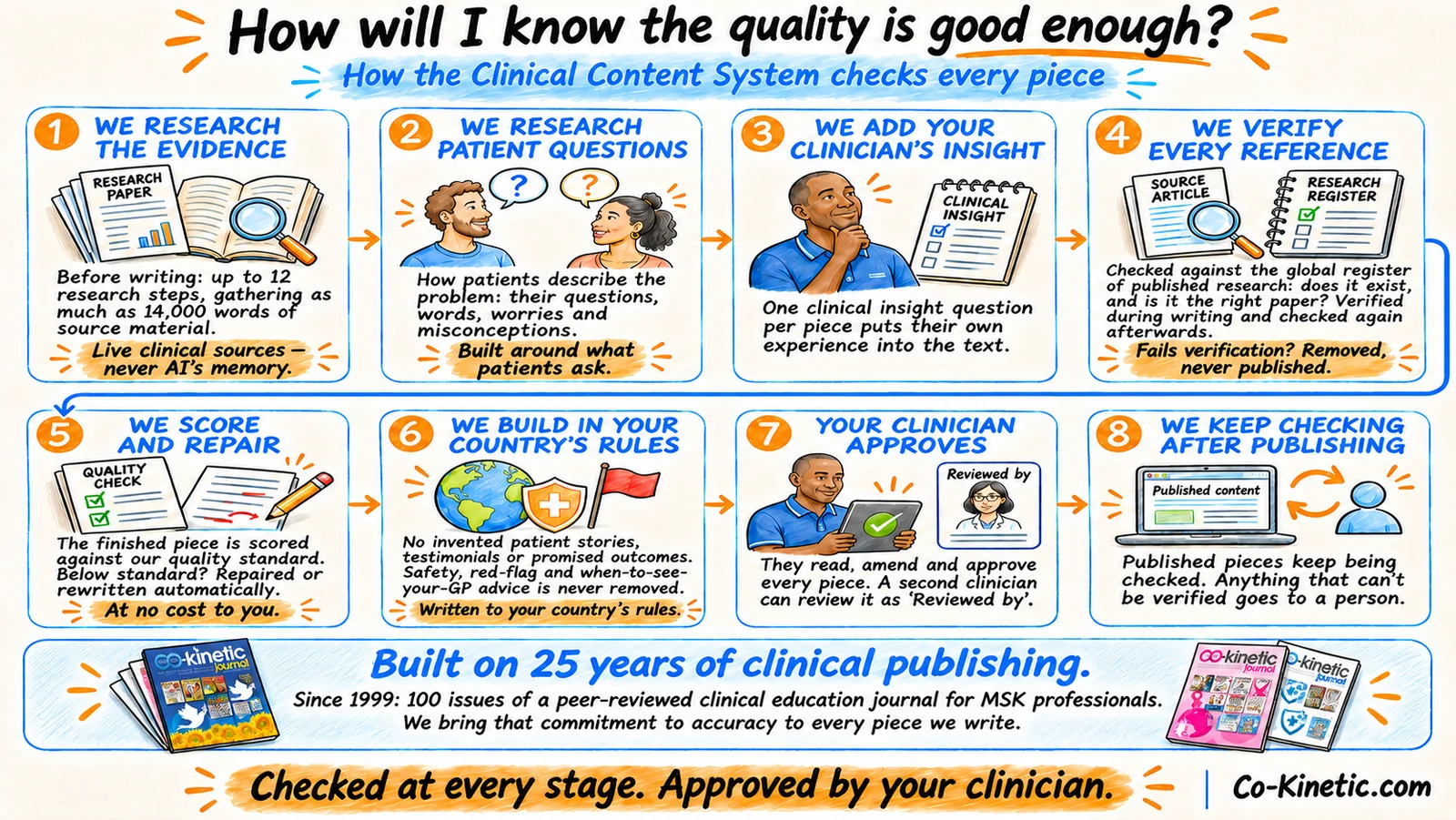
How will I know the quality is good enough? Eight checks: researching the evidence, researching patient questions, your clinician's insight, verifying every reference, scoring and repair, your country's rules, your clinician's approval, and checks after publishing.
How we make sure

1. You decide what matters most. Your Practice Priorities, your ranked services and conditions, and your clinicians' specialisms tell us which content is most important to your clinic. The more important the piece, the deeper the research goes.

2. Research, before any writing. Up to 12 research steps for a single piece, run on a live research engine with real-time access to current sources. They include how real patients describe the problem (their words, questions, fears and misconceptions), the current clinical evidence, honestly including where it's limited, and the published research behind each claim. Research is matched to your clinician's profession and your country's healthcare system, banked, and refreshed on a rolling basis so it doesn't go stale.

3. Writing, with your clinician's insight. Your named clinician answers one short question, and their clinical perspective is woven in. We never invent patient examples, quotes or results.

4. Every reference checked. Each one is checked against the global register of published research when the piece is written, again whenever research is reused, and again when the page is shown, including that it points to the paper it claims to. A reference that fails is removed, never published.

5. Scored before you see it. The finished piece is scored against the same research-grounded standard we use on your website. If it falls short, it's repaired and re-scored automatically, at no cost to you. You see finished work, not drafts.

6. Your clinician approves. Your named clinician reads and approves it, and a second clinician can review it and be credited as “Reviewed by”. After publishing, every piece keeps being checked, and anything that can't be verified goes to a person.

It's the standard we kept for 25 years and 100 issues publishing the peer-reviewed Co-Kinetic Journal.

Are the references real?Yes. Every one is checked to exist, and to be the paper it says it is.

Made-up references are the classic failure of AI-written content, so:

  • 📚 Every reference is checked against the global register of published research when the piece is written, to make sure it exists and is the paper it says it is.
  • 🔁 References are checked again after publishing.
  • 🚫 A reference that fails is removed, never published.
  • 🔬 The research behind each piece comes from live clinical sources, gathered in up to 12 research steps, never from an AI's memory.

It's the same standard we kept for 25 years publishing the peer-reviewed Co-Kinetic Journal.

Who checks the clinical content?We check it at every stage before your clinician sees it, and your clinician gives the final approval.

The research comes from live clinical sources, every reference is checked against the global register of published research, and the finished piece is scored against our quality standard and repaired if it falls short. Your clinician then reads and approves it, and a second clinician can review it as “Reviewed by”. Published pieces keep being checked, and anything that can't be verified goes to a person.

Can we choose which content gets the deepest research?Yes. The topics you mark as most important to your clinic get the deepest research.

In order:

  • 🎯 Your Practice Priorities get in-depth research for your practice as soon as you confirm them: what patients are asking about the topic, what they need to know, and where nearby clinics are being named by AI while you're not. Each priority stays in place for 90 days while that research is done and its topic area is built.
  • 📋 Your top-ranked services and conditions count next: your top five of each are guaranteed a place in your plan.
  • 👩‍⚕️ Your clinicians' specialisms shape it too: setting a clinician's primary specialism starts full research on it.

Every piece is still researched properly, whatever its topic. Priorities decide where your plan goes deepest first.

5

Will the content you create sound like us, and be right for our patients?

Yes. We write to answer the questions your patients actually ask, in your clinicians' own voices: every piece goes out under the name of the clinician who knows that area, built from their expertise and their own clinical insight, in plain English.

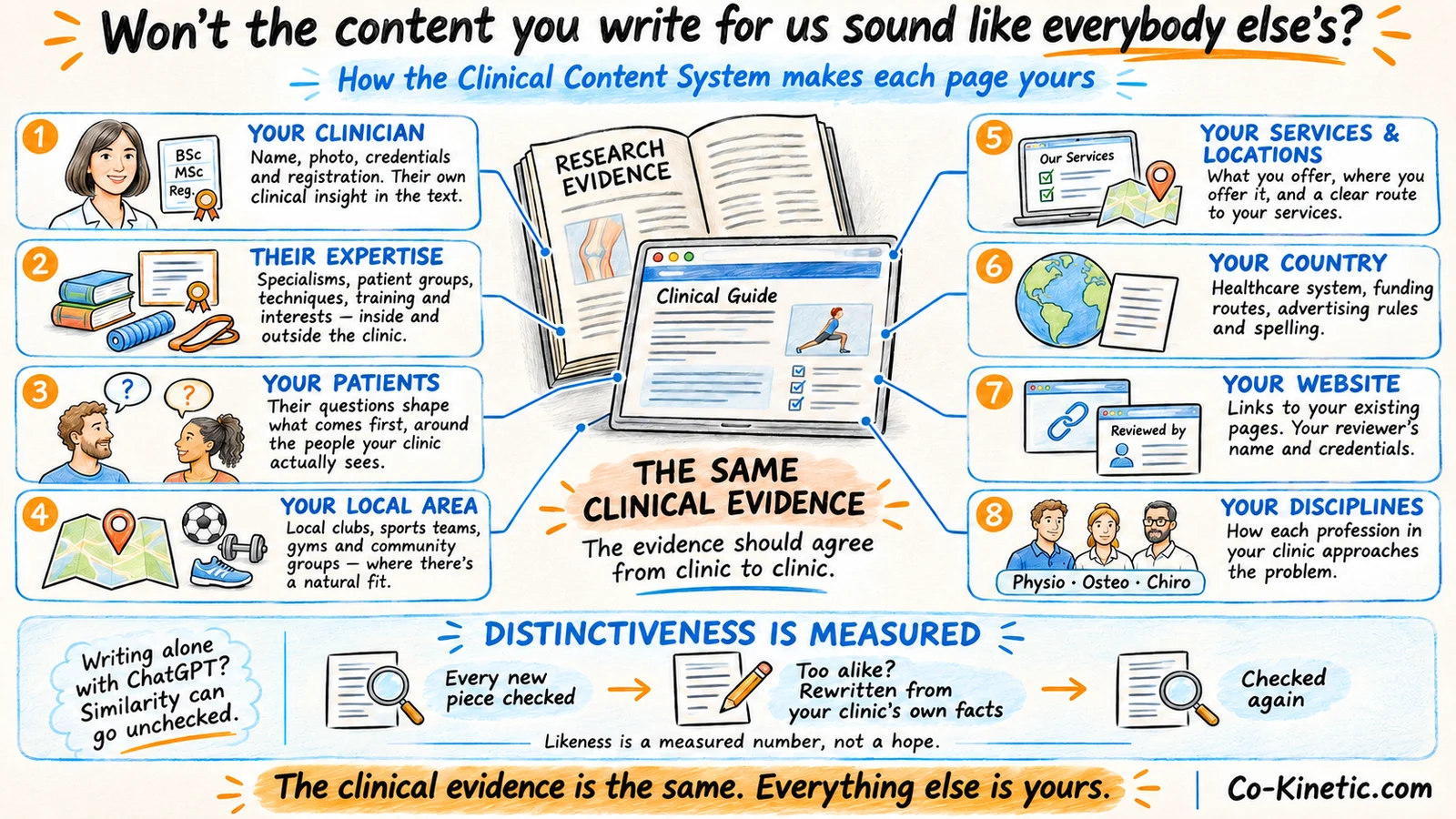
Won't the content you write for us sound like everybody else's? The same clinical evidence, made yours by eight things: your clinician, their expertise, your patients, your local area, your services and locations, your country, your website and your disciplines, with a measured distinctiveness check.
How we make sure

Your clinicians' profiles. Each clinician records what they treat most and how, the patient groups they specialise in, their techniques, training and CPD, and their clinical voice: six questions about how they actually talk about their work. The more specific, the more distinctive: “rotator cuff tendinopathy, mostly overhead athletes in their 40s” tells patients far more than “shoulder pain”.

One question per piece. The clinician who knows that area answers one short question, with a general observation or an anonymised example from their own practice, and it's woven in as their own first-person perspective. Once it's on file, it's kept every time that piece is refreshed.

A fresh reading of your practice, every time. Before each piece is written, the system reads your team afresh: what they treat, their interests, the insight they've given before, your services, even what they do outside the clinic, from coaching a junior team to pacing a parkrun. A team that lives and breathes running injuries gets a runner's-knee page shaped around the questions runners ask.

Right for your patients. Part of the research looks at how real patients describe the problem, so their questions come first. It's written in plain English (around NHS reading age in the UK, Year 8 in Australia), with your country's healthcare system and spelling, and your local area where it fits naturally. A clinic with more than one discipline can show how each of its own disciplines approaches the problem.

Clinical facts are the same the world over. How do you make our pages ours?Through everything around the facts: whose expertise stands behind them, the patients you see, your local area, your services and your country.

The evidence should agree from one clinic to the next, because the evidence is the evidence. Everything else on the page is personalised to you:

  • Your clinician: their name, photo, credentials and registration in the byline, and their own clinical insight in the text.
  • Their expertise: their specialisms, the patient groups they see most, their techniques, training and interests, even what they do outside the clinic.
  • Your patients: which questions come first, shaped around the patients your clinic actually sees.
  • Your local area: the running clubs, cycling groups, sports teams, gyms and community organisations around your clinic, woven in where there's a natural fit.
  • Your services and locations, so each page leads patients to what you offer.
  • Your country: its healthcare system, funding routes, advertising rules and spelling.
  • Your website: links to your own existing pages, and your reviewer's name and credentials.
  • Your disciplines: in a clinic with more than one profession, how each of your disciplines approaches the problem.
Will it sound like us, or like an AI?Like you. Each piece carries your clinician's own insight and goes out under their name.

The substance of every piece comes from your clinic:

  • 💬 Your clinician's own insight, in their words, from one targeted question per piece.
  • 👩‍⚕️ Their name, credentials and registration in the byline, and their experience and specialisms shaping what's written.
  • 📍 Your local area and services, so each page leads patients to what you offer, where you are.
  • 🔍 An automatic distinctiveness check, so it never reads like anyone else's.
  • ✏️ Your edits: you read, amend and approve every word before it goes out.

It's structured the way AI search reads a page, with the key answer first and short sections, but it reads like a well-organised expert page, because that's what it is.

Will it be too technical, or too simple?Neither. It's plain English for patients, with rigorous, referenced evidence underneath.
  • 🗣️ The key answer comes first, in the words patients actually use.
  • 📋 A summary table and short sections make it easy to scan.
  • 📚 The evidence and references are there for anyone who wants to check, including other clinicians and AI tools.
  • ⚖️ Clinical content often misses in one direction: written like a journal paper, or so simple it says nothing. Ours is pitched for an intelligent patient, and you can adjust anything before approving it.
How much of our time does it take?About 10 minutes per piece, once you're up and running.

Where the time goes:

  • 💬 For each piece: the author answers one clinical insight question (a few sentences), then reads, amends and approves the finished piece.
  • 🧑‍🤝‍🧑 Share the load: an administrator can press "Write it for me" and work down the plan, and send the insight question to the author by email, so clinicians only do the clinical part.
  • 🚀 The first few weeks take a little more, while your clinicians complete their profiles. A 20 to 30 minute recorded interview is the quickest way, and we'll turn it into the profile for you.
  • 🗓️ Schedule a month at a time: write your next pieces once every four weeks and schedule them to go live one a week.
Our clinicians hate writing about themselves. Is that a problem?Not at all. We've created short interviews designed to draw out the rich detail that makes each clinician stand out: 20 to 30 minutes, and our team turns the recording into their profile.

Most of them won't need to write anything:

  • 🎙️ A short interview: 20 to 30 minutes, run by a colleague using one of our two guides (for experienced clinicians, and for those earlier in their careers) and recorded on a phone. We transcribe it and turn it into their profile.
  • 📄 Import what they already have: an existing bio page, CV or LinkedIn profile fills the empty fields.
  • 📝 A worksheet: for those who'd rather write, away from their desk, in their own time.
  • ✅ Nothing clinical goes on a profile until the clinician confirms it.

The interview is designed to draw out the detail that makes each clinician stand out, the things they'd never think to write down about themselves.

6

How do you make sure it's not like all the other AI slop out there?

Because AI slop is a prompt pasted into a chatbot, and ours is the opposite. Before a word is written, every piece gets up to 12 research steps and as much as 14,000 words of source material. It's personalised to your clinicians, your patients and your local area, checked so it doesn't read like any other clinic's, then scored and approved before it reaches your website.

Won't the content you write for us sound like a robot, under my name? Four stages: fresh research, your clinician's insight, a clear expert page, and your clinician's final approval.
How we make sure

Research no chatbot does. A chatbot writes from memory. Every piece of ours starts with up to 12 research steps on a live research engine with real-time access to current sources: how real patients describe the problem (their words, questions, fears and misconceptions), the current clinical evidence, honestly including where it's limited, and the published research behind each claim. It's matched to your clinician's profession and your country's healthcare system, and every reference is checked against the global register of published research three times: when it's written, when research is reused, and when the page is shown.

Personalised at every stage. Before each piece, the system reads your practice afresh, and it shapes what gets written:

  • Your clinician: their name, photo, credentials and registration in the byline, and their own clinical insight in the text.
  • Their expertise: their specialisms, the patient groups they see most, their techniques, training and interests, even what they do outside the clinic.
  • Your patients: which questions come first, shaped around the patients your clinic actually sees.
  • Your local area: the running clubs, cycling groups, sports teams, gyms and community organisations around your clinic, woven in where there's a natural fit.
  • Your services and locations, so each page leads patients to what you offer.
  • Your country: its healthcare system, funding routes, advertising rules and spelling.
  • Your website: links to your own existing pages, and your reviewer's name and credentials.
  • Your disciplines: in a clinic with more than one profession, how each of your disciplines approaches the problem.

Your local area, mapped. Your assessment maps the community around your clinic, so a knee-pain page from a clinic near a well-known parkrun reads like it belongs there, because it does. Generic content can't fake that: you have to know the area.

Sameness is measured, not hoped for. Every new article gets an automatic distinctiveness check as it's written, and is rewritten from your clinic's own facts if it comes too close. Published articles can be compared paragraph by paragraph with other clinics' content on the same topic. We built that check before we even had two clinics whose content could overlap, and we test the whole system with deliberately different test clinics whenever we change how it writes.

Checked and tidied before you see it. Each piece is scored against the same research-grounded standard as your assessment, and repaired or rewritten automatically if it falls short, never at your cost. It describes your care with confidence, its FAQs are practical (what happens, how long, how many sessions, when to see your GP), and safety advice always stays.

Won't our content be the same as every other clinic's?No. It's built from things no other clinic has, and we measure it to make sure.

What makes it yours:

  • 👩‍⚕️ Your clinician's insight, credentials, specialisms and interests.
  • 🏥 Your services, your patients and how your disciplines approach a problem.
  • 📍 Your local area: the clubs, gyms, parks and community groups around you.
  • 🌍 Your country's healthcare system, funding routes and spelling.
  • 🔍 Checked, not hoped for: every new piece gets an automatic distinctiveness check as it's written, and anything that drifts too close to another clinic's content is rewritten from your own clinic's facts. Published pieces can be compared paragraph by paragraph with other clinics' content on the same topic.
Why not just write it ourselves with AI?You can, and lots of clinics do. Writing a page is the easy part; knowing which pages will actually move the needle for your clinic is the hard part.

A chatbot can't tell you that: it doesn't know what AI tools say about your clinic today, which clinics they recommend instead of you, which of your pages rank on Google, or which conditions and services your website is missing. The Clinical Content System starts there. It assesses your website and what AI says about you, grades every page, and builds a plan of what to write, for which clinician, and in what order, then re-measures every four weeks so you can see what changed. Content without a plan is guesswork.

Then it writes each piece from your own clinicians' experience and insight, because that expertise is what AI looks for and what sets you apart, and it's exactly what a general chatbot can't give you. Ask a chatbot for a knee pain page and you get much the same page as every other clinic asking.

What if the clinic down the road signs up too?It actually works in your favour: because we write for both of you, we make sure your pages don't sound anything like each other. If you were both writing your own with AI, you'd never know.

We check, automatically. Every new piece gets a distinctiveness check as it's written, and is rewritten from your own clinic's facts if it comes out too alike. Published pieces can be compared paragraph by paragraph with other clinics' content on the same topic, wherever they are, not just down the road. Likeness is a measured number, not a hope. Clinics writing their own content with AI have nobody checking, and no idea how alike they've become.

And it's unlikely to come close anyway. Every page is built from things unique to you: your clinicians, their expertise, insight and interests, the patients you see, your services, your local area and your reviewer's name. They get articles anchored to their team.

Won't Google penalise AI-written content?No. Google's own guidance is that it rewards helpful, high-quality content however it's produced. What it acts against is mass-produced pages that add nothing, which is the opposite of what we write.

What Google says. Google judges content on its quality, not on how it was made. It looks for experience, expertise, authoritativeness and trust, and holds health content to the highest standard, because a wrong answer can harm someone. Its spam policies target “scaled content abuse”: large numbers of pages produced mainly to game search results, with little value to the reader.

Why ours is the opposite. Every piece is written one at a time from your own content plan, under a named clinician with their credentials and registration in the byline. It carries their first-hand clinical insight, is built on fresh research with verified references, and can carry a second clinician as reviewer. That's the experience and expertise Google says it wants to see.

No duplicate content. Covering the same conditions as other clinics is normal and expected. The risk is near-identical text, and that's exactly what our distinctiveness check prevents.

And your clinician reads and approves every piece before it's published.

Is it safe and compliant with health advertising rules?Yes. It's written natively for your country, with its health advertising rules built into every piece, and clinical safety always comes first.

The same core rules everywhere. No invented patient stories, testimonials, patient quotes or promised outcomes. Plans never suggest case studies or success stories, titles that promise a result or a speed, or titles that claim one treatment beats another. Any patient example comes from your clinician, anonymised, and never says how it turned out. Safety, red-flag and when-to-see-your-GP advice is never removed. Credentials appear exactly as your clinician entered them, and an empty field is never filled in.

Australia. Written to AHPRA's advertising rules: no testimonials, no outcome guarantees, no superlative or comparative claims, and the protected title “specialist” is never used for a clinician without specialist registration (“special interest” or “practice focus” instead). Medicare Chronic Condition Management, NDIS and WorkCover are covered where they're relevant.

New Zealand and Canada. New Zealand pages cover ACC; Canadian pages cover provincial health insurance and extended health benefits.

The UK. NHS pathways, NICE guidance and private medical insurance, in British English.

Because a patient's result counts as a testimonial in Australia and New Zealand, we apply that rule in every country, so every article is safe wherever it's read. You still approve every piece.

7

How much content will we be able to create?

Four to seven pieces every four weeks, depending on the mix: a full condition guide is a much bigger piece of work than a service page, so it uses more of your allowance. You also earn credits back as you publish: about a third of each piece's credits, so publishing regularly gets you extra content on top of your allowance. That works out at about £85 to £150 a piece, with the assessment, the plan and the re-measuring included. Compare that with agencies charging around £800 a month for two or three blog posts.

How we make sure

Each four-week period comes with 30 content credits. A condition guide uses 9, a treatment page 7, a blog post 5, a service page 3 and a team page 2, so most clinics get four to seven in-depth pieces depending on the mix.

Consistency is rewarded. Every piece you publish adds to what Google and AI can find on your site, and each new page links into the ones before, so steady publishing builds on itself. That's why we give credits back: when a piece is live, press Validate & earn and about a third of its credits come back, so a clinic that publishes everything gets up to around 45 credits' worth of content every four weeks. If you publish through our WordPress plugin or Co-Kinetic Sites, that's one click.

Unused allowance credits roll over and keep adding up while you're subscribed; credits you earn back last four weeks and are always used first. Each piece includes three free regenerations.

What we do

Keep your assessment current. Keep your plan ordered. Research each piece from the clinical evidence base, write it under your clinician's name, verify its references and check it is not a near-copy of anyone else's.

Track where your pages rank and which questions you are now named for, and show you in your dashboard what comes next.

What you do

Click “Write it for me”, answer one short question, then read and approve. Publish with one click, or copy it across.

And keep asking patients for Google reviews: the one thing nobody can do for you.

How long is each piece?As long as the research says that kind of page should be: a condition guide runs to 1,800 to 3,000 words, a treatment page 800 to 1,500, a blog post 600 to 1,200, a team page 600 to 1,000 and a service page 500 to 750.
  • 📏 Based on research, not guesswork. These lengths come from Ahrefs' study of 174,048 pages and 560,346 AI Overviews, which looked at what actually gets shown and cited.
  • 💳 Why the credits differ. A condition guide covers the condition in depth and points patients to your other pages, so it's a much bigger piece of work than a service page. That's why it uses 9 credits and a service page 3.
  • 🎯 Length alone doesn't win. The same research found word count barely affects whether AI cites a page. Depth, structure and evidence do, so every piece is written to the length that does the job, and never padded.
  • 🔬 The research behind it is bigger still. Each piece is built on as much as 14,000 words of source material, gathered in up to 12 research steps.
Do our credits expire?Your allowance credits never expire while you're subscribed.
  • 💳 You get 30 every four weeks, and unused allowance credits roll over and keep adding up.
  • 🎁 Earn some back: when a piece is live on your website, press Validate & earn and about a third of its credits come back.
  • ⏳ Earned-back credits last four weeks and are always used first, to keep your momentum going.
  • 📏 What each piece uses: a condition guide 9 credits, a treatment page 7, a blog post 5, a service page 3 and a team page 2, so most clinics get four to seven in-depth pieces every four weeks.
We already have an SEO agency. Do we need both?Most clinics move the content part of that budget here. We track much of what an SEO agency tracks, but our focus is what now matters most: the content.

We measure many of the same things: your Google positions, every page's score, technical issues such as whether AI crawlers can reach your site, and how many people search for your topics. Where we go much further is the content itself:

  • Quality: researched, referenced, written under your clinicians' names, and scored before you see it.
  • Depth and understanding of your profession: 27 years serving MSK professionals and 100 issues of a peer-reviewed clinical journal, written natively for physiotherapists, osteopaths, chiropractors and massage therapists.
  • Structure: topic clusters built as hubs and spokes, with a main page for each subject and supporting pages answering patients' questions, all linked together so Google and AI can see your depth.

If your agency looks after the technical side of your site, that can carry on alongside. If they write your content, this replaces it, at four to seven pieces every four weeks.

8

How will we know it's working?

You'll see it for yourself. Every page is scored and re-measured, every AI answer we collect is stored word for word and shown to you, and every figure is dated, so nothing is taken on trust.

How we make sure

Your dashboard. One Site Health figure, your AI visibility score with the real rate at which AI names you behind it, and breakdowns for technical foundations, local trust, professional credibility, and content and discovery.

Every page, every time. Each page's score and grade, with a plain list of what to fix. For pieces we wrote, the score as written next to the live score, so you can see if anything was lost on the way onto your site.

What AI says, word for word. All 64 answers are stored for each run, with who was named instead of you. Each re-measure re-reads your pages, re-asks the AI tools and refreshes your Google positions and reviews, and is kept as a new dated snapshot beside the last.

Your topics filling out. Your plan shows each topic's progress, for example “main page live, 3 supporting pages live, 3 in your plan”. New pages are picked up automatically, and every new piece links into the ones before, so each one makes the next count for more.

Where's the proof that it works?We'll hold our hands up: it's brand new and has only been live for a few weeks, so we don't have results to show you yet. As soon as we do, they'll be right here.

What we do know. Everything it does is built on research into how AI tools choose the sources they recommend, and on what we've learned from assessing over 200 clinic websites. The standard every page is scored against is grounded in that published research, not guesswork.

Everything is measured, all the time. Every page is scored, every AI answer is stored word for word, and every result is dated, so you see your own clinic's figures from your very first assessment. It will only take a few weeks to build data across our clinics, and we'll put it on this page as soon as we have it. We won't make it up in the meantime.

And you don't have to take it on trust. Start with the one-off Review, see what it finds on your own website, and if you like what you see, your first four weeks are £99. No contract.

How quickly will we see a difference?Some fixes can show within weeks; the depth that gets you named consistently builds over months, and every piece makes the next count for more.
  • ⚡ Within weeks: some fixes can show quickly, such as unblocking an AI tool that couldn't read your site, or giving a clinician a proper profile page.
  • 📈 Over months: the depth that gets you named consistently builds as each topic area fills out and your pages link together. Every piece makes the next count for more.
  • 📊 Measured, not guessed: we re-measure every four weeks. AI answers vary from one conversation to the next, which is why we run several and show you every one, so you see the trend, not a one-off.
Will this get our clinic recommended by AI?That's exactly what it's built for: AI can only recommend what it can find, and we make your clinicians' expertise easy to find and trust.

No one controls what an AI tool says, so anyone who guarantees it is overselling. What we do is everything within reach:

  • 📚 Depth on the conditions you treat: main pages and the supporting pages around them, linked together.
  • 👩‍⚕️ Your clinicians' expertise visible, under their own names, with their credentials.
  • 🧱 Pages structured the way AI search reads them, with the answer first and the structured information it looks for.
  • 🔧 Anything stopping AI tools reading your site, found and explained.
  • 📊 Measured every four weeks, so you can read what AI says about you and see what's changed.

Your reputation, location and the clinics around you matter too, which is why we show you the evidence rather than a promise.

What if we just do nothing?Your website may leave important reasons to choose your clinic unexplained.

You may already have the experience patients are looking for, but thin profiles, missing pages and disconnected information make it harder for patients, Google and AI to discover.

  • 🔎 The free check shows what AI says about your clinic today, in a few minutes.
  • 📋 The assessment shows exactly where the gaps are: which conditions have no page, which clinicians are invisible, which pages AI can't read.
  • 🧭 Then you can decide what deserves attention, whether you do it yourself, with the Review, or with the Clinical Content System.

Didn't find your answer above? Ask Coki, our assistant. It knows the Clinical Content System, our prices and our research, and answers straight away.

Who it's for

Is this for our clinic?

It's for clinics with expertise worth making visible, priorities they want to develop, and someone who can add clinical insight, approve the content and publish it. Size doesn't come into it.

It suits a solo clinician as well as a team of ten. What matters is that your clinicians have experience patients would want to know about, and that each author can give about 10 minutes per piece to adding their insight and approving it.

If you already pay an agency or a freelancer for content, it's worth checking what that budget is getting you: see “Already paying for content?” above.

If what you want most is to stay in touch with the patients you already have, through emails, social posts, campaigns and offers, the Clinic Growth Hub is built for that, and we'll happily point you there.

Can a solo clinician use this?Yes. Add a peer reviewer: any clinician you respect, such as a mentor or a colleague from outside your clinic, and it adds credibility to every piece.
  • 👥 Why two people. Your plan unlocks when one profile reaches 60% (you, as the author) and a second reaches 50% (your reviewer).
  • 🤝 Your reviewer doesn't have to work with you. A mentor, a former colleague or any clinician you respect can be your reviewer: they don't need to be connected to your clinic. Add them to your clinic in the system and fill in their profile to 50%.
  • ✅ It makes your content stronger. A second clinician reviewing each piece, and named as the reviewer, is a mark of credibility patients, Google and AI all look for.
  • ⏱️ Very little extra work. They read the finished piece and give it a second clinical eye. You still approve every word.
What's the difference between this and the Clinic Growth Hub?One gets you found; the other keeps you in touch and brings people back.
  • 🔍 The Clinical Content System helps new patients, Google and AI find you, by making your team's expertise visible on your website: assessment, plan, and in-depth pages under your clinicians' names.
  • 📣 The Clinic Growth Hub helps you get more bookings from the patients and community you already have: patient emails, social posts, campaigns and ready-made patient content.
  • 🤝 Together: one brings new patients to your website; the other keeps them coming back and recommending you. Many clinics start with whichever matters most right now.
Who's behind it

Who is behind the Clinical Content System?

Tor Davies with Lupa on Holkham Beach, Norfolk
  • Former physiotherapist
  • Physiotherapy, Addenbrooke's Hospital
  • Sports Science, Birmingham University
  • Publisher, Co-Kinetic Journal, 1999 to 2024
  • 335 clinic websites assessed
Named Best Physical Therapy Marketing Platform 2026 and Best Physical Therapy Marketing Specialists 2024 by GHP's Global Excellence Awards · Shortlisted, Top 5 Patient Experience Solutions Providers UK 2024, Healthcare Tech Outlook

I am Tor Davies. I trained as a physiotherapist before I became a publisher for physiotherapists, and I have spent 27 years turning clinical research into something busy clinicians can use.

I started Sportex Medicine in 1999, a peer-reviewed clinical journal for physiotherapists that we used to describe as a journal in a magazine's clothing. It became Co-Kinetic, and across 100 issues between 1999 and 2024 we published clinical education, evidence reviews and patient-facing resources, including patient information for the British Heart Foundation, Diabetes UK and Asthma UK, which is some of the most rigorously reviewed health content there is.

In 2015 our subscribers asked for help with social media, and we built an early version of our marketing platform so clinics could schedule and automate it. That led to e-learning platforms for Central YMCA and YMCA Fit, content systems, and membership systems.

Since ChatGPT launched in November 2022 I have been building what you are reading about: a way to give clinics content that is clinically sound and specific to them, at a pace one person could never keep up by hand. I have been a closet geek throughout, building software long before AI made it fashionable.

The combination matters. I understand clinical credibility and I understand marketing, and in this particular job you need both.

Tor Davies with her dog, beside Co-Kinetic Journal covers and patient resources
27 years of clinical and patient resources: 100 journal issues, 1999 to 2024

Our content has been trusted by leading health and wellbeing organisations

British Heart Foundation Diabetes UK Asthma UK YMCA Fit Physio First Register of Exercise Professionals

What people say about working with us

Prefer to talk?

Four ways to get your questions answered

Ask now

Type your question and get an answer straight away, any time of day. It knows our products, prices and research inside out.

Ask a question

AI Visibility Check Q&A

Every Thursday, 8am and 5pm UK time

Free, 45 minutes, on Google Meet. Run the free check, then bring your result: Tor goes through what it found for each clinic booked, and what to fix first.

Book a place

Co-Kinetic Café

Every Tuesday, 8am and 5pm UK time

Free, an hour, on Google Meet, and open to everyone. Each week Tor answers a burning question clinic owners are asking, then it’s your questions: marketing, AI visibility, the subscriptions, anything.

Save a seat

20 minutes with Tor

Thinking about subscribing? A one-to-one to answer your questions about the Clinical Content System or the Clinic Growth Hub, so you know whether it's right for your clinic.

Book 20 minutes
Not ready to decide?

Start with the one-off Review: the low-risk way in

If you're thinking about it, the Website & AI Visibility Review is the halfway step. It's the full assessment of your website, written up as a one-off report and packed with what you need to know: how AI sees your clinic, what's holding you back, and exactly what to fix.

  • The result of all 64 AI answers, six of them quoted word for word, and the clinics AI recommended instead of you
  • Whether your website is blocking AI tools from reading it, and exactly which ones
  • What's stopping AI reading and trusting your site, and what's missing
  • A checked diagnosis of your website and of how your clinicians come across, with every claim checked against your live site
  • A do-it-yourself list, and a separate list for whoever looks after your website, showing exactly how to improve it so Google and AI can read and recommend you
  • Examples of the quick wins a content plan would start with, and the detail behind them
  • A plain-English explanation of how AI tools choose who to recommend

It's £599, one payment, and it's yours to keep whatever you decide. If you like what you see, subscribe within 35 days of buying the Review and your first four weeks of the Clinical Content System are just £99 instead of £599, with the full 30 content credits. No contract.

See what the Review covers Purchase the one-off Review

Choose your next step

Subscribe to the Clinical Content System

£599 every four weeks. No setup fee, no contract: stop whenever you like.

Subscribe today

Start with the Review

The Website & AI Visibility Review (£599) shows exactly what to fix on your website so Google and AI can recommend you, and it's yours to keep either way. If you then go ahead with the Clinical Content System within 35 days of buying the Review, your first four weeks cost £99 instead of £599, with the full 30 credits. No contract.

Or see where you stand, free

Free: find out whether AI recommends your clinic today, and who it's sending your patients to instead.

Check whether AI recommends your clinic (free)
Tor Davies

Tor Davies trained as a physiotherapist and holds a degree in sports science. In 1999 she founded sportEX Medicine, which became the peer-reviewed Co-Kinetic Journal: 100 issues of clinical education for MSK professionals over 25 years. She has run professional education for the MSK professions, including for Headley Court, the armed services rehabilitation centre, helped get the Sports Massage Association off the ground, and produced patient information for the British Heart Foundation, Asthma UK, Diabetes UK and Physio First. She built the Clinical Content System so independent clinics can get their expertise found, with content that’s clinically sound and specific to them. About Tor

Updated