
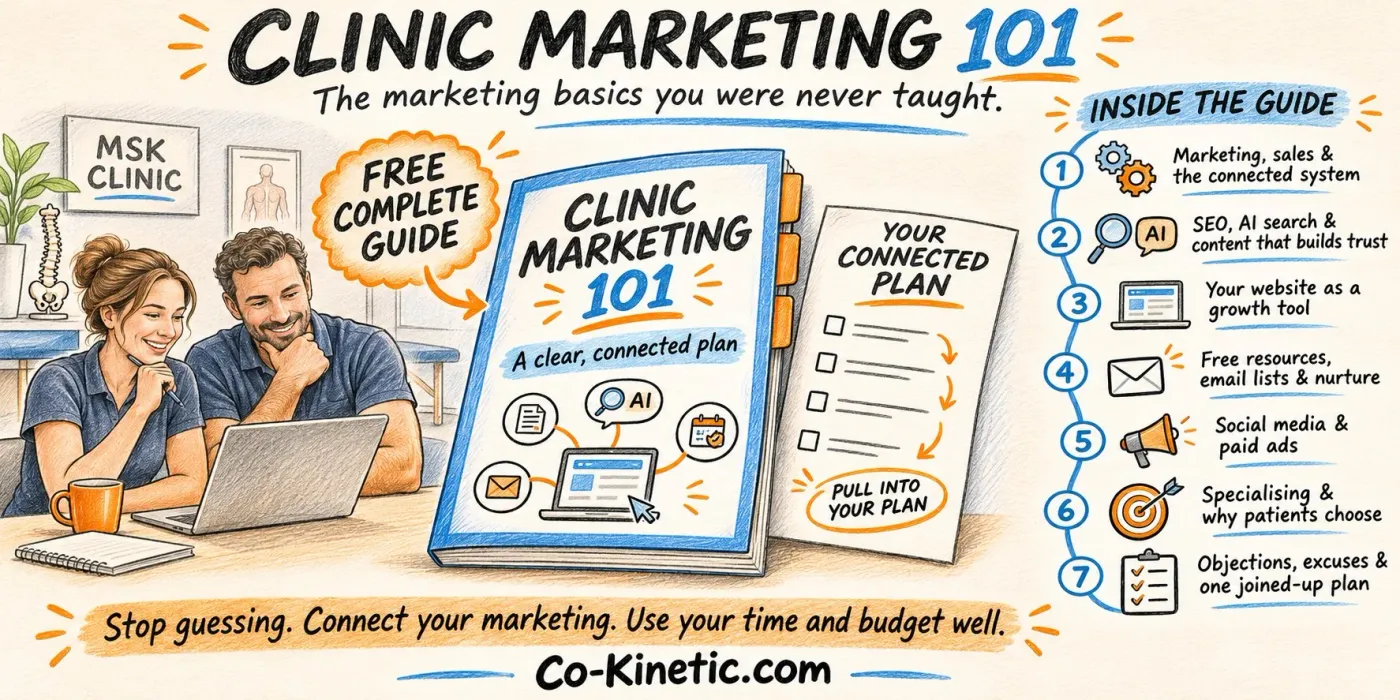
Clinic Marketing 101: A Clear, Connected Plan to Stop Wasting Time and Money
## 😶🌫️ **Clinic marketing feeling a bit all over the place?** Most people get stuck in the weeds—posting on social, fiddling with websites, running the odd ad, writing the occasional blog post—without ever stepping back to see how it all connects. That's what this guide is for. Not to teach you every technical detail about how to do it—but to help you **see the system**. How each part feeds the next. Where your marketing bucket might be leaking. And why disconnected tactics (no matter how well-intentioned) won't get you the results you want. It'll also help you figure out **who to hire, and when**—because if you're going to pay someone to "do your SEO" or write blogs, you need to understand how those roles connect. Good SEO needs content. Good content needs an SEO strategy behind it. One without the other won't get you far. This guide joins the dots—so your time, money, and energy aren't being wasted on half-built systems. It's straight-talking, practical, and designed to be read in order—each section builds on the last. So start at the top. Work your way through. No fluff. No gimmicks. Just a proper walkthrough of what works—and how to make it work for *you*.
👋 Introduction: Why You Need to Rethink Clinic Growth Today
Let's be honest.
Most clinics (at least well established ones) have grown off the back of word of mouth, referrals, and a few walk-ins. Nothing wrong with that—it worked for years.
But the world's moved on.
- Word of mouth isn't predictable (at all)
- Local competition's doubled (or tripled)
- Newer clinics are showing up everywhere—on Google, on Instagram, in your patients' inboxes
Are they better than you? Probably not. But they're easier to find. Easier to trust. Easier to remember.
That's what digital marketing gives you. Visibility. Credibility. A way to build trust before someone even needs you.
And no—it's not about gimmicks or being "salesy." It's just about showing up consistently, saying something useful, and giving people a reason to come back to you when they're ready.
But here's the bit most people miss: marketing only works when it's connected.
- One blog post won't fix a quiet diary
- A single email won't fill your books
- An Instagram post won't get you fully booked
This guide is here to help you stop guessing—and start building something that actually works.
Not a one-off campaign. Not a panic post. A proper system that keeps you visible, builds trust, and gets people through the door—without the stress.
What is digital marketing? Using online tools—like your website, content, email, social media, and ads—to attract, engage, and convert potential clients into paying customers.
🏃 Marketing vs. Sales: Know the Difference
This is where a lot of people get muddled.
Things go quiet. Panic sets in. So you jump into action:
- "Let's post something."
- "Maybe we should run a quick ad."
- "Could we print some flyers?"
But here's the reality: that's not sales. That's marketing.
And if the rest of your system isn't already working behind the scenes, those last-minute efforts usually do nothing.
Think of it like this:
- Marketing is the training. The reps, the early mornings, the boring stuff you do before the big day.
- Sales is race day. It's the moment someone's ready—and you've done the prep to meet them at the line.
You can't train for a marathon the night before. And you can't cram marketing when the diary's empty.
Marketing is what gets you ready. It builds visibility, trust, and reputation before someone's ready to buy.
- Your content helps people find you
- Your lead magnets collect their contact details
- Your emails keep you front of mind
- Then—when they need help—you're the one they already trust
If you only ever market when you're desperate, you'll always be chasing.
Key concept: You can't cram marketing. Build the system before you need it.
The Buyer's Pyramid
Here's the other piece most people don't understand: not everyone is ready to book right now.
In fact, according to the Buyer's Pyramid, only about 3% of people are actively looking for help right this minute. That's it.
Everyone else is somewhere on the scale between thinking about it and not even aware they have a problem yet.
In a physical therapy context, that might look like this:
- 3%: "I've injured myself. I need treatment. Who can I book with today?"
- 7%: "Something's not right. I'm Googling around. Maybe I'll get it looked at."
- 30%: "It's been bothering me for a while, but I'm not doing anything yet."
- 60%: "No idea I'll even need you in the next 6 months."
Most clinics only ever market to that top 3%.
And sure—Google Ads and SEO are perfect for those people. They're searching. They're ready. Your job is to show up and convert them quickly.
But the other 90%+? That's where the real opportunity is.
Key concept: Most of your future clients aren't ready yet. But if you wait until they are, it's already too late.
🔗 The Modern Clinic Growth Model: A Connected System
This is the bit most people never see.
They try a few things—post on socials, write a blog, maybe run an ad—and wonder why it's not working.
It's because they're doing tactics in isolation.
But marketing only works when the parts connect.
The Connected System
Here's what a proper growth system looks like:
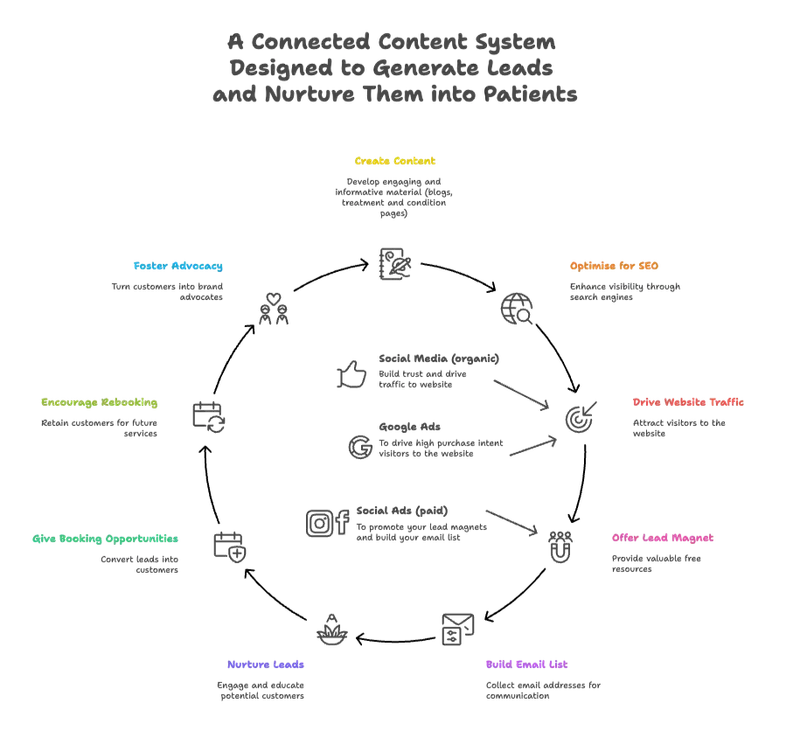
Each part feeds the next. Miss one, and you break the chain:
- Content gets you seen on Google (SEO)
- SEO brings people to your website
- Your website offers them something useful (lead magnet)
- That builds your email list
- Your emails keep you front of mind
- And that's when bookings start to happen
It's not a funnel. It's a system. A loop.
Think of it like your nervous system—everything's connected. One dodgy link, and the whole thing suffers.
So if you've ever thought "social doesn't work" or "my SEO isn't doing anything"—chances are it's not the tactic that's broken. It's the missing piece next to it.
Key concept: A tactic on its own won't grow your clinic. You need the system working together.
Key Definitions:
- Funnel: The journey someone takes from "never heard of you" to "I'm ready to book."
- Conversion: When someone takes a step you wanted—downloads a guide, joins your list, books a session.
- Lead: Someone who's shown interest but hasn't booked yet. Think of them as "nearly ready."
- Nurture: Staying in touch with people over time—usually with helpful, non-salesy emails.
- Authority: What happens when people trust you before they've ever met you.
🔍 Where SEO Fits (and Why It Matters So Much)
Let's be clear—SEO matters. A lot.
Because if people can't find you when they search, you're invisible. And if you're invisible, you don't even get the chance to earn someone's trust.
But here's the mistake clinics make: they treat SEO like a silver bullet. As if just ranking on Google will magically fill their diary.
It won't.
SEO helps you show up. It gets eyes on you. But what those eyes land on—and what happens next—is just as important.
What Good SEO Does
- Gets your content seen when people search for help
- Drives the right kind of people to your website
- Starts a journey that could lead to a booking
But if your website doesn't have anything useful to offer—like a lead magnet, a reason to stay, or even clear next steps—people bounce. Fast.
So yes, SEO is powerful. But only if it's part of a bigger plan.
What Good SEO Involves (Simple Version)
- Writing helpful, relevant content that answers real questions people are searching for
- Making sure each page has a clear topic, useful headings, and keywords in the right places
- Adding links between your pages so Google (and humans) can navigate your site easily
- Making sure your website loads fast, looks good on mobile, and is easy to use
- Setting up your Google Business Profile so you show up in local searches
That's it. No dark magic. Just clear, useful content on a solid website structure.
What You Need Alongside It
- Content that actually answers people's questions (not just hits keywords)
- A website that builds trust and makes next steps easy
- A lead magnet that turns anonymous visitors into contacts
- A nurture sequence that follows up and builds the relationship
Key concept: SEO is how people find you. But what they find needs to be worth sticking around for.
Example Journey: Someone Googles "shoulder pain help Norwich" → lands on your blog → downloads your free guide → joins your list → gets 3 helpful emails over 2 weeks → books in when their pain gets worse.
💡 Your Content Is Your Trust Engine (and SEO Fuel)
If SEO helps people find you, then content is what makes them trust you.
And if your content's good enough, it does both at the same time.
What Content Means
- Blog posts
- Short videos
- FAQs
- Treatment guides
- Case studies
- Anything that explains, educates, or reassures
You might think of it as marketing. But really—it's just being helpful in public.
And helpfulness builds trust.
- Google rewards it (that's where SEO comes in)
- Patients notice it (and remember you for it)
- You can use it everywhere—on your site, in your emails, on socials, in lead magnets
Good content shows you get people's problems. That you understand what they're going through. That you're not just trying to sell them something—you're trying to help.
And that alone makes you stand out.
Key concept: The more useful your content is, the more people trust you—and the more likely Google is to send people your way.
Not All Content is Created Equal
It's easy to think that "doing content" just means posting something, writing a blog, or uploading a video.
But not all content builds trust. Some actually chips away at it.
If your content is all about you—your clinic, your team, your services—it's not helping the person reading it. To be perfectly blunt, it's just noise to everyone else.
The stuff that works? It's the content that helps without asking for anything in return.
Or as I like to say: "selfless, not selfish".
How to Tell the Difference
- Selfless content answers a question your patient is already thinking
- Selfish content is about what you want—usually a booking, a comment, or a sale
The Bait-and-Switch Problem
You offer something helpful…like give helpful advice, and then sneak in a very short, seemingly insignificant (to you) sales pitch at the end.
You had their attention. You were earning trust. And then—boom—you flipped it. It feels manipulative. Because it is.
Key concept: If you're pretending to give value just to get a booking—you're not building trust. You're draining it.
The Trust Bank
Think of it as a Trust Bank.
- Every time you post something genuinely useful—absolutely no strings attached—you're making a deposit
- Every time you ask for something (a booking, a review, a reply), you're making a withdrawal
To keep the balance healthy, you need the right value-to-ask ratio:
- Minimum: 9 value-led posts or emails for every ask
- Ideal: Closer to 20:1 if you want to stand out and stay trusted
- Non-negotiable: Never disguise a sales pitch as something helpful
This applies to everything you create—blogs, social posts, videos, guides, emails.
Because what you're really building isn't just visibility. It's credibility. And once you've lost trust, it's a long road back.
🌐 Your Website: From Online Brochure to Growth Tool
Let's be honest—most clinic websites are just glorified business cards.
Nice logo, a bit of text, a few photos, a phone number somewhere.
But that's not a growth tool. That's just existing on the internet.
Your website should be doing way more than that.
What Your Website Needs To Do
- Help people quickly work out if you can help them
- Offer a simple next step (usually in the form of a lead magnet)
- Make booking dead easy
- Build trust straight away—before they ever pick up the phone
And yep, that includes people finding you through SEO or clicking on a paid ad. Because if your website isn't up to scratch, all that traffic is wasted.
Key concept: Your website isn't just a shop window. It's the hub where leads are captured, trust is built, and bookings happen.
What a Proper Website Should Include
- Clear info on what you help with (not just who you are)
- A way for people to self-identify their issue ("That's me")
- A lead magnet offer—something genuinely helpful in exchange for their email
- A smooth, low-fuss way to book (no long forms or confusing buttons)
- Fast loading and mobile-friendly (because most people will be on their phones)
Landing Pages Matter
A landing page is a focused, stripped-back version of your website. It's designed to do one thing well—like getting someone to download your guide, join your email list, or book in.
Your general website is like your full story—it's the hub. But when you're running an ad or linking from social media, sending people to a landing page keeps them focused.
Key Definitions:
- Landing page: A single web page designed for one goal—usually to collect contact details or drive bookings. No distractions, no menu, no fluff—just one action.
- Mobile optimisation: Your website works properly on a phone—loads quickly, buttons are easy to click, and everything's readable without zooming in.
🧲 Lead Magnets: Turning Traffic into Opportunity
So someone finds your website. Or clicks your ad. Or taps through from Instagram.
Great. But now what?
Most of them won't book on the spot. They're just browsing. They're not ready yet—but they might be soon.
And this is where a lead magnet changes everything.
A lead magnet is a small, helpful resource you offer in exchange for someone's contact details—usually their email.
It's how you go from anonymous traffic to actual contacts you can follow up with.
Key concept: No lead magnet = no list = no follow-up. You're losing people before you even know they were interested.
Why Lead Magnets Matter
- Gives people a reason to share their email with you (without feeling "sold to")
- Starts a relationship without pressure
- Builds your email list, so you're not relying on social media or SEO alone
- Gives your ads and website something useful to point people toward
Here's the key: it needs to be specific, helpful, and relevant to your ideal patient.
Not general advice. Not your clinic brochure. Something they actually want.
Examples That Work Well for Clinicians
- Free guide: "5 Mistakes That Make Back Pain Worse"
- Checklist: "Is It Safe to Keep Running With Knee Pain?"
- Mini course or email series: "7 Days to Better Sleep"
- Quiz: "What's Causing Your Shoulder Pain?"
- Self-assessment tool: "Is Your Posture Contributing to Your Headaches?"
The goal? Offer a small win, build trust, and stay in touch until they're ready to book.
🥚 Email Lists: The Goose That Lays Your Golden Eggs
Let's get one thing straight: your email list isn't just a nice-to-have.
It's your most valuable marketing asset.
Not because of what it is, but because of what it lets you do.
- It gives you a direct line to people who've already shown interest
- You're not fighting algorithms or paying to be seen
- And you're not at the mercy of social platforms changing the rules overnight
Social media is rented space. Your email list? That's yours. You own it.
But here's the catch—owning a list means taking responsibility for it.
And most clinics don't.
They either ignore it entirely… or they send the kind of "newsletters" no patient wants—news about the clinic, not help for the reader.
The Golden Goose
Here's the thing I always say:
Your email list is like the golden goose in Aesop's famous fable.
- Feed it regularly. Look after it. Nurture it.
- And it will lay you golden eggs—appointments, rebookings, voucher purchases, referrals—over and over again.
But if you neglect it? Or worse—try to squeeze it too soon with endless offers and salesy messages? It dies. Simple as that.
Key concept: Your list is a long-term asset. Respect it, and it'll carry your business. Abuse it, or ignore it, and it's worthless.
How to Care for Your List
- Keep your list clean (remove people who haven't engaged in 12 months or more)
- Focus on selfless, helpful content—not thinly disguised sales pitches
- Stick to a value-to-ask ratio of at least 9:1
- (That means 9 helpful emails before you ask for anything. The best marketers work closer to 20:1.)
- And whatever you do—don't bait and switch
- (That's where you pretend to offer value, then sneak in a pitch at the end. It breaks trust faster than saying nothing.)
Every useful email you send is a deposit in your trust bank.
Every sales push is a withdrawal.
You can only withdraw if you're in credit.
And yes, some people will unsubscribe. That's fine. They never would have become patients in the first place.
If you're sending value 95% of the time, you'll keep the right people—the ones who trust you, remember you, and book when they're ready.
What if another therapist set up in your area tomorrow?
If you've already been building trust with your list—adding value, staying visible, showing up consistently—they've got a mountain to climb. Because your name is already in people's heads. You've been helping before they even needed help. That kind of momentum is really hard to compete with.
🌱 The Nurture Funnel: From 'Not Ready' to 'Let's Book'
So someone finds you on Google.
They read a blog or watch a video.
They download your guide or complete your quiz.
Now they're on your email list.
Great—but they're not ready to book. Not yet.
- Maybe their pain isn't bad enough yet
- Maybe they're still hoping it'll go away on its own
- Maybe they're just… not there yet
This is where the Buyer's Pyramid really kicks in. Remember, only 3% of people are ready to get help now. Another 27-30% are in the consideration phase.
They're in that thinking, exploring, or "not quite yet" zone. The more value you give during that phase, the more trust you earn.
They haven't hit their clinical tipping point—the moment where they stop tolerating it and start taking action.
But when that tipping point hits—or when a friend asks them for a recommendation—guess who comes to mind?
You.
What is Nurture?
Nurture just means staying in touch, while delivering value and building trust. It means showing up consistently.
Reminding them you're here, you get it, and you can help—without shoving a sales message down their throat.
It can be done through email, social media, even short videos. The format doesn't matter as much as the intent.
And remember—you don't have to create everything from scratch. You can share links to helpful leaflets, blog posts, research, short videos, or even animations. If it's useful and relevant, it works.
Key concept: People book when they are ready—not when you need them to. Nurture bridges that gap.
What to Send
- Helpful tips and advice they can act on now
- Links to helpful patient resources
- Short stories or case studies to show what's possible
- Reassurance that what they're going through is normal—and fixable
- The occasional reminder of how to get started (when they're ready)
Not everything needs to be deep or polished. Just show up with something useful.
How Often to Send
- Ideally once a week
- Twice a month if necessary
- Once a month is better than nothing!
Done right, you become the go-to person before they even realise they need you.
📱 Social Media's Role: Visibility, Proof, and Amplification
Let's get one thing out of the way:
Social media is not your booking engine.
If you're expecting it to fill your diary, you're going to be disappointed.
But that doesn't mean it's pointless.
Used properly, social is a trust amplifier.
- It shows people who you are, how you think, and what you care about
- It reminds your audience you exist
- It keeps you top of mind—so when they do hit that tipping point, they already feel like they know you
What Social Actually Helps With
Social doesn't bring in most of your clients—but it does support almost every other part of your system:
- People will look for you there – If you're invisible or inactive, it raises questions
- It helps you look legitimate – A professional, up-to-date presence builds instant credibility
- You can demonstrate authority – Educational posts show you know your stuff
- It creates familiarity – Even if engagement is low, showing up consistently builds recognition
- It builds trust through repetition – Every post is a touchpoint
- It gives you social proof – Testimonials and reviews work—just don't overdo it
- It can support SEO – Active profiles and link clicks can feed into better search visibility
- It grows your audience (with ads) – Low-cost promotions can drive people to your lead magnets
- It creates indirect sales – It won't convert many directly, but it keeps you in people's heads
- It builds goodwill – Keep sharing value, and people will remember who helped them
Key concept: Social media doesn't convert on its own. But it makes everything else work better.
Content Framework: EIRE
To keep your content balanced and human, use the EIRE model (based on analysis of more than 27,500 physical-therapy specific social media posts):
- Educational – Tips, myth-busting, injury insights, infographics, links to resources
- Inspirational – Client stories, progress updates, motivational quotes
- Relatable – Everyday moments, things patients think but don't say (you're aiming for the "that's so me" reaction)
- Entertaining – Personality, humour, small wins - humour is consistently a winner on social
Aim for at least one of those per post—more if you can.
Posting Advice That Actually Matters
- Stick to the 9:1 rule – Aim for at least nine posts that give before you post one that asks
- Be consistent, not constant – Three posts a week is absolutely fine. What matters most is that you keep it up
- Don't overthink the timing – You don't need to post at exactly 7:02am on a Tuesday
Why Nobody Sees Your Posts
If it feels like no one's seeing your content—you're not imagining it.
Most platforms show your posts to less than 5% of your followers. Often less than 2%.
How many followers do you have? 100? That means 2 people will see a post!
It's not personal. It's the algorithm doing its job—keeping people on the platform, showing them ads, and making money.
Key concept: Low reach doesn't mean your content is bad. It means the platform wants you to pay. Keep showing up anyway.
💰 Paid Ads: Speeding Up the System (Once It Works)
Let's start with this:
If your funnel's leaky, ads won't fix it. They'll just drain your budget faster.
Throwing money at ads when your system isn't ready is like pouring water into a bucket full of holes. You might get a few bookings—but most of it will go to waste.
So before you spend a single penny, make sure the foundations are solid.
When to Use Ads
Paid ads are for speeding up what's already working—not rescuing what isn't.
Don't touch them until:
- Your website is clear, helpful, and converts well
- You've got at least one strong lead magnet with a lead collection page
- You're actively nurturing your email list (automated or manual—it doesn't matter, but it has to be happening)
Only then do ads make sense—because now you've got something worth driving traffic to.
Key concept: Ads are fuel. They make a working system go faster. But they won't build the engine for you.
Types of Paid Ads (and What They're Good For)
There are two main types of paid ads clinics tend to use—each with a different role:
Paid Search (Google Ads)
- High intent: people are actively searching for help (e.g. "back pain physio near me")
- Great for driving bookings
- Expensive—but can be worth it if your offer and website are strong
Paid Social (Meta/Facebook & Instagram)
- Low intent: people aren't actively looking for help—they're just scrolling
- Great for list building using lead magnets (high value resources)
- Cheaper and easier to test, but takes longer to convert
They're both useful—but only when used in the right place, at the right time, with the right setup behind them.
🎯 Specialisation: The Shortcut to Momentum
One of the biggest mistakes clinics make?
Trying to be everything to everyone.
It feels safer. But it actually slows you down.
Because when you try to rank for everything, talk to everyone, and serve every kind of injury—you end up blending in. And your marketing becomes vague, diluted, and forgettable.
Key concept: Trying to be for everyone usually means you're remembered by no one.
Why Specialisation Works
Specialising, on the other hand, gives you traction.
It gives your content clarity, your SEO a focus, your ads a direction, and your pricing more power.
It also makes everything else easier:
- SEO becomes more effective—you're not competing on every keyword
- Your messaging gets sharper—people know exactly who you help
- Lead magnets are faster to create—and more likely to convert
- You become the go-to for a specific type of problem or person
- You can charge more—because your expertise is clear
And no—it doesn't mean you only treat that one thing and that you can't see other patients with other conditions or injuries.
It just means you're known for something. You lead with it. You go all in on it.
Then once you've built that trust, people will come to you (or your clinic) for other things too.
Generalists struggle, specialists scale.
If you're going to spend time and money on marketing, focus it where it'll have the biggest impact.
Specialisation helps you do that.
🧠 Core Psychological Principles That Shape Success
Marketing isn't magic—it works because people behave in predictable ways.
If you understand how people make decisions, you can stop guessing—and start doing things that actually move the needle.
The Principles That Matter Most
Trust takes time – It's built slowly and lost fast. Your job is to keep showing up, not just when you need something.
Reciprocity works – When you give first (selflessly, not selfishly), people are more likely to respond later. Help first. Ask second.
Familiarity leads to action – The more people see you, the more they remember you. Visibility matters—especially when the need finally arises.
Consistency beats brilliance – The best clinic marketers aren't flashy—they're just reliable. Think fitness training, not crash diets.
The Buyer's Pyramid is real – Most people aren't ready to book right now. But many will be, and your job is to earn their trust in the meantime.
You have to build the Awareness Bridge – Guide people from "what is this?" to "this is for me." From hesitation to action. From "hmm" to "yes."
Pricing sends a message – Undercharging often signals a lack of confidence or quality—whether you mean it that way or not.
The Trust Bank rules everything – Build credit by giving value. Use it wisely when you make an ask. And don't ever pretend you're doing one when you're actually doing the other.
Why charging more can be an act of service
When you charge what you're worth, you give your clients permission to take you seriously—and you give yourself the space to deliver your best work. That's not selfish. It's sustainable.
🤔 Objections and Excuses: Let's Be Honest
At this point, you might still be thinking:
"I don't want to be salesy" → You're not hustling—you're helping. And people need what you offer.
"I don't have time" → Marketing is what stops you panicking later. Make time now, or make panic later.
"I'm not tech savvy" → Start simple. Use tools that do the heavy lifting. Ask for help.
"I can't afford it" → You don't need fancy tools. Use your legs and a printer.
"I don't know what to publish" → Use the tools inside Co-Kinetic. They're literally built for this.
"I don't know what I should be doing" → You do now. You've just read this guide.
Old-School Still Works
In fact, it often works better now—because most people have stopped doing it:
- Leaflets in shops and waiting rooms
- Posters in gyms, coffee shops, libraries
- Referral partnerships with other professionals
- Café deals, running clubs, cycling groups, park runs
- Getting out in your community and being visible
None of this is complicated. But it does take effort.
The blunt truth:
You can't start a business and expect not to market it.
After your clinical delivery, marketing is the next most important thing—maybe even the first, because without patients, there's nothing to deliver.
If you're hoping to grow a business without doing any marketing or sales—you're living in la-la land.
Get real. Get focused. And stop faffing.
Marketing isn't optional. It's essential.
So stop waiting for the perfect moment—and start doing something about it.
🧩 Pulling It All Together: A Realistic Clinic Growth System
Let's zoom out for a second.
This guide isn't designed to give you a deep dive into SEO or a step-by-step breakdown of Facebook Ads.
That's not the point.
The point is to show you how everything fits together—so you don't waste time or money throwing tactics at the wall, hoping something sticks.
Because too often, people invest in one thing—like paying for SEO or running ads—without supporting it with the content, lead capture, or email nurture that actually makes it work.
You don't grow a clinic by fixing one piece in isolation.
You grow it by building a system where every part supports the others.
If you're only doing one or two things—like posting on Instagram or paying for SEO—but ignoring the rest, you're building a leaky bucket.
The water just drains out.
How the System Flows
SEO brings a visitor → they sign up for a guide → they join your list → they get helpful emails → they book when ready → they rebook → and maybe even refer others.
That's how sustainable growth works. One connected step at a time.
Clinic Growth System Checklist
- Do you have content that answers real questions?
- Do you have a lead magnet to capture interest?
- Are you actively building an email list?
- Are you nurturing that list with useful content?
- Do you have a clear specialism that sets you apart?
- Are you showing up consistently—even when you're busy?
Key concept: Growth isn't about doing everything. It's about doing the right things—connected, consistently, and in the right order.
🚀 Final Thoughts & What to Do First
You made it to the end—which already puts you ahead of most clinic owners.
Because most people either bury their head in the sand or bounce between random tactics, hoping one of them works.
But now you know better.
You've seen how the pieces fit together—SEO, content, lead magnets, email, nurture, social media, and ads.
And more importantly, you've seen why doing one or two things in isolation won't move the needle if the rest of the system isn't there to support it.
This isn't about doing more. It's about doing the right things, in the right order, consistently.
Marketing is just the process of guiding someone on a journey—from "I think I might need help" to "this is the person I trust to help me."
That's it. It's not manipulation. It's not hype. It's just communication—with empathy, intention, and structure.
What to Do First
If you have £0 and almost no time:
Start with trust-building basics:
- Pick a specialism – Get clear on who you help. It makes everything else easier.
- Create one strong lead magnet – Something specific, helpful, and downloadable.
- Add it to your website – Simple form → email collection → auto-email the guide.
- Post once a week on social (or less) – Use the EIRE model. Think useful, not "clever."
- Start an email list – Even if you just email once a month, start building it now.
Do this, and you'll have the bones of a system—without spending a penny.
If you've got a bit of time but no cash:
Focus on free visibility and reputation-building:
- Turn common patient questions into short blog posts
- Hand-deliver printed guides or leaflets to local cafés, sports clubs, GPs, and gyms
- Run a free workshop or Q&A at a community centre or library
- Join a local Facebook group and answer questions helpfully, not pitchy
If you've got a small budget but no time:
Buy back your time and automate where you can:
- Set up a Co-Kinetic campaign (done-for-you lead magnets + nurture emails)
- Run a small Facebook ad to your lead magnet
- Use an email tool with pre-written templates to stay in touch
- Get someone (even part-time) to help you post or schedule your social content
Avoid This Mistake
Don't throw money at ads or SEO before you've got:
- A clear specialism
- A decent lead magnet
- A working email list
- Somewhere for leads to go once they're collected
Otherwise, you're just pouring water into a leaky bucket.
You don't need to be everywhere. You just need to be in the right places—consistently.
So let's stop faffing. And get to work.