
Why Isn't AI Recommending My Clinic?
Why a clinic website needs condition, treatment and service pages before blog posts, and how linking them helps patients and AI tools follow the path from symptom to booking. For clinic owners deciding what to build next.
Reviewed and updated: November 2026
The most likely reason AI isn't recommending your clinic is that your website is a dead end. AI tools try to follow a patient from symptom to booking, and most clinic websites break that path somewhere along the way, so the AI moves on to a clinic whose website gives it the whole picture. Fixing it comes down to four distinct types of page, each doing a different job. In more than 100 visibility assessments I have run on MSK clinic websites, missing pages, not poor content, is the most common structural problem I find.
How Does AI Actually Decide Whether to Recommend a Clinic?
AI search tools look for sources that show real depth on a topic: a set of connected pages that takes a patient from problem to solution, not one page on its own. There is measured evidence for this. Google's AI Overviews now use what is called "query fan-out": Google splits a patient's question into smaller sub-questions and looks for the best answer to each. Ahrefs found (January 2026, updated May 2026) that pages ranking for those sub-questions were 161% more likely to be cited, and a page's citation rate rose from 9% when it ranked for none of them to 57% when it ranked for nine. When a patient asks ChatGPT "why does my shoulder hurt at night," the AI looks for a page that answers that question well, then for what treatment is available, then for which clinic offers it. If your website only covers one stage of that path, the AI has far less to go on, and it is far more likely to name a clinic whose website covers the whole journey. It is not a judgement about your clinic. It is a gap in what the AI can find.
What Are the Four Page Types and Why Do All Four Matter?
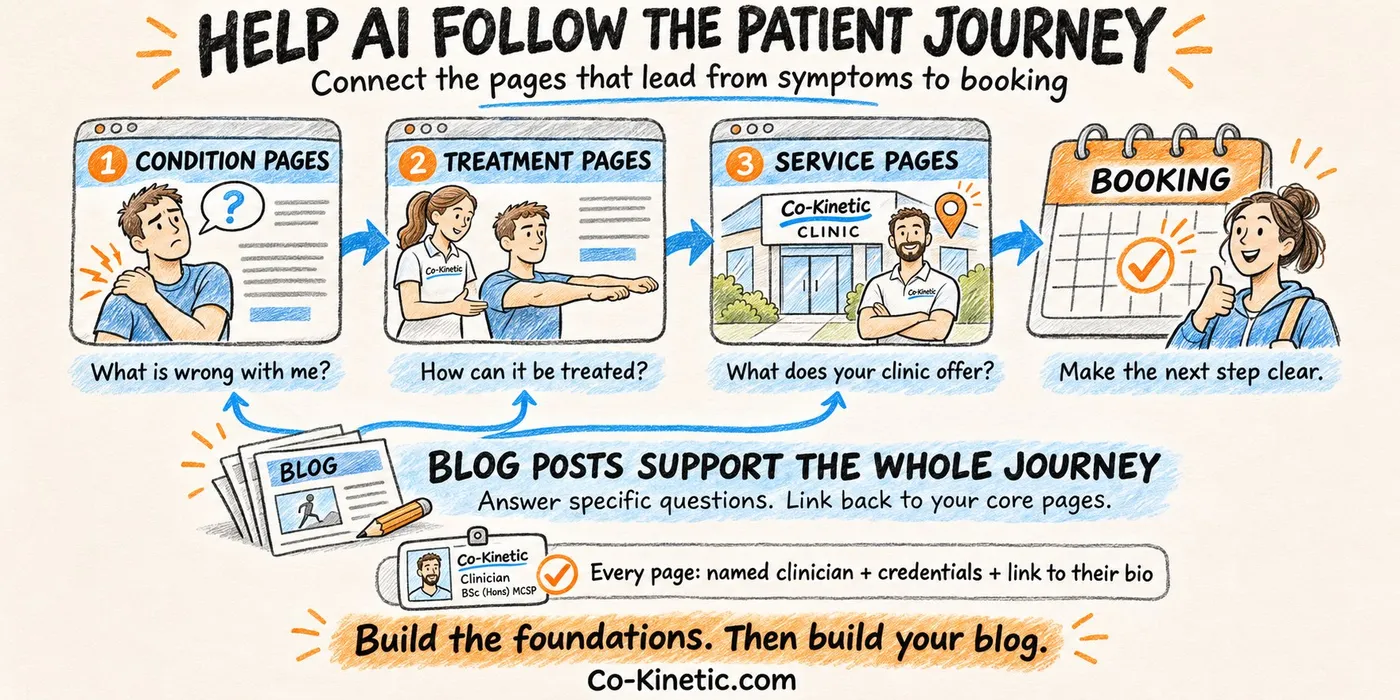
Condition pages, treatment pages, service pages, and blog posts each catch a patient at a different moment in their journey from noticing a symptom to making a booking.
- A condition page answers "what is wrong with me?"
- A treatment page answers "how can it be fixed?"
- A service page answers "does this clinic offer that, and what does it look like?"
- Blog posts sit across the whole journey, building authority and answering the specific questions patients ask at each stage.
Building one type does not substitute for another.
What Is a Condition Page and Why Does It Come First?
A condition page is written for the patient at the very beginning of their journey, before they know what they need or who they need it from. It answers questions like:
- What is plantar fasciitis?
- What causes knee pain when running?
- How long does a rotator cuff injury take to heal?
This is where AI tools most often enter the conversation. BrightEdge tracking found that by December 2025, 93% of the US symptom and condition searches it monitors triggered a Google AI Overview, and 98% of pain-related ones. In the UK, YouGov found in July 2026 that 16% of adults have already used AI to research a condition, and 16% to understand their symptoms. If your clinic has a well-structured, credible condition page on a topic a patient is searching, that page is exactly what the AI is looking for.
Condition pages are where most clinics fall short. They write about what they do rather than what patients experience. They use clinical terminology rather than the language a patient would use at 11pm when their knee is keeping them awake. Those long, real-world questions are exactly where AI answers appear most: WebFX's analysis of 130,070 US health searches (July 2025) found AI Overviews on 73.9% of health searches of seven words or more. Write condition pages for the patient who does not yet know they need you, and you will capture them at the moment they are most open to a recommendation.
What Is a Treatment Page and Why Does the Order Matter?
A treatment page comes after the condition page in the patient journey. It answers the next question: now that I know what is wrong, how can it be fixed?
- What does physiotherapy for a rotator cuff injury actually involve?
- Is acupuncture useful for lower back pain?
- What is the difference between manual therapy and exercise rehabilitation?
From an AI visibility perspective, treatment pages are where you establish clinical authority around specific approaches. BrightEdge found that 100% of the treatment searches it tracked triggered an AI Overview by December 2025, so this is a question AI is answering every time.
A condition page and a treatment page do different jobs and both need to exist. A single page trying to cover both the condition and the treatment is doing neither job properly. Condition pages should link to treatment pages, and treatment pages should link back. That linking is what signals depth and coherence to the AI.
What Is a Service Page and What Makes It Different?
A service page is where you talk about what you specifically offer, how your clinic operates, and what a patient can expect when they come to see you. It is the "book with us" layer: your approach, your facilities, your team, your pricing, your booking process. Most clinic websites start here. They build a polished service page and not much else. The problem is that a patient arriving on a service page without having gone through the condition and treatment journey first does not yet understand why they need you.
AI tools have the same issue. A service page with no condition or treatment pages linking into it is a dead end. The AI has no clinical context for what you do. Build your service pages last, link everything into them, and they become the landing point at the end of a journey rather than an isolated island.
Where Do Blog Posts Fit In?
Last. Not unimportant, but last. Blog posts are your thought leadership layer. They build authority, answer long-tail questions, and give AI tools more material to work with when deciding how credible and expert you are in a given area. But they should not come before the foundational pages are in place, and this is the single most common mistake I see right now.
I've spoken to a large number of clinics, particularly in Australia, who are smashing out one or two blog posts a week, because that is what worked for traditional SEO but the world has shifted. Sure, they are doing the work, putting in the time, and genuinely believing they are building visibility. But without condition pages, treatment pages, and service pages already in place, those blog posts have nowhere to land or connect to. They create the impression of expertise but give the AI nothing to navigate towards. It is authority without infrastructure, and it does not convert.
If this is you, I am not saying stop writing. I am saying pause, build the foundation first, and then your blog posts will actually do the job you are writing them to do. (When you get there, this simple blog post structure helps each one answer the patient's question quickly.)
One Rule That Applies to Every Single Page
Before any of the above matters, every page on your site, every condition page, every treatment page, every service page, and every blog post, needs a named clinician author with credentials and a link to their full bio page. Without it, the content is anonymous, and anonymous healthcare content is hard for any patient to trust. It is also exactly what Google's own quality guidance asks about: is it "self-evident to your visitors who authored your content", and what is their experience? The page structure work above does far less without the attribution work in place first.
Frequently Asked Questions
What is the most common structural mistake MSK clinic websites make?
The most common problem is missing page types, not poor content. Clinics with only blog posts and no condition or treatment pages. Clinics with service pages but nothing linking into them. When AI tools cannot follow the path from what a patient needs to what you provide, you are far less likely to be the clinic they recommend, however good your individual pages are.
Do I need a separate page for every condition I treat?
Yes, ideally. Each condition page targets a specific patient at a specific moment in their journey and accumulates its own search authority over time. A single "conditions we treat" page that lists everything in one place does not give AI tools the depth of signal they are looking for. Start with your most common presentations and build from there. (Here's how to plan condition pages so they support each other instead of competing.)
Does it matter what order I build the pages in?
Yes. Condition pages and treatment pages should come before service pages, and all of them should come before blog posts. The foundational pages are what give the AI something to navigate. Blog posts extend that foundation. Building in the wrong order means you are creating authority without infrastructure, and it does not convert.
What does a well-structured MSK clinic site look like?
A well-structured site has clear, consistent paths for each page type:
- /conditions/back-pain/
- /conditions/knee-pain/
- /treatments/manual-therapy/
- /treatments/exercise-rehabilitation/
- /treatments/acupuncture/
- /services/physiotherapy/
- /services/osteopathy/
- /blog/
Each section has a clear purpose. A patient, a search engine, or an AI crawler can look at any URL and immediately understand what type of content it is and how it relates to everything else on the site.
Warm wishes as always,
Tor
Related reading
- Which Pages on My Clinic Website Actually Bring In Patients?: stop spending hours on content nobody reads: the few pages that bring in most of your patients, and what to write first.
- How Do I Know Which Pages My Clinic Should Write Next?: stop guessing what to write: see exactly how a content plan decides which page your clinic should write next, and in what order, from what AI says about you, who it recommends instead and where your pages rank, so every piece you publish has a reason to be there.
- Should I Write a Page for Every Condition I Treat?: why a post for every condition can make your own pages compete against each other, and the structure that makes them win together.
- Why Can't I Just Use ChatGPT to Write My Clinic's Articles?: before you write another page with ChatGPT: the seven things it can't do for your clinic, from knowing which pages will move the needle to getting the references right, and why content that sounds like everyone else's leaves your chance of being found to pot luck.
References
- Ahrefs. How to rank in AI Overviews (query fan-out analysis). January 2026, updated May 2026. https://ahrefs.com/blog/how-to-rank-in-ai-overviews/
- BrightEdge. Healthcare and AI Overviews: three-year evolution, 2023 to 2025 (data to December 2025). https://www.brightedge.com/resources/weekly-ai-search-insights/healthcare-ai-evolution-google-2023-2025
- YouGov. AI is becoming part of UK adults' health information journey. July 2026. https://yougov.com/en-gb/articles/55203-ai-is-becoming-part-of-uk-adults-health-information-journey
- WebFX. AI Overviews in healthcare: analysis of 130,070 health queries. July 2025. https://www.webfx.com/blog/healthcare/ai-overviews-in-healthcare/
- Google Search Central. Creating helpful, reliable, people-first content. https://developers.google.com/search/docs/fundamentals/creating-helpful-content
?Frequently Asked Questions
What are the four types of pages needed on a clinic website?
The four essential types of pages for a clinic website are condition pages, treatment pages, service pages, and blog posts. Each serves a unique purpose in guiding patients through their journey from recognizing a symptom to booking an appointment.
Why are condition pages important?
Condition pages are crucial as they address the initial questions patients have about their symptoms before they seek treatment. Well-structured condition pages help AI tools understand patient needs, making it easier for them to recommend your clinic.
How should the order of pages be structured on a clinic website?
The recommended order is condition pages leading to treatment pages, which then connect to service pages. This logical structure allows AI tools to follow the patient journey effectively and enhances the chances of your clinic being recommended.
What role do blog posts play on a clinic website?
Blog posts serve as a thought leadership layer, building authority and addressing long-tail questions. However, they should be developed after establishing the foundational condition, treatment, and service pages to create a cohesive patient journey.
How can I assess if my clinic website is missing important pages?
You can use Google Search Console to analyze your top pages by impressions and categorize them into condition, treatment, service, or blog pages. This will help you identify gaps and prioritize the pages you need to build next.