
How Should I Write a Blog Post So AI Actually Uses It?
A simple template for structuring a clinic blog post so patients, Google and AI tools can find the answer quickly. For clinic owners writing their own posts who want each one to work harder.
Reviewed and updated: November 2026
If you want AI tools like ChatGPT and Perplexity to use your blog post, the structure matters just as much as the content. Get it wrong, and even good content is hard for AI to pick out and quote. Get it right, and AI tools can lift a clear answer straight from your page and name you as the source.
Here’s a simple template that does exactly that. The same structure also helps your post show up in Google searches and voice assistants like Alexa and Siri, and it makes it easier for patients to read.
Why Blog Structure Matters Now
The way people search has changed dramatically in the last couple of years. In the US, KFF’s polling found monthly use of AI chatbots for health information rose from 17% of adults in 2024 (KFF, August 2024) to 29% in May 2026, in a survey of 2,480 adults (KFF, June 2026). In the UK, YouGov’s July 2026 survey of 2,100 adults found 8% now go to AI first for health information, rising to 13% of millennials (YouGov, July 2026). They’re not just typing “knee pain treatment” into Google. They’re asking ChatGPT: “What should I do about my knee pain that gets worse after running?” They’re using voice search: “How long does physiotherapy take for a tennis elbow?”
And here’s what matters: AI tools and voice assistants look for direct answers, clear questions, and easy-to-extract information.
If your blog posts are long walls of text with vague headings, they’re hard for patients and AI tools to use. Structure them properly and you make your answer easy to find. Structure alone won’t get a page cited, though: the substance has to be there too. The strongest evidence we have is that substance counts: peer-reviewed research from Princeton and IIT Delhi (Aggarwal and colleagues, KDD 2024) tested 10,000 queries across 25 subject areas, including health, and found that adding expert quotations, statistics and real sources each lifted a page’s visibility in AI-generated answers by roughly 24 to 28% on the paper’s main measure, with the best results reaching around 40% in benchmark tests.
The Five Essential Elements
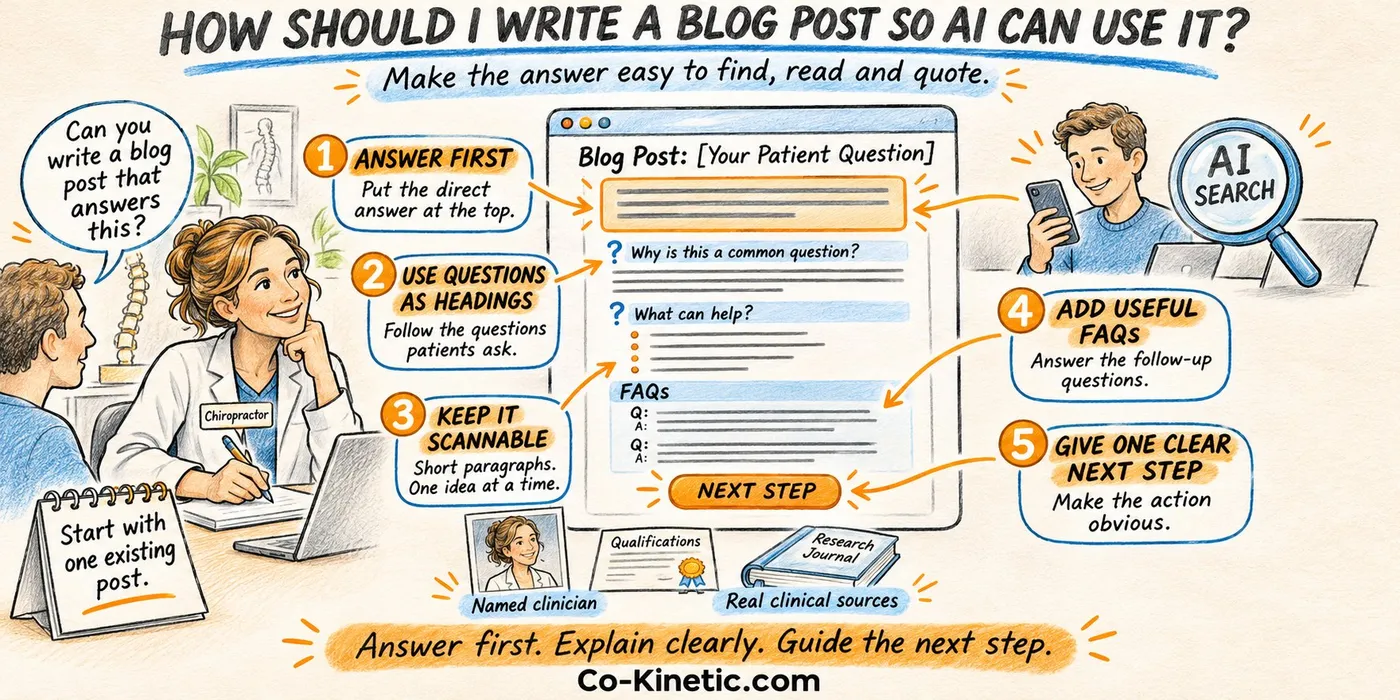
Every blog post you write should include these five elements, in this order:
1. Direct Answer (First 50 Words)
Start with the answer. Not an introduction about why the topic matters. Not a story about a patient you once treated. The actual answer to the question your blog post addresses.
This goes right at the top, immediately after your title.
Why it matters: Patients want the answer first, and AI tools tend to draw on clear answers near the top of a page: one large analysis of 18,012 verified ChatGPT citations, drawn from 1.2 million answers, found 44.2% came from the first 30% of a page (Kevin Indig, Growth Memo, via Search Engine Land, February 2026). Google’s chat-style AI Mode behaves the same way: when Pillarbase analysed 15.7 million AI Mode citations, 80% of the quoted passages put the answer in their first sentence (Search Engine Land, July 2026). Featured snippets on Google often show content from the top of articles too.
If your answer is buried in paragraph six, it’s much less likely to be the part anyone, patient or AI, picks up.
Example:
Bad opening: “Low back pain is one of the most common reasons people seek physiotherapy treatment. In my years of clinical practice, I’ve seen countless patients who could have benefited from earlier intervention…”
Good opening: “Most episodes of low back pain settle within a few weeks. The key is getting the right advice early, staying active within comfortable limits, and following a structured exercise programme.”
That’s it. Two sentences. Direct answer. Expand later in the post.
2. Question-Based Headings
Your H2 and H3 headings should be actual questions that patients ask.
Instead of “Treatment Options”, write “What are the most effective treatments for low back pain?”
Instead of “Recovery Timeline”, write “How long does it take to recover from a rotator cuff injury?”
Why it matters: This matches how people search. When someone asks ChatGPT or Google a question, they’re looking for content that addresses that exact question. Question-based headings signal that your content provides the answer. Questions are also where Google most often shows an AI answer: a Washington University in St Louis study of 55,393 Google searches in spring 2026 found AI Overviews on 65% of question-style searches, against 9.5% of other searches (Montgomery, Iqbal and Xu, September 2026). And in the Pillarbase study above, passages led by a question were reused about twice as often.
Where to find these questions:
- Google’s “People Also Ask” section
- Your own patient consultations, what do patients actually ask? (Sometimes the answer is quite literally right in front of us!)
- AI tools themselves: ask ChatGPT what patients commonly ask about a condition, then check the answers against your own experience
- Google autocomplete suggestions
Write these questions down as you encounter them. Use them as headings in your blog posts.
3. Short, Scannable Paragraphs
Keep paragraphs to 2-3 sentences maximum. Use bullet points when listing information. Add plenty of white space.
Why it matters: People scan content. They’re looking for the specific information they need. If they have to read through dense paragraphs to find it, they’ll leave.
Clear structure also makes it easier for AI tools to pick out the right passage. Bullet points, numbered lists, and short paragraphs are easier to extract.
Formatting that works:
- Use bullet points for lists of symptoms, treatment options, or exercises
- Use numbered lists for step-by-step processes
- Bold key phrases (sparingly)
- One idea per paragraph
- Short sentences
4. FAQ Section
Include an FAQ section at the end of every blog post. Address 3-5 common questions related to your topic.
Each question should be formatted as an H3 heading. Each answer should be 40-60 words and stand alone without relying on other sections for context.
Why it matters: An FAQ section answers the follow-up questions patients actually have, in a form they can scan, and each answer makes sense on its own wherever it’s read. Nobody can promise an FAQ gets a page cited, but answering patients’ real questions clearly is never wasted.
FAQ sections are one of the most useful, lowest-effort additions you can make for your readers. Do it for them, not for a search feature: Google stopped showing FAQ rich results in May 2026 (more in our May 2026 AI search update).
Example FAQ questions for a post about knee pain:
- Do I need an MRI for knee pain?
- How long should I rest a painful knee?
- When should I see a physiotherapist for knee pain?
- Can physiotherapy help with arthritis in the knee?
- What exercises should I avoid with knee pain?
5. Clear Next Step
End with one clear action the reader should take.
Not multiple options. Not “contact us or download our guide or book an appointment or follow us on social media.”
One action.
Examples:
- “Book an assessment to address your shoulder pain”
- “Download our guide to managing low back pain at home”
- “Call us on [number] to discuss your knee injury”
Make it specific. Make it obvious. Make it easy.
The Template
Here’s the structure to follow for every blog post:
Title: Question-based (e.g., “How Long Does Physiotherapy Take for a Frozen Shoulder?”)
Opening (50 words): Direct answer to the title question
Section 1 (H2 question): “What causes [condition]?”
- Short answer first
- Expand with detail
- Use bullet points if listing multiple causes
Section 2 (H2 question): “How does physiotherapy help with [condition]?”
- Short answer first
- Explain treatment approach
- Mention what to expect
Section 3 (H2 question): “How long does treatment take?”
- Short answer first
- Explain variables
- Set realistic expectations
Section 4 (H2 question): “What can I do at home?”
- Short answer first
- List specific exercises or strategies
- Safety considerations
FAQ Section (H2):
- H3 question 1 with 50-word answer
- H3 question 2 with 50-word answer
- H3 question 3 with 50-word answer
- (3-5 questions total)
Clear Call-to-Action:
- One specific next step
- Contact information if relevant
Author Bio:
- Your name and qualifications (here’s what a good clinician bio page includes)
- Clinic name and location
- Brief expertise statement
What About Length?
Aim for 800-1,200 words for most topics. Some topics need more depth. Some need less.
Focus on answering the question thoroughly, not hitting a word count. Length on its own doesn’t win AI citations: Ahrefs’ study of 560,346 AI Overviews and 1.68 million cited pages (December 2025) found almost no link between word count and being cited, and 53.4% of citations went to pages under 1,000 words (Ahrefs, December 2025).
If you can answer the question well in 600 words, stop at 600 words. If you need 1,500 words to cover it properly, use 1,500 words.
Common Mistakes to Avoid
Starting with a story: Get to the point. Answer the question. Stories can come later if they’re relevant.
Vague headings: “Treatment Overview” doesn’t help. “What are the most effective treatments for plantar heel pain?” does.
Burying the answer: If someone has to scroll past three paragraphs to find the actual answer, they’ll leave.
Writing for search engines instead of patients: Use natural language. Write the way you’d explain something to a patient in your clinic. In the KDD 2024 research above, keyword stuffing, the old SEO shortcut, didn’t help, and in some tests it made things worse.
Forgetting the FAQ section: It takes 10 minutes to add and answers the questions patients would otherwise have to go elsewhere for.
Start With One Post
If you’re looking at your existing blog and feeling overwhelmed, start with one post.
Pick your most-visited blog post (check Google Analytics). Restructure it using this template:
- Add a direct answer at the top
- Change headings to questions
- Add an FAQ section
- Check that paragraphs are short
- Add a clear call-to-action
That’s one post updated. Then do another. Then another.
You don’t need to rewrite your entire blog in one weekend. Start with the posts that get the most traffic. Improve those first.
Quick Reference Checklist
Use this before publishing any blog post:
- Title is a question patients actually ask
- Opening 50 words answer the question directly
- H2 and H3 headings are question-based
- Paragraphs are 2-3 sentences maximum
- Bullet points used where appropriate
- FAQ section included (3-5 questions)
- Each FAQ answer is 40-60 words and standalone
- Clear call-to-action at the end
- Author bio with qualifications included
- Clinical claims backed by sources you’d be happy for a patient (or a colleague) to check
- Post is 800-1,200 words (unless topic requires more/less)
I’ve turned this into a Canva template you can grab here. Download it, tweak it to match your branding, stick it on your desktop.
What This Actually Achieves
Blog posts structured this way are built to work in:
- Traditional Google search results
- Featured snippets (position zero)
- Google’s “People Also Ask” boxes
- AI-generated answers (ChatGPT, Perplexity, Google AI)
- Voice search results
They’re easier to read, easier to extract information from, and give the substance inside them the best chance of being picked up as a source.
Most importantly, they actually help patients find the information they need. Which is the point.
Tor
P.S. The structure matters more than you think. I’ve seen identical content perform differently based on structure alone. Put the answer at the top. Use question-based headings. Add FAQs. Then make sure what’s underneath is worth finding.
Related reading
- Which Pages on My Clinic Website Actually Bring In Patients?: stop spending hours on content nobody reads: the few pages that bring in most of your patients, and what to write first.
- Why Isn't AI Picking Up My Blog Posts?: if you've been writing short blog posts, this explains why AI skips them, and what a page needs so AI uses it.
- Does My Clinic Website Need an FAQ Section?: one of the quickest wins on your website this week: answering the questions patients actually ask, so your pages become the ones AI quotes.
- What Should Go on My Clinicians' Bio Pages?: your clinicians' experience is wasted if patients and AI can't see who wrote your pages. This shows exactly what a bio and byline need, so their expertise counts.
References
- KFF. KFF Health Misinformation Tracking Poll: artificial intelligence and health information. August 2024. www.kff.org/public-opinion/kff-health-misinformation-tracking-poll-artificial-intelligence-and-health-information/
- KFF. KFF Tracking Poll on Health Information and Trust: use of social media and AI for health information and advice. 2,480 US adults, fieldwork 7 to 31 May 2026. 17 June 2026. www.kff.org/public-opinion/kff-tracking-poll-on-health-information-and-trust-use-of-social-media-and-ai-for-health-information-and-advice/
- YouGov. Survey of 2,100 UK adults on AI and health information (fieldwork 13 to 14 July 2026). July 2026. yougov.com/en-gb/articles/55203-ai-is-becoming-part-of-uk-adults-health-information-journey
- Aggarwal P, et al. GEO: Generative Engine Optimization. KDD 2024 (Princeton University and IIT Delhi); benchmark of 10,000 queries across 25 domains. arxiv.org/abs/2311.09735
- Kevin Indig, Growth Memo, summarised by Search Engine Land. Analysis of 18,012 verified ChatGPT citations from 1.2 million answers. 18 February 2026. searchengineland.com/chatgpt-citations-content-study-469483
- Pillarbase, reported by Search Engine Land. Analysis of 15.7 million Google AI Mode citations. July 2026. searchengineland.com/what-15-7-million-ai-mode-citations-reveal-about-getting-quoted-by-google-483393
- Montgomery, Iqbal and Xu, Washington University in St Louis. Measurement study of 55,393 Google searches and 61,212 AI Overview citations (13 March to 21 April 2026). Published 2 September 2026; forthcoming at the ACM Internet Measurement Conference, October 2026. Preprint arXiv:2605.14021. https://arxiv.org/abs/2605.14021
- Ahrefs. Short vs long content in AI Overviews (560,346 AI Overviews, 1.68 million cited URLs). December 2025. ahrefs.com/blog/short-vs-long-content-in-ai-overviews/
?Frequently Asked Questions
Why is blog structure important for physiotherapy topics?
Blog structure is crucial because it helps both patients and AI tools find relevant information quickly. A well-structured post increases the likelihood of appearing in search results and ensures that readers can easily extract answers.
What are the five essential elements of a blog post?
The five essential elements include a direct answer at the beginning, question-based headings, short and scannable paragraphs, an FAQ section, and a clear next step for the reader.
How can I create effective question-based headings?
To create effective question-based headings, consider what patients commonly ask about a topic. Use resources like Google’s 'People Also Ask' section and AI tools to identify these questions and incorporate them as headings.
What should I include in the FAQ section of my blog post?
The FAQ section should address 3-5 common questions related to your topic, formatted as H3 headings with concise answers of 40-60 words each. This section enhances the post's value and helps answer potential patient queries.
How can I ensure my blog posts are suitable for voice search?
To optimize for voice search, structure your content around direct answers to questions people might ask verbally. Use clear, conversational language, and ensure key information is presented at the top of the post.