
What Should Go on My Clinicians' Bio Pages?
What a proper clinician bio page and byline need to include, from registration links to specialisms, and why patients and Google's own quality guidance care who wrote a health page. For clinic owners whose team pages are a name and a photo.
Reviewed and updated: November 2026
If you want patients to trust what they read on your clinic's website, one of the most important things you can do is make sure the people behind your content are properly visible: named, credentialled, and linked to a bio page that shows their clinical experience.
That's not a minor technical detail. It sits at the heart of Google's own quality guidance, known as E-E-A-T: Experience, Expertise, Authoritativeness, and Trustworthiness (in plain words: who wrote this, have they really done it, and can I trust them?). Google holds health content to the highest standard because bad health advice causes real harm, and right now most MSK clinic websites fall well short of it.
The fix is specific and practical. Here's what it involves, and why getting it right matters so much to the patients deciding whether to book with you.
Why Author Attribution Is the Biggest Gap on Most Clinic Websites
When a patient lands on your knee pain page, often after Google or an AI tool has pointed them there, they ask: who wrote this? Are they qualified? Can I check that? Does this clinic really know this condition?
If your content has no author name, no credentials, and no link to a verifiable bio, they have no way to answer those questions. So they move on to a clinic that does. Google's own guidance asks exactly the same question: is it "self-evident to your visitors who authored your content"?
We've now assessed more than 200 MSK clinic websites, and missing authorship is the gap we see most often. The reason is almost always the same: there's no named author on their content, no credentials visible, no bio page worth speaking of. Practitioners with real qualifications, real experience, and real clinical authority are essentially invisible on their own websites, just when their years in practice could be their biggest advantage online.
In our research-grounded quality checklist, every page's grade starts with the author: a page can't reach an A or B without a named author. That reflects how much it matters to patients, and to Google's guidance on health content.
The Two Things You Need to Get in Place
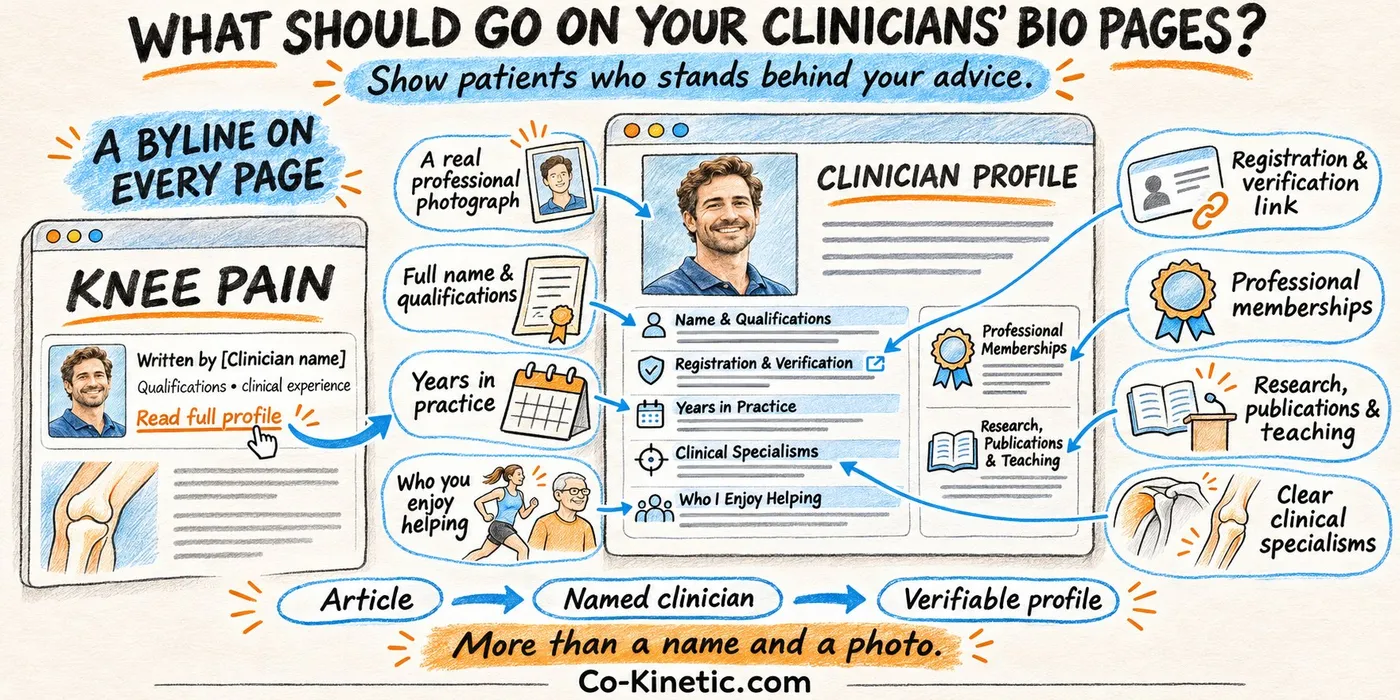
This isn't complicated, but it does require doing it properly. There are two distinct components that work together: a full bio page is the destination, and the byline on each piece of content is the link that gets your reader there.
1. The Author Bio Page
Your author bio page is not the same as your team page. Most clinic websites have a team page with a headshot, a name, and a paragraph that reads something like 'Sarah qualified from X University in 2012 and has a passion for helping patients return to sport.' That's not an author bio page. That's a placeholder.
A proper author bio page is a dedicated, detailed, publicly accessible page that exists specifically to establish your clinical authority. A patient follows the link in your content byline, lands on this page, and finds everything they need to decide whether to trust the content you wrote. (Your web person can also add schema, hidden labels that tell search engines this page is about a person and their qualifications. It's tidy practice, but the words on the page matter far more.)
Here's what it needs to contain:
Full name and primary qualifications
Your full professional name, exactly as it appears on your HCPC or GOsC registration, followed immediately by your qualifications: BSc, MSc, MCSP, HCPC, or equivalent. These aren't just letters after your name; they tell patients at a glance that you're properly trained and regulated.
Example: Sarah Mitchell BSc (Hons) Physiotherapy, MSc Sports Rehabilitation, MCSP, HCPC Registered
Professional registration number with a verification link
This is the step most clinic owners skip, and it's one of the most powerful trust signals available. Include your HCPC registration number and link directly to the HCPC register so anyone can verify it in one click. The same applies to GOsC for osteopaths or any other relevant regulatory body in the country in which you work.
Why does this matter so much? Because it converts a claim into a verifiable fact. Any clinic can say their practitioners are qualified. Only a genuinely qualified practitioner can point to a live registration record. That's exactly the kind of accountability that earns trust, and Google's guidance calls trust the most important part of E-E-A-T.
Example: HCPC Registration: PH012345 — Verify on the HCPC Register [link]
Years of experience
Be specific rather than vague, not 'over a decade of experience', but exactly how many years you've been in practice and, where relevant, how long you've been specialising in a particular area. Specificity signals confidence and authenticity in a way that vague language simply doesn't.
Example: Sarah has been practising physiotherapy for 14 years, with the last eight years focused specifically on post-surgical rehabilitation and complex knee conditions.
Your specialism, defined clearly
If you have a clinical focus, say so explicitly. Patients, and the AI tools they ask, are trying to match a specific problem to the right person. A practitioner whose bio page clearly states their specialism in shoulder rehabilitation gives them something to match to a shoulder question that a 'general physiotherapist treating a wide range of conditions' never will. Both may be equally skilled. Only one is giving the AI something useful to work with.
Professional affiliations and memberships
This includes Chartered Society of Physiotherapy membership, PhysioFirst, any specialist interest groups, and postgraduate training bodies. These affiliations add a layer of third-party validation that carries real weight in E-E-A-T terms, so include them with links where possible.
Any research, publications, or teaching
Have you contributed to a journal? Presented at a conference? Delivered CPD training? Lectured at a university? All of these count as authoritativeness signals. You don't need to be an academic researcher, and even a single contribution to a professional publication, or a guest lecture, is worth including. Most practitioners have more here than they realise once they sit down and think about it.
A real professional photograph
Not a stock image or a cropped group photo, but a proper professional headshot. A real photograph builds the kind of personal credibility that supports a booking decision: patients like to see who they'll be meeting.
The kinds of patients you enjoy working with
This is the element most people wouldn't think to include, but it does real work. It personalises your profile in a way that no list of qualifications can. It also helps the AI understand your clinical identity at a more nuanced level, which matters for matching you to specific query types.
Example: Sarah particularly enjoys working with post-partum women managing musculoskeletal pain, returning runners after lower limb injury, and older adults looking to stay active and independent.
The more a patient can find on your bio page, the more reason they have to trust you, and right now it's an afterthought on most clinic websites when it needs to be a core trust-building asset.
2. The Author Byline: The Link That Connects Everything
Every single piece of content on your website needs an author byline: every blog post, every condition page, every treatment page, every service page. Without a byline, the content is anonymous, and anonymous healthcare content gives patients no reason to trust it.
A byline isn't just a name. It needs to do three things: identify the author by name, state their key credentials, and link through to the full bio page. That link is what gives your reader everything on the bio page. Without it, the byline is decorative. With it, it's a trust chain.
Weak byline: Written by Sarah Mitchell
Strong byline: Written by Sarah Mitchell BSc (Hons), MSc, MCSP, HCPC Registered Physiotherapist. Sarah has 14 years of clinical experience specialising in post-surgical rehabilitation. [Read Sarah's full profile [hyperlink]]
The strong version gives a patient everything they need to start trusting you; the weak version gives them nothing.
Where should the byline appear? Directly below the article title, before the content begins, not at the bottom of the page. Patients decide very quickly whether to trust a page, so your author attribution needs to be right at the top, where they'll see it straight away.
Why Generic Content Is Now Genuinely Risky for Healthcare Clinics
If you're using a content agency, a freelance writer, or an AI tool to produce blog posts that go out without a named, credentialled clinician as the author, you're not just missing an opportunity. You're giving patients less reason to trust your clinic, and in the case of health-related content, you may be falling short of the trust standards that Google's quality guidelines describe.
Healthcare is classified as YMYL content, meaning 'Your Money or Your Life'. The standard of proof required is significantly higher than for almost any other content type. An uncredentialled blog post about managing lower back pain is judged against a much harsher standard than an uncredentialled blog post about managing a restaurant booking. Google's guidance is explicit that the bar is highest for health topics.
And the stakes are rising, because patients are already putting their health questions to AI and trusting what comes back. Deloitte's survey of 4,156 UK adults (May 2026) found that 63% have used generative AI, a quarter of those users have asked it for health advice, and 38% of those believe the health information it gives is always accurate. When an AI answer sends a patient to your page, a named, registered clinician is what tells them a real professional stands behind it.
The flip side is useful to know too. If you do get your author attribution right, for example, if your content is clearly written by a named, HCPC-registered physiotherapist with a detailed bio page linked from every article, you stand apart from the generic health websites, AI content farms, and marketing agency blogs competing for the same patients. And when that named clinician adds what generic sites can't, their own clinical insight backed by real sources, that's the kind of content the research does link to AI visibility: peer-reviewed research from Princeton and IIT Delhi (presented at KDD 2024, a leading data-science conference) tested 10,000 search queries across 25 subject areas, including health, and found that adding expert quotations lifted a page's visibility in AI-generated answers by around 27 to 28%, statistics by 25 to 26% and cited sources by 24 to 25%, with gains of up to 40% in the best cases. Your clinical credibility is your advantage. The question is whether you're making it visible.
What to Do This Week
On the visibility assessments we run, missing authorship is the gap we see most often. Most blog posts don't even have an author name on them, let alone credentials or a link to a professional registration body.
To make fixing this as easy as possible, I have built a 'Golden Profile'. This is the gold standard of exactly what your author bio page needs to look like to build immediate trust with patients and meet what Google's quality guidance asks for.
Instead of trying to figure it out from scratch, just click the link below to view the Golden Profile. You can use it as a direct template for your own site, making sure you hit every critical trust signal we have talked about, from your verification links to your specific clinical interests.
Get this right, and you will immediately put yourself ahead of the vast majority of clinics out there.
With warm wishes,
Tor
Related reading
- Did You Know Experienced Clinicians Now Have a Superpower?: you've spent years losing out online to clinics with slicker social media. Now the tables have turned: Google and AI tools are looking for exactly what you have, real clinical experience. This shows why you now have the upper hand, and how to get your experience written down and visible so you use it.
- Why Do Google and AI Trust Some Clinics More Than Others?: why Google and AI trust some clinics' pages and not others, and the simple changes that put your team's experience and credentials where they can see them.
- Am I Too Old for All This AI Stuff? (Or Can I Just Ignore It?): if you've watched marketing fads come and go, this is the honest answer to whether you can sit this one out, and why your years in practice put you ahead if you don't.
- Why Can't I Just Use ChatGPT to Write My Clinic's Articles?: before you write another page with ChatGPT: the seven things it can't do for your clinic, from knowing which pages will move the needle to getting the references right, and why content that sounds like everyone else's leaves your chance of being found to pot luck.
References
- Google Search Central, Creating helpful, reliable, people-first content, accessed November 2026. https://developers.google.com/search/docs/fundamentals/creating-helpful-content
- Deloitte UK, Digital Consumer Trends, press release (4,156 UK adults), 6 July 2026. https://www.deloitte.com/uk/en/about/press-room/digital-consumer-trends-over-a-third-of-consumers-believe-gen-ai-health-advice-is-always-accurate.html
- Aggarwal P. et al., Princeton University and IIT Delhi, GEO: Generative Engine Optimization, KDD 2024, 2024. https://arxiv.org/abs/2311.09735
?Frequently Asked Questions
What is the importance of an author bio page on a clinic website?
An author bio page shows patients who wrote your content and why they should trust it: their qualifications, registration, experience and the conditions they know best. Google's own quality guidance asks whether it is clear who wrote a page, with the highest bar for health topics, so a good bio page helps on both counts.
How can I improve my clinic's visibility through E-E-A-T?
E-E-A-T stands for experience, expertise, authoritativeness and trust: Google's way of describing what good health content shows. Make sure every page has a named author, their credentials and a link to a detailed bio page, so patients can see a real, qualified clinician stands behind it.
What key elements should be included in an author bio page?
An author bio page should include the author's full name, professional qualifications, registration number with a link to the register, years of experience, specialisms, professional memberships, any research or teaching, the kinds of patients they enjoy working with, and a real professional photograph. Together these help patients understand who they will be seeing and why to trust them.
What is a strong author byline, and why is it important?
A strong author byline names the author, states their key credentials, and links to their full bio page. It matters because it connects the content to a qualified, accountable person, which is what patients look for and what Google's guidance asks for in health content.
What are the risks of using generic content on a healthcare clinic website?
Health content is what Google calls YMYL (Your Money or Your Life), held to the highest trust standard. Generic content with no named, qualified author gives patients little reason to trust it and may fall short of Google's quality guidance, which makes it harder for patients to choose you.
How can I start improving my clinic's author attribution this week?
Start by reviewing your existing team and bio pages, then create a detailed bio page for each clinician who writes for you. Then add a strong byline to every piece of content, with the author's name, qualifications and a link to their bio page, placed at the top where patients see it first.