
Which Pages on My Clinic Website Actually Bring In Patients?
Which pages on a physio clinic website actually bring in patients, and what to prioritise when time is short. For clinic owners who want to stop wasting hours on content nobody needs.
Reviewed and updated: November 2026
Most physiotherapy clinics waste time on content that doesn’t bring in patients. They write loads of blog posts, update their social media regularly, and still wonder why the phone isn’t ringing.
The truth is simpler: 20% of your website content will drive 80% of your results. Focus on that 20%, get it right, and you’ll see more impact than trying to maintain 50 mediocre pages.
(Pareto’s 80:20 Law is tried and tested, apply it to everything you can!)
Here’s what actually matters.
The Pages That Actually Drive Results
Not all website pages are equal. Some bring in patients. Others just sit there.
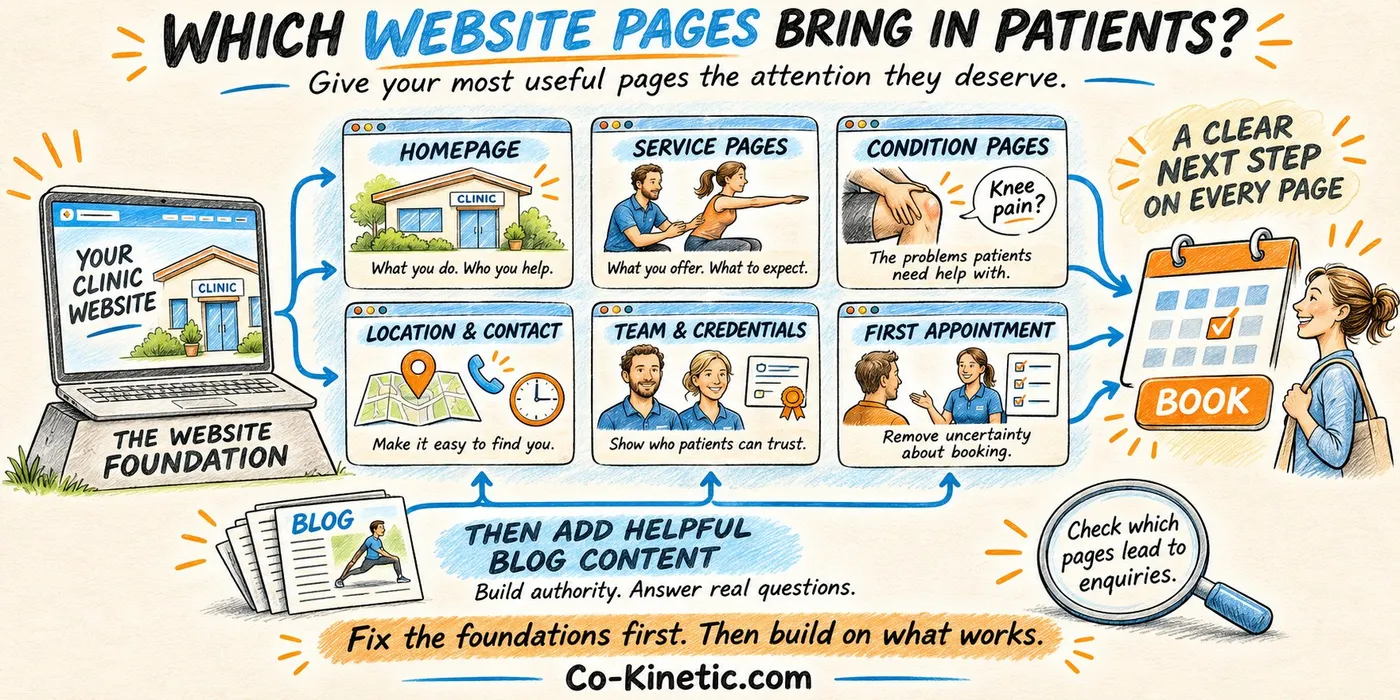
Your Homepage
This is where most visitors land. It’s also where most clinics mess up by trying to say everything at once.
Your homepage needs three things (there’s a fuller, prioritised list in what a clinic homepage needs):
What you do. Not what physiotherapy is. What your clinic does. “We treat sports injuries, post-surgical rehabilitation, and chronic pain in Manchester” is better than “We provide evidence-based physiotherapy care.”
Who it’s for. Be specific. “We work with runners, weekend athletes, and active adults recovering from injury” tells people whether you’re right for them.
How to book. Phone number at the top. Booking button that’s actually visible. Don’t hide this in a dropdown menu. (A buried booking button is one of the six visibility mistakes I see on nearly every clinic website.)
Everything else is optional. Awards, team photos, your treatment philosophy, these are nice but they don’t book appointments. The three essentials do.
Your Service Pages
These are your money pages. People searching for “sports injury physiotherapy Manchester” or “post-surgical rehab near me” land here. If these pages don’t convert, nothing else matters.
Each service page needs:
Clear description of what the service is. Not marketing language. Plain explanation of what you do and who it helps.
What to expect. What happens in the first appointment? How long does treatment take? What should patients bring?
Credentials that matter. Your qualifications, yes, but also relevant experience. “I’ve worked with 200+ runners recovering from stress fractures” means more than listing every CPD course you’ve attended.
How to book. Again. Every page needs this.
Honest expectations. Not “we achieve excellent results.” Explain what care usually involves: how many sessions a plan typically includes, what you’ll work on together, and what affects recovery. Specifics build trust, but never promise an outcome or a timescale.
You need one service page for each major treatment area you offer. Sports injuries, post-surgical rehab, chronic pain management, women’s health, whatever makes up the bulk of your appointments.
Don’t create 20 service pages for every minor variation. You’ll spread yourself thin and dilute your message.
Your Location/Contact Page
This matters more than most clinics realise. It’s one of the ways Google, AI tools and patients confirm you’re a real clinic in a real place.
Must-haves:
Full address. Not just “Manchester.” The complete address with postcode.
Phone number. The one patients actually ring, not your mobile that you forget to check.
Opening hours. Accurate and current. If you close at 6pm on Thursdays, say so.
Parking information. Where to park, whether it’s free, how to find the entrance. Patients need this.
Map. Embedded Google Map showing your location.
How to find you. Nearest tube station, bus routes, landmarks. Make it easy.
This page does heavy lifting for local search. Get it right once. Update it when things change. Done.
Content That Converts vs Content That Educates
There’s a difference between content that brings in patients and content that just gets read.
Content That Converts
Service pages. These describe what you offer. “Sports Injury Physiotherapy” or “Post-Surgical Rehabilitation”. They answer “What services does this clinic provide?”
Condition pages. These explain how you treat specific problems. “ACL Reconstruction Rehabilitation” or “Frozen Shoulder Treatment”. They answer “Can this clinic fix my specific problem?”
Local pages. Your location/contact page, plus service pages that mention location. “Physiotherapy in Chorlton” or “Sports Injury Clinic Didsbury”. They answer “Is this clinic near me?”
First appointment information. What happens in your initial assessment. This removes barriers for people considering booking. Answers “What actually happens if I book?”
All of these answer the question “Should I book an appointment at this clinic?” They provide the information someone needs to make that decision.
Content That Educates
Main topic pages. Comprehensive guides to broad topics like “Low Back Pain” or “Shoulder Injuries”. These are the hub of your educational content.
Specific topic pages. Focused articles around each main topic, like “Low Back Pain in Pregnancy” or “Shoulder Pain in Swimmers”. These are the spokes.
Individual blog posts. Articles about conditions, treatment approaches, exercises, prevention advice. “What causes tennis elbow?” or “5 exercises for low back pain”.
General health information. Broader content about staying active, injury prevention, movement. “Benefits of strength training” or “How to avoid running injuries”.
Educational content isn’t worthless. It builds authority, and it’s what AI tools draw on when patients ask about their symptoms, which is increasingly where a patient’s journey starts: YouGov’s July 2026 survey of 2,100 UK adults found 16% had used AI to understand symptoms and 16% to research a condition (YouGov, July 2026). But on its own it doesn’t bring in patients the way converting content does.
The 80/20 principle: spend 80% of your time on converting content, 20% on educational content.
For more on organising your educational content effectively, see the guide “Should You Write About Every Condition You Treat?” which covers the main page and specific page structure in detail.
What to Prioritise When Time Is Limited
You’re running a clinic. You don’t have 20 hours a week for content creation. Here’s the priority list.
Priority 1: Get Your Core Pages Right
Before you write a single blog post, make sure these pages exist and work:
- Homepage (clear, specific, easy to book)
- 3-5 service pages (one for each major treatment area)
- Location/contact page (complete and accurate)
- About page (team qualifications, why patients should trust you)
These are the foundation. Get them right first. Everything else builds on this.
Priority 2: Create Condition Pages for What You Treat
These are your highest-return pages. They target people actively looking for treatment for a specific problem. They’re also exactly the searches where Google now puts an AI answer at the top: by December 2025, BrightEdge found AI Overviews on 100% of the healthcare treatment searches it tracks in the US, 98% of pain searches and 93% of symptom and condition searches (BrightEdge, 2026). A clear, specific condition page gives that answer something good to draw on.
The difference from service pages: Service pages describe what you offer (sports injury physiotherapy, post-surgical rehab). Condition pages describe specific problems you fix (ACL reconstruction rehabilitation, frozen shoulder treatment, runner’s knee).
Start with conditions you treat most often. If half your patients come in with low back pain, you need a comprehensive low back pain page. If you see lots of runners with knee problems, create a page about runner’s knee.
Aim for 5-10 of these. Cover your most common conditions. Make each one comprehensive. Don’t rush to create 30 mediocre pages.
These pages work differently from the blog content structure covered in Priority 3 below. Condition pages are standalone treatment pages that rank for “how to fix X” searches. They’re about bringing in patients who have that specific problem.
Priority 3: Organise Your Blog Content Properly
Once your service pages and condition pages are solid, organise your blog content using the main page and specific page structure.
This is different from the pages above. This is about organising educational content, advice, and detailed information into a structure that works well for search engines and AI tools.
I’ve written a separate guide on this: “Should You Write About Every Condition You Treat?” Read that for the full explanation of main pages and specific pages.
Quick summary: Pick 2-3 broad topics (like “Low Back Pain” or “Sports Injuries”). Create one comprehensive main page for each. Then write focused specific pages that cover different aspects (like “Low Back Pain in Runners” or “Low Back Pain During Pregnancy”).
This structure prevents your blog posts from competing with each other and helps patients find the right information for their specific situation.
This takes months to build out. That’s fine. Better to do this properly than rush it.
Priority 4: Add Educational Content
Only after everything above is in place should you start regular blog posts.
Write one good blog post per month. Not weekly. Monthly. Focus on questions patients actually ask. Answer them thoroughly.
Quality over quantity. One excellent 1,500-word article per month beats four rushed 400-word posts.
What Not to Prioritise
Daily social media posts. Unless social media directly brings you patients (and for most physio clinics, it doesn’t), this is a time sink. Post occasionally. Don’t make it your main focus.
Press releases about minor updates. “We’ve updated our logo” isn’t news. Save announcements for things that matter to patients.
Content about every CPD course you attend. Your patients don’t care that you went to a weekend course on dry needling. They care whether you can fix their shoulder.
Elaborate “About Us” pages with your life story. Keep it relevant. Qualifications, experience, why you’re good at what you do. That’s enough.
Blog posts on trending health topics that aren’t relevant to your clinic. Writing about general wellness because it’s popular won’t bring you physio patients.
The Pages That Matter Most for Local Search
If you rely on local patients (and most physio clinics do), these pages drive results:
Google Business Profile. Not technically a website page, but this is crucial. Complete profile. Regular posts. Photos of your actual clinic. Reviews. For “near me” searches Google still shows the map and local listings rather than an AI answer: BrightEdge’s tracking found AI Overviews on healthcare “near me” searches fell from 100% in December 2023 to between 0% and 14% through 2024 and 2025. When a patient is ready to book, your profile is still what they see.
Location page. As covered above. Full address, hours, parking, map.
Service pages with location mentions. “Sports Injury Physiotherapy in Manchester” not just “Sports Injury Physiotherapy”.
Staff pages with locations. “Sarah Thompson, Physiotherapist in Didsbury” helps with local search for your specific area.
Blog posts about local topics when relevant. “Preparing for the Manchester Marathon” or “Best Running Routes in South Manchester (and How to Avoid Injuries)” can attract local traffic. Do this occasionally, not as your main content strategy.
How to Check What’s Actually Working
Most clinics guess at what content works. Stop guessing. Check what’s actually bringing in patients.
What to Look At
Which pages people visit before contacting you. If you have website statistics (ask whoever built your website how to access these), you can see which pages people view before filling out your contact form or booking online.
Which pages people look at before ringing. Ask new patients how they found you. “I saw your page about ACL rehabilitation” tells you that page works. Keep a simple tally for a month.
Which pages get visitors. If you have access to your website stats, see which pages people actually visit. High traffic doesn’t always mean bookings, but it shows what patients are looking for.
What comes up when people search for you. Google your clinic name plus common searches like “physiotherapy [your area]” or “sports injury [your town]”. See what pages appear. These searches bring in patients who are ready to book.
What AI tools say when patients ask. More patients now describe their problem to ChatGPT or Google’s AI answers and ask who to see: Deloitte’s May 2026 survey of 4,156 UK adults found a quarter of people who use generative AI have asked it for health advice (Deloitte, July 2026). Try a few of your patients’ questions yourself, or run our free AI visibility check, which tests real patient questions across ChatGPT, Google AI Overviews, Perplexity and Claude, and your report arrives by email, usually within the hour.
What to Do With This Information
Double down on what works. If your ACL rehabilitation page brings in patients, make it even better. Add more detail. Answer more of the questions patients ask you about it: Ahrefs’ 2026 analysis found pages that also rank for the follow-up questions behind a search were 161% more likely to be cited in Google’s AI Overviews (Ahrefs, 2026). Keep it up to date.
Improve underperforming pages. If a page gets visitors but no enquiries, something’s wrong. Usually it’s unclear what to do next or doesn’t build enough trust. Fix these issues.
Stop investing in what doesn’t work. If you’ve been writing blog posts about general health topics for six months and they’ve brought in zero patients, stop. Redirect that time to content that converts.
The Minimum Viable Website
If you’re starting from scratch or have limited time, here’s the absolute minimum:
- Homepage with a clear description of what you do, who you help, and how to book.
- Three service pages covering your main treatment areas.
- Location/contact page with full details.
- About page with team qualifications.
That’s it. Four pages. Get these right and you have a functioning website that can bring in patients.
Everything else is optimisation. Important, yes. But not essential on day one.
Common Questions About Website Content
How many pages should my website have?
Start with 10-15 core pages (homepage, services, conditions, about, contact). Then add 1-2 pages per month as you build out your content. For most physio clinics, 30-50 strong pages will do more than 200 thin ones.
Should I write blog posts if my core pages aren’t finished?
No. Finish your service pages and condition pages first. These bring in patients. Blog posts can wait.
How do I know which service pages to create?
Look at your appointment book. What conditions do you treat most often? Those are your service pages. If 40% of your patients come in with shoulder problems, you need a shoulder pain service page.
Is it worth paying someone to write content for me?
Only if they understand physiotherapy and can write like a physiotherapist, not a marketer. Generic content written by non-specialists rarely converts well. If you outsource, make sure the writer interviews you thoroughly and includes your actual clinical experience.
How often should I update my content?
Core pages (services, conditions): review every 6-12 months. Update when treatment approaches change or you gain significant new experience. Blog posts: less urgent. Update high-traffic posts annually if needed.
Start With What Converts
Don’t get distracted by the idea that you need hundreds of blog posts or daily social media updates.
Focus on the 20% that drives 80% of results:
Pages that bring in patients:
- Homepage that clearly explains what you do and how to book
- Service pages (what you offer: sports injury treatment, post-surgical rehab, etc.)
- Condition pages (specific problems you fix: frozen shoulder, ACL rehab, runner’s knee)
- Location/contact page with complete information
Pages that organise your educational content:
- Main topic pages (broad topics like “Low Back Pain” or “Sports Injuries”)
- Specific pages around each main topic (focused articles for different patient situations)
- Individual blog posts that answer patient questions
Get the first group right first. These directly convert visitors into patients.
Then organise your educational content using the second group. This builds your authority and helps specific types of patients find you.
Most clinics do this backwards. They blog regularly whilst their service pages are vague and their contact information is buried in a dropdown menu, which also makes it hard for AI tools to follow the path from symptom to booking.
Fix the foundation first. Everything else is easier after that.
Tor
P.S. The fastest way to waste time on your website is creating content that nobody needs. Before writing anything, ask: “Will this help someone decide to book an appointment?” If the answer is no, don’t write it.
Related reading
- How Do I Know Which Pages My Clinic Should Write Next?: stop guessing what to write: see exactly how a content plan decides which page your clinic should write next, and in what order, from what AI says about you, who it recommends instead and where your pages rank, so every piece you publish has a reason to be there.
- Why Isn't AI Recommending My Clinic?: why most clinic websites are a dead end for AI, and the four page types that let it follow a patient from symptom to booking with you, instead of the clinic down the road.
- Should I Write a Page for Every Condition I Treat?: why a post for every condition can make your own pages compete against each other, and the structure that makes them win together.
- Why Isn't AI Picking Up My Blog Posts?: if you've been writing short blog posts, this explains why AI skips them, and what a page needs so AI uses it.
- How Should I Write a Blog Post So AI Actually Uses It?: a simple template that makes every post you write easier for patients to read and for AI to quote.
- Does My Clinic Website Need an FAQ Section?: one of the quickest wins on your website this week: answering the questions patients actually ask, so your pages become the ones AI quotes.
- Why Can't I Just Use ChatGPT to Write My Clinic's Articles?: before you write another page with ChatGPT: the seven things it can't do for your clinic, from knowing which pages will move the needle to getting the references right, and why content that sounds like everyone else's leaves your chance of being found to pot luck.
References
- YouGov. Survey of 2,100 UK adults on AI and health information (fieldwork 13 to 14 July 2026). July 2026. yougov.com/en-gb/articles/55203-ai-is-becoming-part-of-uk-adults-health-information-journey
- BrightEdge. Healthcare and AI Overviews: three-year evolution, 2023 to 2025 (US, BrightEdge’s tracked keyword set). December 2025 data. www.brightedge.com/resources/weekly-ai-search-insights/healthcare-ai-evolution-google-2023-2025
- Deloitte UK. Digital Consumer Trends press release: survey of 4,156 UK adults aged 16 to 75 (fieldwork 6 to 15 May 2026). 6 July 2026. www.deloitte.com/uk/en/about/press-room/digital-consumer-trends-over-a-third-of-consumers-believe-gen-ai-health-advice-is-always-accurate.html
- Ahrefs. How to rank in AI Overviews: query fan-out and citation analysis. January 2026, updated May 2026. ahrefs.com/blog/how-to-rank-in-ai-overviews/
?Frequently Asked Questions
What is the 80/20 principle in relation to physiotherapy website content?
The 80/20 principle suggests that 20% of your website content will drive 80% of your results. By focusing on the most impactful pages, such as your homepage and service pages, you can significantly improve patient engagement and bookings.
What essential elements should I include on my homepage?
Your homepage should clearly state what your clinic does, specify who your services are for, and provide an easy way for visitors to book an appointment. Avoid clutter and focus on these three key elements to enhance conversion.
How many service pages should I create for my physiotherapy clinic?
It's recommended to create 3-5 service pages that cover your main treatment areas. Each page should focus on a specific service you offer, providing clear descriptions, what to expect, and how to book.
Why is a location/contact page important for my website?
A location/contact page is crucial for local search visibility and helps potential patients verify your clinic's legitimacy. It should include your full address, phone number, opening hours, parking information, and an embedded map to guide patients to your clinic.
Should I prioritize educational content or converting content for my website?
You should prioritize converting content, such as service and condition pages, that directly leads to patient bookings. Educational content can be added later, but it's essential to ensure your core pages are effective first.
How often should I update my website content?
Core pages, such as service and condition descriptions, should be reviewed and updated every 6-12 months, while blog posts can be updated annually if necessary. Regularly checking for accuracy and relevance helps maintain your website's effectiveness.