
Why Can't I Just Use ChatGPT to Write My Clinic's Articles?
Google won't penalise you for using ChatGPT. The real risks are that every clinic gets the same articles, and that a chatbot can't tell you which pages will move the needle. Seven things ChatGPT can't do for your clinic, and what to do instead.
Rewritten and updated: November 2026
You can. Lots of clinic owners already do, and I understand why. Ask ChatGPT for a page on knee pain and you'll have something readable in thirty seconds.
But here's what I've learned from assessing more than 200 clinic websites: writing the page was never the hard part. The hard part is knowing which pages to write, in what order, how they fit together, and making sure every one is unmistakably yours. That's a strategy, and a chatbot can't give you one.
First, the worry most people start with.
Won't Google penalise me for using AI?
No. That was a fear a few years ago, and some agencies still repeat it. Google's guidance is clear: it cares whether a page is helpful, accurate and trustworthy, not how the first draft was typed. What it acts against is low-quality pages churned out to game search results, however they were made.
So the penalty isn't the problem. These seven things are.
1. It doesn't know which pages will move the needle
When you ask ChatGPT for a page, it has no idea:
- what AI tools say about your clinic today, when a patient in your town describes their symptoms and asks who to see;
- which clinics AI recommends instead of you, and what they have that you don't;
- which of your pages rank on Google, and for what;
- what patients in your area actually search for;
- which conditions and services you treat but have no page for.
Without those answers you're choosing topics by gut feel. You end up with twenty blog posts on whatever came to mind, and no proper page for the conditions that bring patients in. You wouldn't treat a patient without assessing them first. Writing content without an assessment is the same: you might get lucky, but you're guessing.
2. It can't build the structure AI looks for
The clinics AI recommends usually have a joined-up set of pages that lets it follow a patient from symptom to booking: a page on the condition, pages on the treatments that help, the service a patient actually books, and blog posts answering the detailed questions in between, all linked together in the right order. (How does AI decide whether to recommend my clinic?)
ChatGPT writes one page at a time. To build that structure it would need to know every page already on your website, what each one covers, and how they link, so the new page fills a gap instead of competing with one you already have. (Should I write a page for every condition I treat?) It doesn't know any of that.
3. It makes your clinic sound like everyone else's
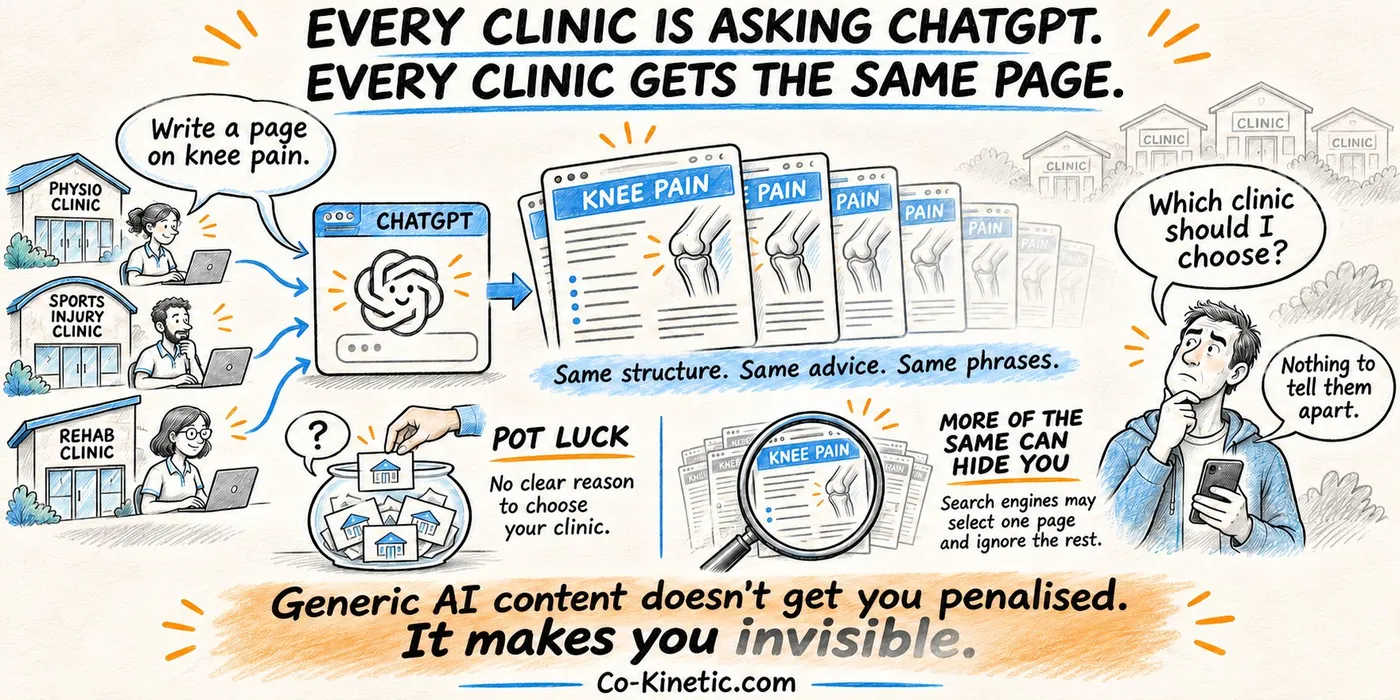
Here's the irony nobody mentions. There are only two or three AI tools most people write with, and ask any of them the same question and you get the same answer, or one so close it makes no difference. That's what they're built to do.
So when every clinic in your town asks ChatGPT for a knee pain page, they all get much the same page. Nothing in it says this clinic, these clinicians, this town.
When a patient asks AI who to see for their knee, it looks across all those pages and finds nothing to choose between them. In the absence of anything that stands out, it goes with the clinic it can establish the most about. If none of them stands out, it's pot luck.
And the more clinics publish the same content, the worse your odds get. Every new identical page is another ticket in the same draw. You can publish fifty articles and be no more likely to be picked than the clinic that published five. Worse, search engines tend to pick one page from a set of near-identical pages and quietly ignore the rest, so a website full of generic AI content can bury the pages that were actually about you. That's what "AI slop" really costs a clinic: not a penalty, but invisibility.
4. It doesn't know your clinicians
What takes you out of the draw is the thing a chatbot has never seen: your clinicians. Their years in practice, the patients they've helped, how they explain a problem, what they're known for locally. AI looks for exactly that kind of real experience when it decides who to trust. A chatbot can't interview your physios, and it can't put their names, credentials and insight into every page. (Experienced Clinicians Now Have a Superpower; What should a clinician's bio page include?)
5. It makes up references
Ask ChatGPT for references and you'll often get studies that don't exist, real papers cited for things they never said, or links that go nowhere. On a health page that's not a small slip: it's the fastest way to lose a patient's trust, and the trust of anyone who checks. Every reference on a clinic page needs to be real, findable and saying what you claim it says.
6. It isn't working from the current evidence
A chatbot writes from what it absorbed in training, which may be out of date and is rarely the best evidence. Good clinical content starts with fresh research into the evidence on that condition, and into the questions patients are actually asking about it, before a word is written.
7. It doesn't sharpen the page to the patient's real question
Generic AI pages start strong and then drift into padding. The pages that get used, by patients and by AI, answer exactly what patients ask, in their words, all the way to the end, and stay within the health advertising rules for your country. (Does my clinic website need an FAQ section?)
If you want to do it yourself, start here
You can absolutely do this yourself. If you do, do it in this order:
- Find out where you stand. Check what AI says about your clinic when patients describe their symptoms. The Free AI Visibility Check does it for you, usually within the hour.
- List what you treat that has no page.
- Build the main pages first: condition, treatment, service, then the blog posts that link to them.
- Put a named clinician's experience into every page.
- Check every reference yourself.
- Re-check what AI says every month, and do more of what moved.
Or let the plan come to you
That's exactly what the Clinical Content System does. It assesses your whole website and what AI says about your clinic, looks at the clinics AI recommends instead and where your pages rank on Google, grades every page, and builds a plan of what to write, for which clinician and in what order, so every new page fits the structure. Then it researches each piece from the clinical evidence and your patients' real questions, writes it from your own clinicians' experience, verifies every reference, and re-measures every four weeks so you can see what changed.
ChatGPT can give you words, and so it can for every clinic down the road. What gets you picked is knowing which pages to write, how they fit together, and making every one of them unmistakably yours.
Start with the question that costs nothing to answer: check whether AI recommends your clinic.
By Tor Davies, former physiotherapist, publisher of Co-Kinetic Journal since 1999.
Related reading
- How Do I Know Which Pages My Clinic Should Write Next?: stop guessing what to write: see exactly how a content plan decides which page your clinic should write next, and in what order, from what AI says about you, who it recommends instead and where your pages rank, so every piece you publish has a reason to be there.
- Which Pages on My Clinic Website Actually Bring In Patients?: stop spending hours on content nobody reads: the few pages that bring in most of your patients, and what to write first.
- Why Isn't AI Recommending My Clinic?: why most clinic websites are a dead end for AI, and the four page types that let it follow a patient from symptom to booking with you, instead of the clinic down the road.
- Should I Write a Page for Every Condition I Treat?: why a post for every condition can make your own pages compete against each other, and the structure that makes them win together.
- Did You Know Experienced Clinicians Now Have a Superpower?: you've spent years losing out online to clinics with slicker social media. Now the tables have turned: Google and AI tools are looking for exactly what you have, real clinical experience. This shows why you now have the upper hand, and how to get your experience written down and visible so you use it.
- What Should Go on My Clinicians' Bio Pages?: your clinicians' experience is wasted if patients and AI can't see who wrote your pages. This shows exactly what a bio and byline need, so their expertise counts.
?Frequently Asked Questions
Will Google penalise my clinic for using AI to write content?
No. Google's guidance says it judges whether a page is helpful, accurate and trustworthy, not how the first draft was written. What it acts against is low-quality pages churned out to game search results, however they were made.
Why does AI-written clinic content all sound the same?
Most people write with the same two or three AI tools, and they give much the same answer to the same question. So every clinic asking for a knee pain page gets much the same page, with nothing in it that's specific to their clinic or clinicians.
What happens when every clinic's content is the same?
AI has nothing to choose between them, so it goes with the clinic it can establish the most about; if none stands out, it's pot luck. Search engines also tend to pick one page from a set of near-identical pages and ignore the rest.
What's the hard part of clinic content, if not the writing?
Knowing which pages will move the needle, in what order, how they fit together on your site, and making each one unmistakably yours with your clinicians' real experience.
Can I use ChatGPT for references on a health page?
Check every one. Chatbots often produce studies that don't exist, or cite real papers for things they never said. Every reference on a clinic page needs to be real, findable and saying what you claim.