
Are You Wasting Your Google Ads Budget?
Why fewer people click Google Ads when AI answers sit at the top of the page, and why a clinic can't buy its way into ChatGPT's or Perplexity's recommendations. For clinic owners wondering whether their ad budget is still working.
Reviewed and updated: November 2026
Here's a question that's worth sitting with for a moment. Of all the people looking for help right now with a problem a physiotherapist or osteopath treats, how many will ever see and click your Google Ad?
Fewer than you might think, and once you understand why, it's quite hard to look at your Google Ads bill the same way again (or it should be at least!).
A growing number of people now start their health questions with an AI tool. In the UK, 8% of adults already say AI is their first port of call for health information (YouGov, July 2026, 2,100 UK adults), and OpenAI says more than 230 million people ask ChatGPT health and wellness questions every week (January 2026). They go straight to ChatGPT, Perplexity, or one of the other AI tools that have become a normal part of how people research their health. They're not making a conscious decision to avoid Google, it's just that asking an AI a question and getting a real, considered answer feels more useful than typing something into a search box and wading through a page of results. So that's what they do. They never see your ad, your listing, nothing.
Most people still use Google too, but they increasingly meet an AI-generated answer at the very top of the page before they see any clinic listings at all. Google calls these AI Overviews, and they're designed to give the searcher what they need without having to click anywhere. In the UK, Ofcom found around 30% of Google searches now carry an AI summary, and 53% of UK adults say they see them often (December 2025). And when one appears, people click far less: Pew Research Center tracked 68,879 real Google searches by 900 US adults in March 2025 and found people clicked a traditional search result on only 8% of visits with an AI summary, against 15% without one, and clicked a link inside the summary itself just 1% of the time. Many get their answer and move on.
Ads feel it too. Seer Interactive's analysis of 25 million search impressions found that on searches showing an AI Overview, the click-through rate on paid ads (the share of people who see an ad and click it) fell 68% between June 2024 and September 2025, from 19.70% to 6.34% (mostly US data).
So after all of that, the group of people who will actually see and click your Google Ad is smaller than it used to be. And the worst thing? Every other clinic in your area with a marketing budget is spending their money chasing exactly the same group.
Have You Noticed Fewer People Finding You Online Lately?
If the answer is yes, this is very likely part of the reason. It's not a sudden drop that you can point to, more of a slow bleed over the past 12 to 18 months that's easy to put down to seasonality or a quiet patch. But it's not a quiet patch. It's a structural shift in where people are going to find the answers to their health questions, and it's been building steadily while most clinic owners have carried on renewing their Google Ads contracts and hoping things pick up.
More and more of the people who would previously have typed "physio for back pain in [your town]" into Google and found you are now asking ChatGPT "what's the best treatment for lower back pain and who should I see near me?" They're getting a detailed, personalised answer. And unless your clinic has the kind of online presence that an AI considers authoritative and credible, your name isn't coming up in that answer. Someone else's is.
This isn't about Google becoming less useful overnight. It's about a gradual shift in patient behaviour that's quietly redistributing who gets found and who doesn't, and most clinics haven't adjusted for it at all.
Can You Buy Your Way Into AI Recommendations the Way You Can With Google?
So this might be a follow up question: "If patients are using AI tools to find healthcare providers, surely the platforms will start selling advertising space the same way Google did?"
Well some have tried, because the pressure on these AI platforms to generate revenue is, and will continue to be, high. ChatGPT began showing ads in 2026, but OpenAI's advertising policy (updated 4 June 2026) says ads from clinical care providers are "currently disallowed", and ads are kept away from conversations about personal health. For anything touching health, the platforms are being much more cautious, and rightly so.
Perplexity's experience is probably the most instructive here. They started showing sponsored answers in November 2024 and abandoned advertising in February 2026. The reason they gave was simple and quite telling: trust. As a Perplexity executive told the Financial Times (reported by Campaign, February 2026), "A user needs to believe this is the best possible answer." The entire value of an AI recommendation, the reason patients act on it so readily, is that it feels impartial. The moment users started sensing that results might be influenced by who had paid for placement, that feeling evaporated. Perplexity decided that protecting trust was more important than the revenue, and they scrapped the ads.
That decision tells you something important about how these platforms understand their own value. They know that the moment they start selling recommendations, the recommendations become worth less. So for now, a clinic can't buy its way into ChatGPT's or Perplexity's answers. Google is starting to show ads in its AI search, but they're labelled and kept apart from the answer. Being recommended inside the answer is earned, not bought.
Why Does That Actually Matter for How Many Patients Book With You?
It matters because trust is the thing that converts a curious person into a booked patient, and AI recommendations carry a level of trust that paid advertising simply can't replicate.
When a patient asks ChatGPT which physiotherapist to see for their shoulder pain and your clinic comes up, something quite different is happening compared to them seeing a sponsored Google result. They haven't been advertised to. The AI has worked through the available evidence and decided that your clinic is a credible, relevant answer to their specific question. That feels, to the patient, like a genuine recommendation from something that knows what it's talking about. Because in a meaningful sense, it is.
By the time that patient clicks through to your website, they've already had a detailed conversation about their condition. They've asked their questions and got answers. They've arrived at your name not because you paid to be there but because the AI considered you the right answer. They're not in browsing mode, comparing options and looking for reasons to hesitate. They've already made most of the decision. They're ready to book.
This is why visitors who arrive from AI tools tend to be further along in their decision. Adobe Analytics, measuring over a trillion visits to US retail websites, found that by May 2026 visitors referred by AI were converting 54% better than average visitors. That's shopping, not clinics, but it fits what the recommendation actually means to the person receiving it, and what state of mind they're in when they arrive at your door.
So What Does This Mean for Where You're Spending Your Money?
The clinics showing up in AI recommendations are there because of the quality of their online presence, not the size of their budget. The AI needs enough to go on to consider a clinic credible and expert, and that means real, substantive content: pages that answer the specific questions patients actually ask, in depth, backed by real sources, written by the clinicians who know each area, on a website AI tools are allowed to read. Peer-reviewed research from Princeton and IIT Delhi (KDD 2024), testing 10,000 search queries across 25 subject areas including health, found that adding quotations, statistics and cited sources each lifted a page's visibility in AI-generated answers by roughly a quarter, and by up to 40% in the best cases. Thin, generic content won't cut it.
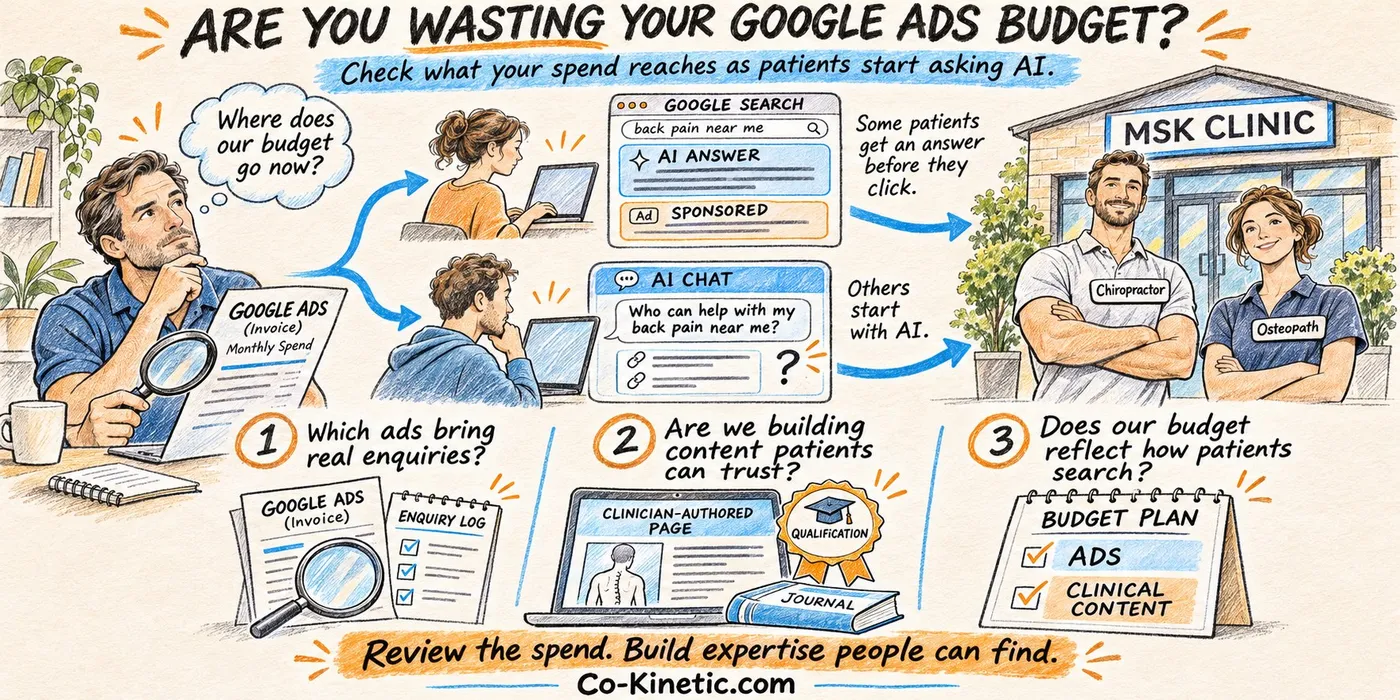
One of the basic jobs of running a business is knowing where your budget is actually working. If you're spending significant money on Google Ads right now, it's worth being honest about what that's reaching, because the evidence shows fewer searchers are clicking, especially when an AI answer sits at the top of the page.
And Google Ads isn't the only place where you're likely to be wasting money. If you're paying an SEO agency or a content writer to produce content optimised for Google search, that budget deserves the same hard look. The old SEO shortcuts don't carry over to AI tools: the same peer-reviewed study found keyword stuffing, the classic SEO trick, did nothing for visibility in AI answers and sometimes made it worse. Content that genuinely answers patients' questions in depth, with real sources, works for Google and AI alike, so it pays twice. We cover this in much more detail across our blog, and it's worth understanding the difference before you renew any contracts. Visit our blog
If you're not putting anything into building the kind of online presence that gets you found through AI, that's where your attention and your money should be going instead. Stop throwing good money after bad. A good first step is our free AI visibility check: it takes a minute to request and shows whether AI tools recommend your clinic when patients near you ask who to see, and who they recommend instead.
"Fewer, the clicks from Google are. Growing, the AI channel is. Waiting, the wise clinic is not."
Warm wishes,
Tor
Related reading
- Are Patients Asking AI Which Clinic to Go To?: patients now ask AI before they ever see your website. This shows what that means for your clinic in plain terms, and the five things that decide whether you're the one it names.
- Is My SEO Agency Still Worth the Money?: find out what your SEO and ads money is really buying now that patients ask AI, so you can move it to where patients actually are.
- Why Can My Clinic Rank on Google but Not Get Recommended by AI?: why you can rank on Google and still be invisible when patients ask AI who to see, and the two things that close the gap.
- How Do I Get Other Websites to Mention My Clinic?: one of the most overlooked ways to get named by AI, and how to build it from relationships you already have: running clubs, gyms, local directories.
References
- YouGov, AI is becoming part of UK adults' health information journey (2,100 UK adults), July 2026. https://yougov.com/en-gb/articles/55203-ai-is-becoming-part-of-uk-adults-health-information-journey
- OpenAI, Introducing ChatGPT Health, 7 January 2026. https://openai.com/index/introducing-chatgpt-health/
- Ofcom, Online Nation 2025, 10 December 2025. https://www.ofcom.org.uk/media-use-and-attitudes/online-habits/from-apps-to-ai-search-how-the-uk-goes-online-in-2025
- Pew Research Center, Google users are less likely to click on links when an AI summary appears in the results, 22 July 2025. https://www.pewresearch.org/short-reads/2025/07/22/google-users-are-less-likely-to-click-on-links-when-an-ai-summary-appears-in-the-results/
- Seer Interactive, AI Overview impact on Google click-through rates, September 2025 update (25 million impressions), September 2025. https://www.seerinteractive.com/insights/aio-impact-on-google-ctr-september-2025-update
- OpenAI, Ad policies, updated 4 June 2026. https://openai.com/policies/ad-policies/
- Campaign, reporting the Financial Times, Perplexity ends its advertising programme, citing user trust, 20 February 2026. https://www.campaignlive.com/article/perplexity-pulls-plug-ads-citing-trust-concerns-ai/1949142
- Google, Google Marketing Live announcements on search ads, including ads in AI Mode, 20 May 2026. https://blog.google/products/ads-commerce/google-marketing-live-search-ads/
- Adobe, Adobe Analytics report on AI-referred traffic, 17 June 2026. https://business.adobe.com/blog/adobe-report-ai-traffic-travel-sites-surges-200-percent
- Aggarwal P. et al., Princeton University and IIT Delhi, GEO: Generative Engine Optimization, KDD 2024, 2024. https://arxiv.org/abs/2311.09735
?Frequently Asked Questions
Why are patients more likely to trust AI recommendations over traditional Google search results?
Because they know a clinic can't simply pay to be named. In ChatGPT and Perplexity there's no paid route in for clinics, so a recommendation reflects what the AI could find about the clinic, which carries more weight with patients than an advert.
Can clinics pay for their placement in AI recommendation responses?
Not in ChatGPT or Perplexity. OpenAI's advertising policy (June 2026) currently disallows ads from clinical care providers, and Perplexity abandoned advertising in February 2026, citing user trust. Google is adding ads to its AI search, but they're labelled and kept apart from the answer, and Google keeps healthcare ads out of AI Overviews apart from a small US test (May 2026).
How does the absence of ads in AI tools benefit healthcare providers?
Because a clinic can't buy its way into the answer, visibility comes from what AI tools can find about the clinic: in-depth pages that answer patients' real questions. That levels the playing field for independent clinics with genuine expertise.
Is investing in Google Ads still worthwhile for healthcare clinics?
That's your call. Ads can still play a part, but fewer searchers click when an AI summary sits at the top of the page: Pew Research Center found people clicked a traditional result on 8% of visits with an AI summary, against 15% without (US, 2025). It's worth checking what your budget is really reaching, and putting some into the content that gets you found through AI.
What should clinics do to improve their organic AI visibility?
Build in-depth pages that answer the specific questions patients ask, backed by real sources and written by the clinicians who know each area, on a website AI tools are allowed to read. Peer-reviewed research (Princeton and IIT Delhi, KDD 2024) found adding quotations, statistics and cited sources improved visibility in AI answers by up to 40% in benchmark tests.