
Are Patients Asking AI Which Clinic to Go To?
Patients are starting to ask AI about their symptoms before they look for a clinic. What has changed in Google and AI search, and the practical steps that help, for clinic owners who want the plain facts without the hype.
Reviewed and updated: November 2026
Here’s something you might not have noticed yet: patients are starting to ask AI tools for healthcare recommendations instead of just Googling.
Not all patients. Not even most patients yet. But enough that if you’re not visible in AI search results, you’re missing a growing number of potential bookings.
I’m not saying this to create panic. I’m saying it because the shift is already happening, and there are practical things you can do about it now – before this becomes mainstream and everyone’s scrambling to catch up.
Let me explain what’s actually happening.
The Numbers: AI Search Is Changing How Patients Find You
Here’s where things stand:
Independent measurement firms Similarweb and Semrush estimate AI Overviews now appear on 43 to 48% of US Google searches (mid 2026), up from around 15% a year earlier (Search Engine Roundtable, July 2026). Those are the AI-generated answers that appear at the top of search results. This isn’t a test anymore. It’s how Google works now. In the UK, Ofcom’s Online Nation report (December 2025) found around 30% of Google searches already carried an AI summary and 53% of UK adults said they see these summaries often. UK visits to ChatGPT rose from 368 million in the first eight months of 2024 to 1.8 billion in the same months of 2025, nearly fivefold.
Health is one of the most affected areas of all. BrightEdge tracking (US) shows that by December 2025, 89% of the healthcare search terms it monitors triggered a Google AI Overview, up from 59% two years earlier, including 100% of treatment queries, 98% of pain-related queries and 93% of symptom queries. If your patients are searching for information about their symptoms or treatment, they’re very likely seeing an AI-generated answer before any traditional search results.
But here’s the critical part: on searches where an AI Overview appears, clicks through to ordinary results fell 61% between June 2024 and September 2025. That’s from Seer Interactive’s analysis of 25 million search impressions (largely US data): the organic click-through rate on those searches dropped from 1.76% to 0.61%. Clicks on paid ads fell even further, by 68%.
That’s not a small decline. For every 100 clicks an ordinary result used to win on those searches, it now wins about 35. Seer’s 2026 follow-up found clicks had recovered partly from a December 2025 low, so it isn’t a straight line down, but the gap is real. The most independent measure we have points the same way: Pew Research Center tracked 68,879 Google searches by 900 US adults in March 2025, and people clicked an ordinary result on 8% of visits when an AI summary appeared, against 15% when none did. If you’ve been investing in traditional SEO, that’s a significant drop in return on investment.
Here’s what this means practically: someone searches “why does my lower back hurt when I bend over?” on Google. An AI Overview appears at the top with an answer. The patient reads it, gets what they needed, and never clicks through to any website, including yours. (Local “near me” searches still show the map and Google Business Profiles, which is why your profile still matters. It’s the research stage, before a patient decides who to see, that is moving to AI.)
Less website traffic means fewer enquiries. Fewer enquiries means fewer new patients. Even if you’re ranking well in traditional search results.
However, if you ARE cited in the AI Overview, you win more clicks, not fewer. Seer Interactive’s 2026 follow-up, covering 53 brands and 2.43 billion organic impressions, found pages cited inside the AI Overview earned 120% more organic clicks per impression than pages that weren’t cited.
This is the shift: being cited in the AI answer can now be worth more than ranking well in the traditional Google results underneath it.
People aren’t just Googling “physiotherapist near me” anymore. They’re asking AI tools: “I’ve got chronic low back pain and I’ve tried everything. What type of practitioner should I see, and how do I find a good one?” BrightLocal’s 2026 survey of 1,002 US adults found 45% now use AI tools for local business recommendations, up from 6% a year earlier.
If your clinic isn’t part of AI’s knowledge base, you won’t be recommended. That’s not a future possibility. It’s happening now.
How AI Search Actually Works (And Why It’s Different)
Traditional Google SEO focuses on your website, keywords, page structure, and backlinks. Get those right, and you rank.
AI search works differently. It scans the entire internet for information about you: your website, yes, but also reviews, mentions in articles, social media presence, directory listings, everything. Then it synthesises that information to decide whether to recommend you.
This creates a challenge for clinics that have been doing SEO the traditional way:
You might have a well-optimised website and good Google rankings, but if you’re not mentioned anywhere else online, AI tools see you as less credible. They need multiple sources to verify that you’re legitimate and worth recommending. In Ahrefs’ study of 75,000 brands (May 2025), how often other websites mentioned a brand was the factor most closely linked to that brand appearing in Google’s AI Overviews: a correlation of 0.664 (where 0 means no link and 1 a perfect one), against 0.218 for backlinks. That shows a link rather than proof of cause, but it’s why mentions of your clinic on other websites are worth building.
If you’ve been too busy treating patients to build presence across multiple platforms, you’re probably invisible in AI search results, even if you’re excellent at what you do.
The gap between “excellent practitioner” and “visible practitioner” is widening. And it’s widening fast.
What This Means For Your SEO Investment
If you’ve been spending money on traditional SEO, optimising your website, building backlinks, targeting keywords, you need to understand that the game has changed. Seer Interactive’s study of 300,000 keywords (January 2025) found backlinks, the classic SEO purchase, had “weak or even neutral” impact on whether AI tools mention a brand.
That 61% fall in clicks when AI Overviews appear means your SEO ROI has fundamentally shifted. You might be ranking #1 for “how long does tennis elbow take to heal,” but if an AI Overview appears above your listing and patients never click through, you’re not getting the traffic you paid to generate.
This doesn’t mean SEO is dead. Google itself says “the best practices for SEO remain relevant for AI features”, and good rankings still feed what AI cites. It means SEO strategy needs to account for AI visibility. You need to be optimising for being cited in AI results, not just ranking in traditional search results that now appear below AI-generated answers.
What’s Coming Next
The pace of this change is accelerating, not slowing down.
Patients are a big part of that. In the US, 29% of adults were using AI chatbots for health information at least monthly by mid 2026, up from 17% two years earlier, according to KFF’s poll of 2,480 adults in May 2026. In the UK, YouGov’s July 2026 survey of 2,100 adults found 8% already say AI tools are their first port of call for health information (13% of millennials), and 16% have used AI to help understand their symptoms.
Here’s where we expect it to go next:
Voice-based AI assistants doing more of the searching. “Hey Siri, find me a physio who specialises in sports injuries” is increasingly answered by AI drawing on what it can find about local clinics, not by a list of links.
Local search transformation. AI will consider not just proximity, but expertise, reviews, and whether you’re mentioned in relevant health communities online.
Integration everywhere. AI search won’t be a separate thing people do. It’ll be baked into social media, email, messaging apps, everywhere people already spend their time.
The practitioners who position themselves now will be the ones AI recommends. The ones who wait will be playing catch-up when competition for AI visibility gets much harder.
What Actually Matters For AI Visibility
Here’s what you need to understand: AI doesn’t care about SEO tricks. It looks for credibility signals across multiple sources.
Here’s what creates those signals:
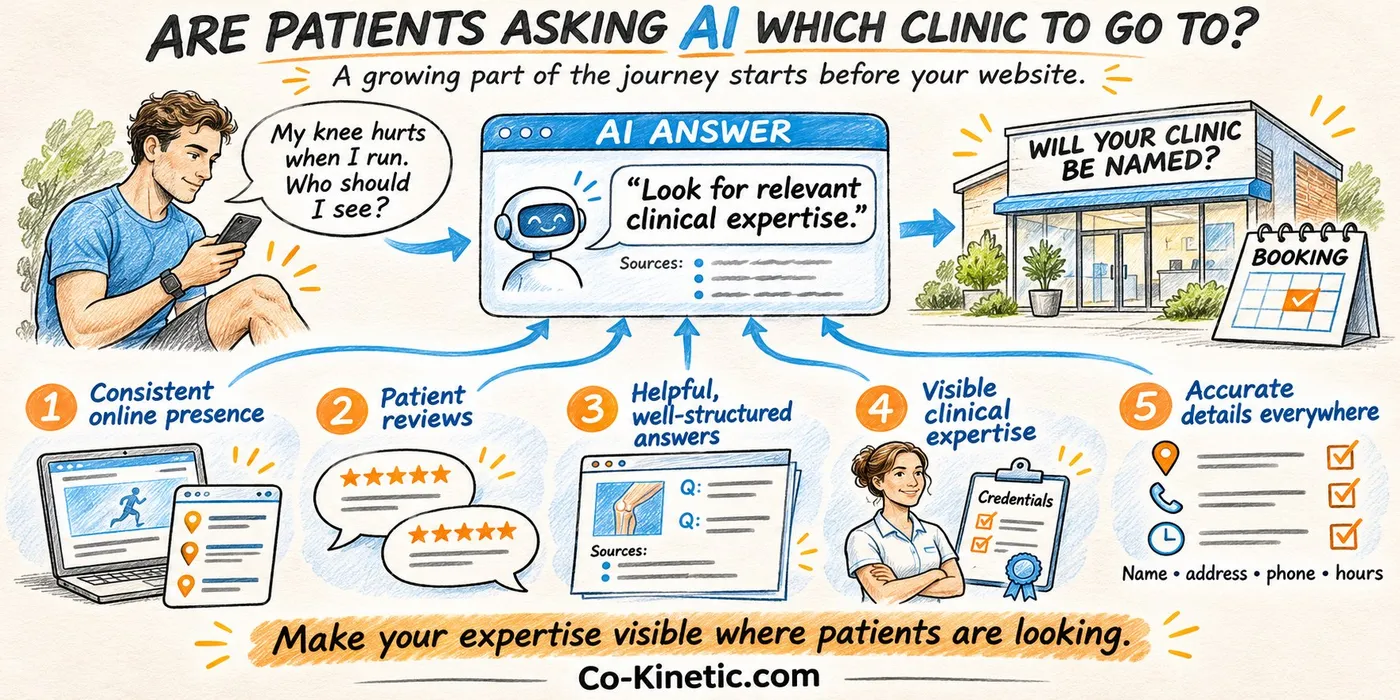
1. Consistent Online Presence
AI scans multiple sources to verify you’re legitimate. One website isn’t enough. You need mentions across platforms: your website, Google reviews, social media, local directories, healthcare publications. Consistency builds AI’s confidence in recommending you.
2. Patient Reviews
Reviews on Google, Facebook, and healthcare-specific platforms aren’t just for SEO anymore. They’re one of the first things a patient checks, and they’re part of what AI tools can find about your clinic when they describe it. Collect them steadily and honestly.
3. Content That Answers Real Questions (And Is Properly Structured)
AI learns by reading content: blog posts, social media, patient education materials. But here’s what most clinics don’t realise: AI doesn’t just read your content. It analyses how it’s structured.
Here’s what makes healthcare content credible to patients, and easier for Google and AI tools to read and use:
Author credentials displayed clearly: Patients want to know who wrote what they’re reading, and Google’s own quality guidance asks the same thing: is it “self-evident to your visitors who authored your content”, and what experience do they have? Your name, qualifications (MSc, MCSP, etc.), and role should be visible on every article.
Publication and update dates: A clear date shows patients the advice is current. Every piece of content needs a clear publication date, and ideally an “updated on” date when you genuinely refresh it.
Structured FAQs: FAQ sections match how people ask questions. Including one in your articles (each question as a heading, with a clear answer straight after it) makes your answers quick to find, for patients and for AI tools.
Technical markup (schema): This is behind-the-scenes code that labels a page: “this is a healthcare article, written by this qualified person, about this specific condition.” It’s good housekeeping, and Google uses it for some search features. But it isn’t a shortcut into AI answers. Google says there’s “no special schema.org structured data that you need to add” for its AI features, and when Ahrefs tracked 1,885 pages that added schema against 4,000 similar pages that didn’t (August 2025 to March 2026), their AI Overview citations didn’t rise at all (they dipped slightly, by 4.6%).
Bio section with credentials: Every article should have an author bio at the end explaining who you are, your qualifications, and your expertise. It tells patients why they can trust what they’ve just read.
Real sources, statistics and expert quotes: This is the one with the strongest evidence behind it. Peer-reviewed research from Princeton and IIT Delhi (Aggarwal and colleagues, KDD 2024) tested changes to web pages across 10,000 search queries in 25 subject areas, including health. Adding expert quotations lifted a page’s visibility in AI-generated answers by around 27 to 28%, adding statistics by 25 to 26%, and citing sources by 24 to 25%, with gains of up to about 40% in the best cases. Keyword stuffing, the old SEO shortcut, didn’t help and sometimes made things worse.
This is why “just writing a blog post” usually isn’t enough. You can write excellent content about managing lower back pain, but if it doesn’t answer the questions patients actually ask, show who wrote it, or back up what it says with real sources, it’s hard for patients to trust and hard for AI tools to use.
It’s also why a lot of DIY content struggles in AI search. Clinic owners write good content, but it often skims the questions patients really ask and leaves out the sources and clinical detail that make it stand out.
4. Visible Expertise
AI can’t recommend expertise it can’t see. Articles you’ve published, contributions to health forums, interviews in local publications, insights shared on social media, these create the “mentions” AI uses to build confidence in your credibility.
5. Accurate Information Everywhere
AI pulls from multiple sources. If your clinic hours are wrong on your website but right on Google, or your phone number is outdated on a directory listing, AI gets confused and might skip recommending you entirely. Consistency matters.
This isn’t about manipulation or tricks. It’s about making sure your expertise is visible where patients are actually looking.
Your AI Visibility Checklist
Here’s what you should audit this week. Don’t try to do everything at once, pick three items and focus on those for the next month.
✅ Google Business Profile: Complete, accurate, regularly updated with posts
✅ Consistent NAP: Name, address, phone number identical across all platforms
✅ Patient Reviews: Actively collecting them on Google and Facebook
✅ Social Media Presence: Regular posts that demonstrate expertise
✅ Blog/Content: Addressing specific patient problems with proper structure (author bio, credentials, dates, clear question-and-answer sections, real sources)
✅ Healthcare Directories: Listed on relevant physiotherapy/healthcare sites
✅ Local Mentions: Featured in local health articles or community resources
✅ Video Content: YouTube or social videos explaining common conditions
Pick three. Make progress. Don’t overwhelm yourself trying to do everything simultaneously.
What We’re Building To Help
This shift is exactly why we built our free AI visibility check.
It tests real patient questions across ChatGPT, Google AI Overviews, Perplexity and Claude, benchmarks you against local competitors, and gives you the three most impactful first steps for your practice. It’s free and takes a minute to request.
But here’s what we realised: just knowing where the gaps are isn’t enough. Creating well-researched, properly structured content is time-consuming. Most clinic owners know they need content, but they don’t have time to research it, write it, and make sure every article shows who wrote it and why patients should trust it.
That’s why we built the Clinical Content System. It researches and writes in-depth condition, treatment, service and blog pages under your clinicians’ own names: up to 12 research steps behind every piece, every reference checked to be real, clear author and reviewer details, and the key answer first, in the words patients use.
It’s not just about creating content faster. It’s about creating content built to be found and trusted by patients, Google and AI, without you needing to become a technical expert.
And if you want the full picture first, the Website & AI Visibility Review scores every page of your website and gives you a prioritised list of what to fix, for one payment of £599.
The Reality
AI search is already here. It’s growing faster than most clinics realise. And it’s fundamentally changing how patients find practitioners.
This creates both a challenge and an opportunity.
The challenge: Traditional SEO alone won’t be enough anymore.
The opportunity: Positioning yourself now, before this becomes mainstream knowledge, gives you a significant advantage over clinics who wait until competition for AI visibility becomes much harder.
You don’t need to become an AI expert. You just need to make sure your expertise is visible in the places AI looks.
Start with the checklist above. Pick three items. Make progress this month.
And if you want to see where you currently stand with AI visibility, try our free AI visibility check. It takes a minute to request and shows you where the gaps are and what to prioritise.
Tor
P.S. Have you noticed patients mentioning they found you through ChatGPT or AI search? I’d genuinely be interested to hear whether this is showing up in your practice yet. Send me a message.
Related reading
- Why Can My Clinic Rank on Google but Not Get Recommended by AI?: why you can rank on Google and still be invisible when patients ask AI who to see, and the two things that close the gap.
- Is My SEO Agency Still Worth the Money?: find out what your SEO and ads money is really buying now that patients ask AI, so you can move it to where patients actually are.
- Are You Wasting Your Google Ads Budget?: why fewer patients click your Google Ads now, and why the recommendation they trust most, AI's, can't be bought: it has to be earned.
- How Much Should Clinic Content Cost?: see what agencies really charge clinics for content, why two or three blog posts a month no longer keeps you visible, and what it actually takes, before you sign or renew a contract.
- What Changed in AI Search: Q2 2026: the changes in AI search this quarter that affect clinic websites, and what to do about each one.
- Why Can't I Just Use ChatGPT to Write My Clinic's Articles?: before you write another page with ChatGPT: the seven things it can't do for your clinic, from knowing which pages will move the needle to getting the references right, and why content that sounds like everyone else's leaves your chance of being found to pot luck.
References
- Search Engine Roundtable. Report on Similarweb and Semrush AI Overview tracking (43 to 48% of US searches). 30 July 2026. https://www.seroundtable.com/half-google-searches-ai-overviews-41780.html
- Ofcom. Online Nation 2025. 10 December 2025. https://www.ofcom.org.uk/media-use-and-attitudes/online-habits/from-apps-to-ai-search-how-the-uk-goes-online-in-2025
- BrightEdge. Healthcare and AI Overviews: three-year evolution, 2023 to 2025 (data to December 2025). https://www.brightedge.com/resources/weekly-ai-search-insights/healthcare-ai-evolution-google-2023-2025
- Seer Interactive. AIO impact on Google CTR: September 2025 update. September 2025. https://www.seerinteractive.com/insights/aio-impact-on-google-ctr-september-2025-update
- Seer Interactive. AIO impact on Google CTR: 2026 update. 24 April 2026. https://www.seerinteractive.com/insights/aio-impact-on-google-ctr-2026-update
- Pew Research Center. Google users are less likely to click on links when an AI summary appears in the results. 22 July 2025. https://www.pewresearch.org/short-reads/2025/07/22/google-users-are-less-likely-to-click-on-links-when-an-ai-summary-appears-in-the-results/
- BrightLocal. Local Consumer Review Survey 2026. 10 March 2026. https://www.brightlocal.com/research/lcrs-ai-trust/
- Ahrefs. Study of 75,000 brands: what correlates with visibility in Google's AI Overviews. May 2025. https://ahrefs.com/blog/ai-overview-brand-correlation/
- Seer Interactive. What drives brand mentions in AI answers. January 2025. https://www.seerinteractive.com/insights/what-drives-brand-mentions-in-ai-answers
- Google Search Central. AI features and your website (current as of December 2025). https://developers.google.com/search/docs/appearance/ai-features
- KFF. Tracking Poll on Health Information and Trust: use of social media and AI for health information and advice. 17 June 2026. https://www.kff.org/public-opinion/kff-tracking-poll-on-health-information-and-trust-use-of-social-media-and-ai-for-health-information-and-advice/
- YouGov. AI is becoming part of UK adults' health information journey. July 2026. https://yougov.com/en-gb/articles/55203-ai-is-becoming-part-of-uk-adults-health-information-journey
- Google Search Central. Creating helpful, reliable, people-first content. https://developers.google.com/search/docs/fundamentals/creating-helpful-content
- Ahrefs. Schema markup and AI citations: a matched-control experiment (data August 2025 to March 2026). 2026. https://ahrefs.com/blog/schema-ai-citations/
- Aggarwal P, et al. GEO: Generative Engine Optimization. KDD 2024. https://arxiv.org/abs/2311.09735
?Frequently Asked Questions
Why is AI search important for my clinic?
AI search is becoming a significant way patients find healthcare providers, with up to 48% of US Google searches now featuring AI-generated overviews. If your clinic isn't visible in these AI results, you risk missing out on potential bookings.
How does AI search differ from traditional SEO?
While traditional SEO focuses on optimizing your website for keywords and backlinks, AI search evaluates your overall online presence, including reviews, social media, and mentions across various platforms to determine credibility.
What can I do to improve my clinic's AI visibility?
To enhance your AI visibility, ensure you have a consistent online presence across multiple platforms, actively collect patient reviews, and create well-structured content that answers common patient questions with credible sources.
What role do patient reviews play in AI search?
Patient reviews are critical as they contribute to your clinic's credibility, influencing AI's decision to recommend you. Regularly collecting and managing reviews on platforms like Google and Facebook can significantly improve your AI visibility.
How can I check my clinic's AI visibility?
You can use our free AI visibility check, which assesses how well your clinic ranks for common patient questions across AI search platforms. It provides insights and actionable steps to improve your visibility.
What should I prioritize to adapt to the AI search shift?
Start by auditing your Google Business Profile, ensuring consistent contact information across all platforms, and actively collecting patient reviews. Focus on these areas to build a strong foundation for AI visibility.