
Is My SEO Agency Still Worth the Money?
Is your SEO agency still worth it now patients ask AI? What your SEO and ads money really buys, what to ask your agency, and where to move budget.
Reviewed and updated: November 2026
It depends on what your agency is actually doing for you. If they're still focused only on rankings and monthly traffic reports, you're buying less than you used to, because fewer searches now end in a click and more patients ask AI who to see. If they're building in-depth content around your clinicians' expertise and checking what AI tools say about your clinic, they're worth keeping.
Here's how to tell which one you've got: where patients are going now, what your SEO and ads money still reaches, the questions to put to your agency, and where to move budget if the answers disappoint you.
Where Patients Are Actually Going
The data behind this comes from multiple sources and the numbers vary slightly depending on which research you look at, but the direction is consistent.
A growing share of people now go straight to an AI tool. In the UK, YouGov found 8% of adults already say AI is their first port of call for health information, rising to 13% of millennials (2,100 UK adults, July 2026), and Ofcom found UK visits to ChatGPT nearly quintupled in a year, from 368 million to 1.8 billion in the first eight months of 2025. In the US, KFF found monthly use of AI chatbots for health information rose from 17% of adults in 2024 to 29% in May 2026 (2,480 US adults): the same pollster asking the same question, two years apart. These people are typing their question straight into ChatGPT, Perplexity, Claude, or whichever tool they prefer, and getting an answer directly, often before they see a Google results page at all.
On Google itself, AI Overviews now appear on around 30% of UK searches (Ofcom, December 2025), and BrightEdge's tracking found 89% of the healthcare search terms it monitors triggered one by December 2025 (US), up from 59% two years earlier, including 100% of treatment searches and 98% of pain-related ones. That's the generated summary that answers the question before the user sees any links. When one appears, far fewer people click. Pew Research Center tracked 68,879 real Google searches by 900 US adults in March 2025: people clicked an ordinary result on 8% of visits when an AI summary appeared, against 15% when it didn't, and clicked a link inside the summary just 1% of the time. Since then the gap has widened: Ahrefs' February 2026 study of 300,000 keywords found an AI Overview goes with a 58% lower click-through rate for the top-ranking page, up from a 34.5% gap in its study a year earlier.
Put that together and the picture is clear. SparkToro's analysis of Similarweb data found 69.5% of UK Google searches ended without a single click to any website in early 2026, the highest of the six countries studied (68.01% in the US, up from 60.45% in 2024). The clicks your Google Ads and SEO-optimised pages compete for are still real, but each search sends fewer of them out, and the research part of the patient journey is moving into AI answers.
What Patients Who Ask AI Are Doing
The people who go straight to AI tools are having a conversation. They describe their symptoms, ask follow-up questions, get recommendations for practitioners, and arrive at a clinic name before they've visited any website at all.
This matters more than it might initially seem. By the time those patients do click a link, they're already largely decided. Adobe Analytics, measuring over a trillion visits to US retail websites, found visitors referred by AI tools were converting 54% better than average visitors by May 2026. That's retail rather than healthcare, and AI still sends far fewer visitors than Google (Conductor measured AI referrals at 1.08% of all website traffic across 3.3 billion US sessions in 2025, roughly ten times the level a year earlier), but the pattern makes sense. They're not browsing. They're booking.
People who get an AI Overview on Google are also getting a curated answer before they see any links. If your clinic's page is cited in that overview, you're well placed: Seer Interactive's 2026 analysis of 53 brands and 5.47 million queries, mostly US, found pages cited inside an AI Overview earned 120% more organic clicks per impression than pages that weren't. If you're not, you're easy to miss at the most important moment of their search.
Where Does Your Money Actually Go?
Here's the question that matters: is your marketing budget only paying for the clicks that are left, or is it also building the kind of content AI tools draw on?
Right now, almost every clinic's marketing spend is chasing those clicks. And while there are still patients there, you're competing for them against every other clinic doing exactly the same thing, for searches that send fewer clicks out than they used to. Paid clicks aren't spared: Seer Interactive's analysis of 25 million search impressions found the click-through rate on ads fell 68% on searches with an AI Overview between June 2024 and September 2025 (from 19.70% to 6.34%), while organic click-through fell 61%, with only a partial recovery since.
Meanwhile, more and more patients are asking AI tools that almost no clinics have prepared for yet. That's not a niche or a passing trend: OpenAI says more than 230 million people ask ChatGPT health and wellness questions every week (January 2026; OpenAI's own figure). And in most areas, the competition is still minimal. The window for getting in early won't stay open indefinitely.
And here's the b*mmer: you can't buy your way into those answers. As of OpenAI's June 2026 advertising policy, ads from clinical care providers are "currently disallowed" in ChatGPT, and Perplexity began winding down its advertising in February 2026, citing user trust. The way in is to be the clinic whose expertise AI can find and trust.
Redirecting a meaningful portion of your budget towards AI visibility, which largely means restructuring and adapting content you already have, isn't a gamble. It's the most straightforward reallocation in digital marketing right now. And it isn't a choice between Google and AI: in healthcare, BrightEdge found 75.3% of Google AI Overview citations went to pages that also rank on Google, the highest of any industry, and Search Engine Land's analysis puts it at nearly 80% (data to September 2025). Google itself says "the best practices for SEO remain relevant for AI features". So in-depth content that genuinely answers patients' questions pays into both. The only question is how long you want to wait before making it.
How do I tell if my agency is still worth it?
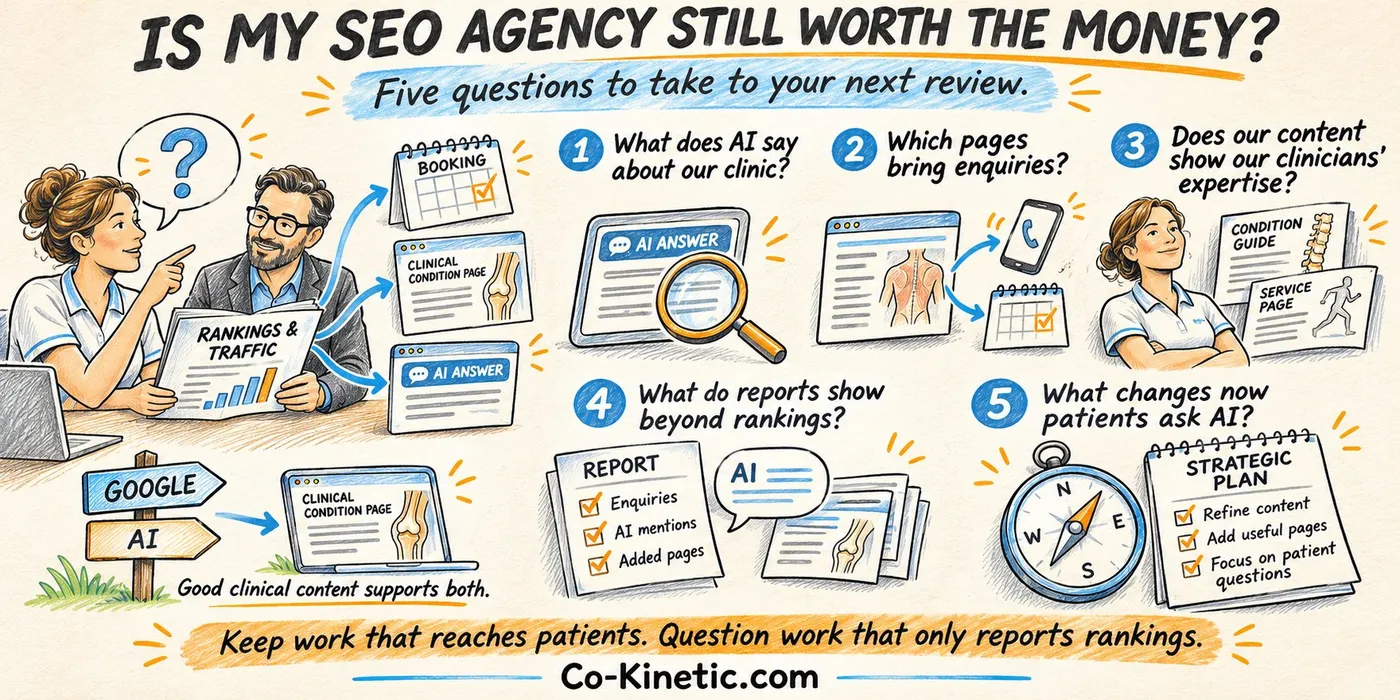
You don't need to understand SEO to judge this. You need to know what your agency spends its time on, and whether that work reaches the patients who ask AI as well as the ones who still click. These are the five questions I'd put to them at your next review.
1. Do you check what AI tools say about our clinic? Ask them to show you what ChatGPT, Perplexity, Claude and Google's AI Overviews say when a patient asks about a condition you treat, in your area. If they've never looked, nobody is watching the part of the patient journey that's growing fastest.
2. Which pages bring us enquiries, not just traffic? Visitors are a means to an end. A good agency can tell you which pages lead to bookings and enquiries, and builds more of what works. If every report is about visits and impressions, ask why.
3. Are you building condition and service pages under our clinicians' names? AI tools and Google look for real expertise. Pages that properly explain the conditions you treat and the services you offer, written by or with a named clinician, give them something to trust. Short, anonymous posts written to hit a keyword don't.
4. What do your reports show beyond rankings? Rankings still matter: in healthcare, most pages cited in Google's AI Overviews also rank on Google. But a place on page one is worth less when fewer searches end in a click. Look for enquiries, whether your pages are being named in AI answers, and what has actually been added to your site.
5. What would you do differently now that patients ask AI? This one tells you the most. A good agency will have a clear answer: deeper content, your clinicians' expertise front and centre, regular checks on what AI says about you. A vague answer, or "nothing needs to change", is an answer too.
Your agency should be able to answer all five in plain English. If they can, and the answers line up with where patients are going, keep them. If they can't, that's worth knowing before your next renewal.
So is my SEO agency still worth the money?
If your agency is working on in-depth content, your clinicians' expertise and your visibility in AI answers, yes. That work pays into Google and AI at the same time, and it's worth protecting.
If they're still selling you rankings and traffic reports and nothing else, you're paying for a shrinking share of the patient journey. That doesn't mean ending the contract tomorrow. It means having a straight conversation.
My suggestion: take the five questions above to your next agency review, then look honestly at how your budget is split between chasing clicks and building content that patients and AI can find. Move more of it towards the second. That's where patients are heading.
Warm wishes
Tor
Related reading
- Are Patients Asking AI Which Clinic to Go To?: patients now ask AI before they ever see your website. This shows what that means for your clinic in plain terms, and the five things that decide whether you're the one it names.
- Why Can My Clinic Rank on Google but Not Get Recommended by AI?: why you can rank on Google and still be invisible when patients ask AI who to see, and the two things that close the gap.
- Are You Wasting Your Google Ads Budget?: why fewer patients click your Google Ads now, and why the recommendation they trust most, AI's, can't be bought: it has to be earned.
- How Much Should Clinic Content Cost?: see what agencies really charge clinics for content, why two or three blog posts a month no longer keeps you visible, and what it actually takes, before you sign or renew a contract.
References
- YouGov, AI is becoming part of UK adults' health information journey, July 2026. https://yougov.com/en-gb/articles/55203-ai-is-becoming-part-of-uk-adults-health-information-journey
- Ofcom, Online Nation 2025, 10 December 2025. https://www.ofcom.org.uk/media-use-and-attitudes/online-habits/from-apps-to-ai-search-how-the-uk-goes-online-in-2025
- KFF, KFF Tracking Poll on Health Information and Trust: use of social media and AI for health information and advice, 17 June 2026. https://www.kff.org/public-opinion/kff-tracking-poll-on-health-information-and-trust-use-of-social-media-and-ai-for-health-information-and-advice/
- BrightEdge, Healthcare and AI Overviews: three-year evolution, 2023 to 2025, data to December 2025. https://www.brightedge.com/resources/weekly-ai-search-insights/healthcare-ai-evolution-google-2023-2025
- Pew Research Center, Google users are less likely to click on links when an AI summary appears in the results, 22 July 2025. https://www.pewresearch.org/short-reads/2025/07/22/google-users-are-less-likely-to-click-on-links-when-an-ai-summary-appears-in-the-results/
- Ahrefs, AI Overviews reduce clicks (2026 update), 4 February 2026. https://ahrefs.com/blog/ai-overviews-reduce-clicks-update/
- SparkToro, Zero-click searches highest in the UK, lowest in Germany (six-country study of Similarweb data), 16 June 2026. https://sparktoro.com/blog/zero-click-searches-highest-in-the-uk-lowest-in-germany-and-france-has-the-most-efficient-searchers/
- SparkToro, In 2026, less than one third of Google searches still send a click (US study of Similarweb data), 9 June 2026. https://sparktoro.com/blog/in-2026-less-than-one-third-of-google-searches-still-send-a-click/
- Adobe, Adobe report: AI traffic to travel sites surges (Adobe Digital Insights), 17 June 2026. https://business.adobe.com/blog/adobe-report-ai-traffic-travel-sites-surges-200-percent
- Conductor, 2026 AEO/GEO Benchmarks Report, November 2025. https://www.conductor.com/academy/aeo-geo-benchmarks-report/
- Seer Interactive, AIO impact on Google CTR: 2026 update, 24 April 2026. https://www.seerinteractive.com/insights/aio-impact-on-google-ctr-2026-update
- Seer Interactive, AIO impact on Google CTR: September 2025 update, September 2025. https://www.seerinteractive.com/insights/aio-impact-on-google-ctr-september-2025-update
- OpenAI, Introducing ChatGPT Health, 7 January 2026. https://openai.com/index/introducing-chatgpt-health/
- OpenAI, Ad policies, updated 4 June 2026. https://openai.com/policies/ad-policies/
- Campaign (reporting the Financial Times), Perplexity pulls plug on ads, citing trust concerns, 20 February 2026. https://www.campaignlive.com/article/perplexity-pulls-plug-ads-citing-trust-concerns-ai/1949142
- BrightEdge, AI Overview rank overlap after 16 months, September 2025. https://www.brightedge.com/resources/weekly-ai-search-insights/rank-overlap-after-16-months-of-aio
- Search Engine Land, AI Overviews and YMYL topics (guide), June 2026. https://searchengineland.com/guide/ai-overviews-ymyl
- Google Search Central, AI features and your website, current as of December 2025. https://developers.google.com/search/docs/appearance/ai-features
?Frequently Asked Questions
Is my SEO agency still worth the money?
It depends on what they're doing. An agency still focused only on rankings and traffic reports is buying you less than it used to, because fewer searches end in a click and more patients ask AI. One that's building in-depth content under your clinicians' names and checking what AI tools say about your clinic is worth keeping.
How do I tell if my SEO agency is still worth it?
Ask them five things: do they check what AI tools say about your clinic, which pages bring enquiries rather than just traffic, whether they're building condition and service pages under your clinicians' names, what their reports show beyond rankings, and what they'd do differently now that patients ask AI.
How many Google searches now end without a click?
SparkToro's analysis of Similarweb data found 69.5% of UK Google searches and 68% of US searches ended without a click to any website in early 2026. People still search on Google as much as ever, but fewer searches send a visitor to a clinic's website.
How has the use of AI tools impacted patient search trends?
More patients now start with AI. In the UK, 8% of adults say AI is their first port of call for health information (YouGov, July 2026). In the US, monthly use of AI chatbots for health information rose from 17% to 29% of adults between 2024 and 2026 (KFF). These patients often get a clinic recommendation before they visit any website.
Should I cancel my SEO or Google Ads budget based on these trends?
No, you shouldn't cancel your SEO or Google Ads budget outright. It's worth reassessing how your budget is split, so more of it builds in-depth content that works for both Google and AI tools.
What makes a clinic more visible in AI tools and Google AI Overviews?
AI tools draw on sources that show real depth on a topic and genuinely answer patients' questions, and they can only pass on what they can find. Clinics that clearly show their clinicians' expertise, services and the conditions they treat give AI something to work with. Adding real sources, statistics and expert insight also helps: peer-reviewed research (the GEO study, KDD 2024) found it improved visibility in AI answers by up to about 40% in benchmark tests.
What are the key differences in online visibility for AI versus traditional SEO?
Traditional SEO was built to rank pages in a list of links. AI tools answer a patient's question directly and name the clinics whose expertise they can find. It isn't either/or: in-depth, well-sourced content under named clinicians works for both, and Google says the best practices for SEO remain relevant for its AI features.