
Why Can My Clinic Rank on Google but Not Get Recommended by AI?
Why a clinic with great SEO can still be invisible when patients ask AI who to see, and what actually helps. For physio and MSK clinic owners wondering whether their SEO spend still gets them found.
Reviewed and updated: November 2026
Your SEO agency is not lying to you. They are just solving the wrong problem.
I went down this rabbit hole because I was building a content system for clinic owners and I realised there was no point giving people a tool to create content if that content was invisible to the platforms their patients were actually using. I spent six months going deep into this before I was confident enough to say it out loud. I ran visibility assessments on real clinic websites, I tested the data, and I kept finding the same thing: the clinics with the best SEO scores were not the ones being recommended by AI. In some cases, the clinic with the worst website was beating everyone else.
That is not a glitch. It is the point.
THE WAY PATIENTS FIND CLINICS HAS FUNDAMENTALLY CHANGED
- In the UK, 54% of adults now use AI tools, rising to 79% of 16 to 24 year olds (Ofcom, April 2026), and Deloitte's May 2026 survey of 4,156 UK adults found a quarter of generative AI users have asked it for health advice, with 38% of those believing the health information it gives is always accurate (Deloitte, July 2026). In the US, Pew Research Center's June 2026 survey of 3,488 adults found 34% use AI chatbots for at least one health reason, and a quarter say they use them to try to diagnose symptoms (Pew Research Center, August 2026).
- Independent trackers Similarweb and Semrush estimate AI Overviews now appear on 43 to 48% of US Google searches, up from around 15% a year earlier (Search Engine Roundtable, July 2026), and around 30% of UK Google searches carry an AI summary (Ofcom Online Nation, December 2025).
- When an AI summary appears, people click less. Pew Research Center tracked 68,879 real searches by 900 US adults in March 2025: people clicked an ordinary result in 8% of visits when an AI summary appeared, against 15% without one, and clicked a link inside the summary just 1% of the time (Pew Research Center, July 2025). Ahrefs' February 2026 re-run of its 300,000-keyword study found the gap has widened: an AI Overview now correlates with a 58% lower click-through rate for the top-ranking page, up from 35% a year earlier (Ahrefs, February 2026).
- In the UK, 69.5% of Google searches ended without a click to any website in early 2026, the highest of the six countries SparkToro studied (the US was 68%). That includes searches answered by maps and weather boxes as well as AI, but the direction is clear (SparkToro, June 2026).
In other words, Google is as busy as ever (Ofcom counts around 3 billion UK Google searches a month, and 82% of UK adults use it), but if you have been investing in traditional SEO alone, the clicks it sends you are shrinking (and most clinics have no idea).
Think about the difference in experience. You type 'shoulder pain worse at night' into Google and you get a wall of links, ads, and competing information. You type the same thing into ChatGPT or Perplexity and you get a personalised, conversational answer that feels like it was written for you. You can carry on the conversation with context. It is not remotely surprising that people are moving this way.
When AI recommends your clinic, the patient has already had a guided consultation and been pointed specifically to you. They arrive at your website practically ready to book.
This is why the conversion numbers are so striking. Adobe Analytics, measuring more than a trillion visits to US retail websites, found that by May 2026 visitors arriving from AI tools converted 54% better than average visitors, up from 9% worse in February 2025 (Adobe Analytics, June 2026). That is retail, not healthcare, but the reason carries over: people arriving from an AI recommendation have already done their research, so they arrive with completely different intent.
OpenAI reported in February 2026 that ChatGPT had passed 900 million weekly users (TechCrunch, February 2026), and says more than 230 million people ask it health and wellness questions every week (OpenAI, January 2026), with seven in ten of those conversations happening outside normal clinic hours (OpenAI, AI as a Healthcare Ally). This is not a trend on the horizon. It has already happened.
GOOD SEO DOES NOT EQUAL GOOD AI VISIBILITY
This is where I get pushback, usually from marketing agencies. They will tell you that whatever they have done for your SEO will work for AI visibility too. In my experience of running visibility assessments on real clinic websites, that is not what the data shows.
In one comparison I ran across five UK physiotherapy clinics, the clinic with the weakest website on paper had the highest AI citation rate of the five. Its site health score was the kind that would have most agencies recommending a full rebuild. But it was being recommended by ChatGPT, Perplexity, and Google AI Overviews more than clinics with websites that are technically far superior.
The reason is niching. It was a clinic very specifically known for children's physiotherapy. The AI could see exactly what it does, who it treats, and why it is the right choice for that query. The more specialised and focused your digital presence, the easier it is for AI tools to match you to a patient's question.
The best clinicians are not necessarily the ones being recommended by AI right now. The ones being recommended are the ones whose online presence most clearly signals what they do and who they do it for.
I want to address something I hear every time I raise the niching point. Niching your digital presence does not mean turning patients away. If someone comes in with a back problem and your specialism online is shoulders, you can absolutely still treat them. What we are talking about is choosing an area to build your digital authority around, because the tighter your focus, the easier it is for AI to understand and recommend you.
WHICH AI PLATFORMS ACTUALLY MATTER FOR YOUR CLINIC
There are now around seven or eight main AI platforms. Not all of them matter equally for a healthcare clinic in the UK, and it is worth understanding the landscape before you start optimising for it.
In our AI visibility check and assessments, we test the four tools patients use most for health questions and for finding a clinic:
Google AI Overviews. Most patients are still using Google, even with the shift to AI search. When Google returns an AI Overview for a health query, it appears above all the organic results, and health is where they appear most: BrightEdge found AI Overviews on 89% of the US healthcare searches it tracks by December 2025, including 100% of treatment searches (BrightEdge). Seer Interactive's 2026 study of 53 brands and 2.43 billion organic impressions found that being cited inside an AI Overview delivered 120% more organic clicks per impression than not being cited (Seer Interactive, April 2026), which makes it one of the most valuable AI visibility positions for a clinic.
ChatGPT and Perplexity. ChatGPT is the platform most people think of when they think of AI search. Perplexity tends to show its sources prominently, which makes it especially relevant for clinic recommendations.
Claude. Anthropic's AI assistant is smaller but one of the fastest growing: Ofcom found UK visits to Claude grew 138% in the year to August 2025.
The picture across all of them tends to be consistent: if you are visible on one, you are usually visible on most. And if you are invisible on one, you are usually invisible on all of them.
WHY HEALTHCARE CONTENT IS HELD TO A HIGHER STANDARD
If you have never heard of YMYL, you need to know about it. It stands for Your Money or Your Life, and it is Google's designation for content that could directly impact someone's health, finances, or safety. Healthcare sits right at the top of that list.
The standard of proof required for YMYL content is significantly higher than almost any other content type. Bad restaurant advice leads to a bad meal. Bad health advice can cause real harm. Because of this, AI health answers lean heavily on sources that are already trusted. BrightEdge's 16-month tracking found that, to September 2025, 75.3% of Google AI Overview citations in healthcare went to pages that also rank in Google's ordinary results, the highest of any industry (BrightEdge, September 2025).
A named clinician author with credentials is not just good practice for healthcare content. It is what Google's own quality guidance asks for, and it is the first thing a patient looks for when deciding whether to trust what they are reading.
The standard Google sets for health content is what it calls E-E-A-T: Experience, Expertise, Authoritativeness, and Trustworthiness, in plain words, does this come from someone who knows the subject first-hand and can be trusted? Google's own guidance on helpful content says "trust is most important". For a physio or osteopath, this means your content needs to be attributed to you by name, with your qualifications clearly shown. Clinical citations from peer-reviewed research are not optional extras either. Peer-reviewed research from Princeton and IIT Delhi (Aggarwal and colleagues, KDD 2024) tested 10,000 queries across 25 subject areas, including health: adding expert quotations, statistics and cited sources each lifted a page's visibility in AI-generated answers by roughly 24 to 28% on the paper's main measure, with the best results reaching around 40% in benchmark tests.
The flip side is genuinely encouraging. If you get E-E-A-T right, you have a real advantage over generic health websites. Your clinical credibility is exactly what patients and Google are looking for, and AI can only pass on what it can find. You just have to make it visible.
WHAT ACTUALLY MAKES AI RECOMMEND YOUR CLINIC
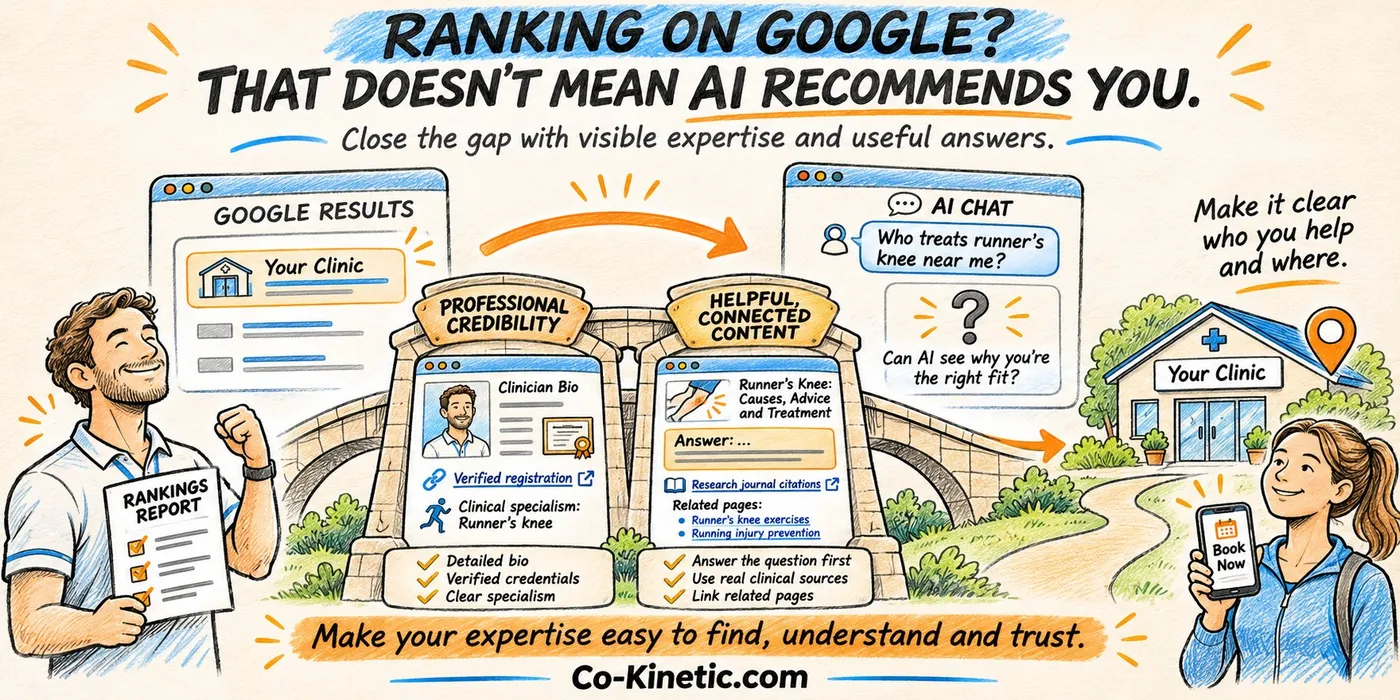
Nobody controls what an AI tool says, but there are two pillars that matter most, and both are about content.
Pillar one: your professional credibility online
Patients, Google and AI tools all need to be able to see who you are and why you are qualified to write about health topics. This means having a proper professional bio page on your website that includes your qualifications, your registration numbers, links to your regulatory body such as the HCPC, your areas of specialism, and any research, publications, or teaching you have done. AI can only pass on what it can find, so the more there is to find about you as a clinician, the more it has to say about you.
Pillar two: how your content is structured
One large analysis of 18,012 verified ChatGPT citations, drawn from 1.2 million answers (Kevin Indig, Growth Memo, via Search Engine Land, February 2026), found 44.2% came from the first 30% of a page. It isn't peer-reviewed, but the advice stands on its own: patients want the answer first too.
The concept to understand here is the answer capsule. In the first 30% of any page, you should have a direct 40 to 60 word answer to the main question that page addresses. Whatever someone is most likely to type into an AI tool that this page should answer, answer it directly right at the top. You can go into more depth below, but that first section has to deliver the goods immediately.
Beyond that, structure your content as hub and spoke clusters. A central pillar page for a condition, knee pain for example, with cluster articles covering different aspects: causes, treatment options, recovery, sport-specific issues. All the cluster articles link back to the pillar page. A tight cluster of 5 to 6 well-written articles on one specific topic will usually do far more for you than 50 disconnected generic ones. There is data behind this: Ahrefs' 2026 analysis found pages that also rank for the follow-up questions behind a search were 161% more likely to be cited in Google's AI Overviews (Ahrefs, 2026).
Use question-based headings. Your H2s and H3s should be written as questions, because AI is looking to match your content to the queries people are putting in, and questions are where AI answers appear most: a Washington University in St Louis study of 55,393 Google searches in spring 2026 found AI Overviews on 65% of question-style searches, against 9.5% of other searches (Montgomery, Iqbal and Xu, September 2026). Answer the questions patients ask in plain words (a short FAQ section is a good way to do it). Include clinical citations from reputable journals. Weave in genuine local context: mention a local parkrun by name, reference nearby landmarks. This is not keyword stuffing. It is about being unmistakably local, so patients and AI tools can see you are the right answer for a local question.
One really well-optimised article on a specific niche question will get you further than ten mediocre ones. Quality compounds. Quantity without quality does not.
THE COMPOUND EFFECT: WHY STARTING NOW MATTERS
AI visibility is not a one-time fix. It compounds. A competitor who starts publishing two well-optimised pieces of content a month today will be ahead of you in three months. In six months they are the established authority in your area for their niche. In twelve months the gap is significant and widening with every new piece of content they publish.
The depth that gets a clinic named builds over months, and every piece makes the next count for more, because each new page links into the ones before. That does not mean a complete website rebuild or a year-long campaign before anything happens. It means starting with a handful of well-structured, well-attributed articles, done properly.
Most clinics have not started building their AI visibility at all. Getting the foundations right now puts you ahead of the vast majority of your local competitors, not because you are doing something complicated, but because you are doing something most of them have not started yet.
The window to get ahead is open. It will not stay open indefinitely.
Want to Go Deeper on This?
The quickest way to see where your own clinic stands is our free AI visibility check. It takes a minute to request and tests real patient questions across ChatGPT, Google AI Overviews, Perplexity and Claude, so you can see who AI recommends when patients near you ask.
Once you have your report, you are invited to my weekly live review, where I go through the reports of the clinics who attend and you can ask anything specific to your own clinic. Whether you are starting from scratch or you already have a website full of content that is not getting found, there will be something in it for you.
Tor
Related reading
- Are Patients Asking AI Which Clinic to Go To?: patients now ask AI before they ever see your website. This shows what that means for your clinic in plain terms, and the five things that decide whether you're the one it names.
- Is My SEO Agency Still Worth the Money?: find out what your SEO and ads money is really buying now that patients ask AI, so you can move it to where patients actually are.
- Are You Wasting Your Google Ads Budget?: why fewer patients click your Google Ads now, and why the recommendation they trust most, AI's, can't be bought: it has to be earned.
- Why Do Google and AI Trust Some Clinics More Than Others?: why Google and AI trust some clinics' pages and not others, and the simple changes that put your team's experience and credentials where they can see them.
References
- Ofcom. Adults' Media Use and Attitudes 2026. 2 April 2026. www.ofcom.org.uk/media-use-and-attitudes/media-habits-adults/passive-social-media-use-ai-companionship-and-online-side-hustles-uk-adults-media-and-online-lives-revealed
- Deloitte UK. Digital Consumer Trends press release: survey of 4,156 UK adults aged 16 to 75 (fieldwork 6 to 15 May 2026). 6 July 2026. www.deloitte.com/uk/en/about/press-room/digital-consumer-trends-over-a-third-of-consumers-believe-gen-ai-health-advice-is-always-accurate.html
- Pew Research Center. From diagnoses to treatments: why Americans use AI chatbots for health. Survey of 3,488 US adults (American Trends Panel, fieldwork 22 to 28 June 2026). 25 August 2026. https://www.pewresearch.org/science/2026/08/25/from-diagnoses-to-treatments-why-americans-use-ai-chatbots-for-health/
- Search Engine Roundtable. Report on Similarweb and Semrush AI Overview prevalence estimates (US). 30 July 2026. www.seroundtable.com/half-google-searches-ai-overviews-41780.html
- Ofcom. Online Nation 2025. 10 December 2025. www.ofcom.org.uk/media-use-and-attitudes/online-habits/from-apps-to-ai-search-how-the-uk-goes-online-in-2025
- Pew Research Center. Google users are less likely to click on links when an AI summary appears in the results. 900 US adults, 68,879 searches, March 2025. 22 July 2025. www.pewresearch.org/short-reads/2025/07/22/google-users-are-less-likely-to-click-on-links-when-an-ai-summary-appears-in-the-results/
- Ahrefs. AI Overviews and click-through rate, updated study of 300,000 keywords (December 2023 vs December 2025). 4 February 2026. ahrefs.com/blog/ai-overviews-reduce-clicks-update/
- SparkToro (Rand Fishkin), analysis of Similarweb clickstream data. Zero-click searches across six countries, January to April 2026. 16 June 2026. sparktoro.com/blog/zero-click-searches-highest-in-the-uk-lowest-in-germany-and-france-has-the-most-efficient-searchers/
- Adobe Analytics. AI-referred traffic report (more than a trillion visits to US retail and travel sites). 17 June 2026. business.adobe.com/blog/adobe-report-ai-traffic-travel-sites-surges-200-percent
- TechCrunch. ChatGPT reaches 900 million weekly active users (OpenAI disclosure). 27 February 2026. techcrunch.com/2026/02/27/chatgpt-reaches-900m-weekly-active-users
- OpenAI. Introducing ChatGPT Health. 7 January 2026. openai.com/index/introducing-chatgpt-health/
- OpenAI. AI as a Healthcare Ally. January 2026. cdn.openai.com/pdf/2cb29276-68cd-4ec6-a5f4-c01c5e7a36e9/OpenAI-AI-as-a-Healthcare-Ally-Jan-2026.pdf
- BrightEdge. Healthcare and AI Overviews: three-year evolution, 2023 to 2025 (US, BrightEdge's tracked keyword set). December 2025 data. www.brightedge.com/resources/weekly-ai-search-insights/healthcare-ai-evolution-google-2023-2025
- Seer Interactive. AIO impact on Google CTR: 2026 update (53 brands, 5.47 million queries, 2.43 billion organic impressions). 24 April 2026. www.seerinteractive.com/insights/aio-impact-on-google-ctr-2026-update
- BrightEdge. AI Overview citations and organic rank overlap after 16 months. September 2025. www.brightedge.com/resources/weekly-ai-search-insights/rank-overlap-after-16-months-of-aio
- Google Search Central. Creating helpful, reliable, people-first content. Documentation. developers.google.com/search/docs/fundamentals/creating-helpful-content
- Aggarwal P, et al. GEO: Generative Engine Optimization. KDD 2024 (Princeton University and IIT Delhi); benchmark of 10,000 queries across 25 domains. arxiv.org/abs/2311.09735
- Kevin Indig, Growth Memo, summarised by Search Engine Land. Analysis of 18,012 verified ChatGPT citations from 1.2 million answers. 18 February 2026. searchengineland.com/chatgpt-citations-content-study-469483
- Ahrefs. How to rank in AI Overviews: query fan-out and citation analysis. January 2026, updated May 2026. ahrefs.com/blog/how-to-rank-in-ai-overviews/
- Montgomery, Iqbal and Xu, Washington University in St Louis. Measurement study of 55,393 Google searches and 61,212 AI Overview citations (13 March to 21 April 2026). Published 2 September 2026; forthcoming at the ACM Internet Measurement Conference, October 2026. Preprint arXiv:2605.14021. https://arxiv.org/abs/2605.14021
?Frequently Asked Questions
How has patient search behaviour changed with AI tools?
More patients now ask AI tools about their symptoms before they ever search for a clinic. In the UK, 54% of adults use AI tools (Ofcom, April 2026), and when Google shows an AI Overview, the top-ranking page gets far fewer clicks (Ahrefs found a 58% lower click-through rate, February 2026). Google is still busy, but the clicks it sends to clinic websites are shrinking.
What is the difference between good SEO and good AI visibility?
Good SEO does not automatically translate to good AI visibility. In the assessments we run, clinics with clear, specific expertise online are often named by AI more than clinics with technically stronger websites, because AI tools can easily match them to a patient's question.
Which AI platforms should physiotherapy clinics focus on?
The four tools patients use most for health questions and finding a clinic: Google AI Overviews, ChatGPT, Perplexity and Claude. Google AI Overviews matter a great deal because they sit above the ordinary results on most health searches.
What are the key components for AI to recommend a clinic?
Nobody controls what AI says, but two things matter most: professional credibility that patients and AI can actually find (a detailed bio with qualifications and registration), and content that answers patients' questions clearly, with the key answer first and real clinical sources.
How can clinics improve their content for AI visibility?
Answer common patient questions directly near the top of the page, use question-based headings, and include clinical citations: peer-reviewed research (KDD 2024) found adding sources, statistics and expert quotes improved visibility in AI answers by up to about 40% in benchmark tests. Focusing on a specific niche and local context helps patients and AI see you are the right fit.
Why is it important to start enhancing AI visibility now?
AI visibility is not a one-time effort; it builds over time, and each new page makes the ones before it count for more. Most clinics have not started yet, so clinics that start now have the chance to get ahead in their area.