
Why Isn't AI Picking Up My Blog Posts?
Why a 500-word blog post rarely gets a clinic named by AI, and what a page needs instead. For clinic owners deciding what to write next.
Reviewed and updated: November 2026
Here's something that catches most physio and osteo clinic owners off guard: remember that quick 500-word blog post you put out last week?
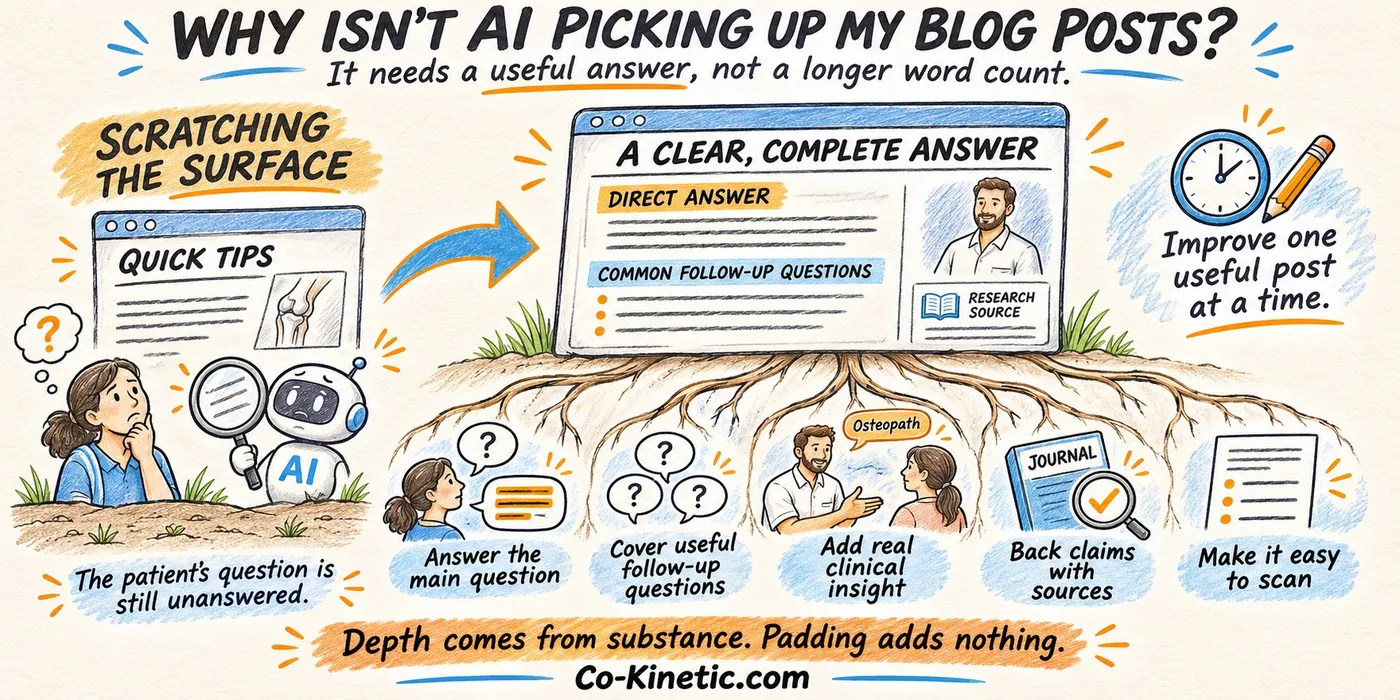
AI search engines are very unlikely to use it. It's not that you've written rubbish, and it's not that nobody cares about the topic. It's that 500 words is rarely enough to properly answer a patient's question.
I know that sounds harsh, but it's true. And if you're wondering why your content isn't getting traction, why you're not showing up in ChatGPT or Google's AI-generated answers, this is probably why.
Let me explain what's actually happening with content visibility right now, and more importantly, what you need to do about it....
The Game Has Changed (Whether You Like It or Not)
Remember when Google was the only search engine that mattered? Those days are gone.
Your potential patients aren't just Googling "physiotherapist near me" anymore. They're asking ChatGPT. They're using Perplexity. They're relying on Google's AI-generated overviews to get their answers: independent trackers Similarweb and Semrush estimate AI Overviews now appear on 43 to 48% of US Google searches (mid 2026), up from around 15% a year earlier, and Ofcom puts the UK figure at around 30% (December 2025).
These are called answer engines, and they work completely differently to traditional search.
Here's the key difference: traditional search engines rank pages. Answer engines summarise information and cite sources.
And here's the bit that matters for your clinic: answer engines favour content that genuinely answers the question, in depth.
If your blog posts are short, surface-level pieces designed to "tick the SEO box," you're essentially invisible to the tools your potential patients are actually using.
Why Short Posts Don't Cut It Anymore
Let's be blunt about what's happening when someone asks an AI a question about treatment.
Say a potential patient types: "Should I see a physio for low back pain or will it go away on its own?"
ChatGPT, Perplexity, and Google's AI don't just pull the first result from Google. They scan multiple sources, extract the most comprehensive and relevant information, then compile an answer. Google, for example, splits a question into related follow-up questions and draws on the results for each. Ahrefs found that pages ranking for those follow-up questions were 161% more likely to be cited, and a page's chance of being cited rose from 9% when it ranked for none of them to 57% when it ranked for nine (2026 data). That's what depth looks like to AI: covering the questions around the question.
What gets included?
- Content that thoroughly addresses the question
- Articles that provide context, nuance, and depth
- Sources that back up what they say with real evidence: research, statistics and expert insight
What gets skipped?
- 500-word "Top 5 Tips" posts
- Surface-level listicles with no real depth
- Thin content that doesn't actually answer the question properly
If your blog post barely scratches the surface, it gives AI engines very little worth using. Simple as that.
So What's the Magic Number? (Spoiler: There Isn't One)
Right, let's talk about word count. Because I know that's what you're wondering.
Here's the reality:
Minimum Length: 800-1,000 Words
This is your baseline. It isn't a rule AI applies, and word count on its own doesn't get a page cited: Ahrefs' study of 560,346 AI Overviews (December 2025) found almost no link between a page's length and whether it was cited (a correlation of 0.04). It's simply how long it usually takes to answer a clinical question properly. Most posts shorter than this end up skimming the surface, which leaves patients (and AI) without a real answer.
Optimal Length: 1,200-2,000 Words
This is the sweet spot for most clinical blog content. It's long enough to properly address a topic, provide real value, and establish authority without becoming a textbook chapter.
Pillar Content: 2,000+ Words
For big, comprehensive topics (like "Complete Guide to Managing Chronic Low Back Pain" or "Everything You Need to Know About Sports Injury Recovery"), go longer. These become your main page for each subject, the one your other posts link back to.
But here's what really matters: it's not just about hitting a word count. It's about thoroughly answering the question your reader is asking.
If you're padding a 600-word post with fluff to hit 1,200 words, that's pointless. But if you're genuinely explaining a topic in depth, providing context, addressing common misconceptions, and giving actionable advice? That's what gets visibility.
Why This Matters for Physiotherapists and Osteopaths
Look, I get it. You're a physiotherapist or osteopath, not a content writer. You didn't train for years just to spend hours writing blog posts.
But here's why this actually matters for your clinic:
Answer Engines Are How Your Patients Find You
More and more people researching treatment options now start with AI tools. In the UK, YouGov found 8% of adults already say AI is their first port of call for health information, rising to 13% of millennials (2,100 UK adults, July 2026). In the US, KFF found monthly use of AI chatbots for health information rose from 17% of adults in 2024 to 29% in May 2026 (2,480 US adults). They ask ChatGPT if they need treatment. They use Google's AI overview to understand their symptoms.
If your content isn't showing up in those answers, you're missing out on patients who are actively looking for help.
Real Evidence = More Reasons to Cite You
Every time an answer engine cites your content, that's a vote of confidence. It's like a referral from a trusted source.
What earns those citations isn't length for its own sake. Peer-reviewed research from Princeton and IIT Delhi (the GEO study, presented at KDD 2024) tested this on 10,000 questions across 25 subject areas, including health. Adding expert quotations lifted a page's visibility in AI answers by about 27%, adding statistics by about 25%, and citing sources by about 24%, with gains of up to about 40% in the best cases. Keyword stuffing, the old SEO shortcut, didn't help and sometimes made things worse. That kind of evidence needs room, and it rarely fits into a quick 500-word post. More citations mean more visibility. More visibility means more patients finding your clinic.
Clinical Topics Demand Depth
This isn't fashion or food blogging. People searching for information about their pain or injury want expertise. They want thoroughness. They want to feel confident that the advice they're reading is solid.
A 500-word post that skims the surface doesn't build trust. A 1,500-word post that genuinely helps someone understand their condition and what to do about it? That's what gets bookmarked, shared, and remembered.
You're Competing Against Dr. Google (And You Need to Win)
Your potential patients are self-diagnosing on the internet before they ever contact you: Pew Research Center found 34% of US adults use AI chatbots for at least one health reason, including trying to work out what's behind their symptoms (3,488 adults, June 2026). If your content isn't there to guide them, they're getting their information from somewhere else (and it might not be accurate). Researchers at Washington University in St Louis checked 55,393 Google searches in spring 2026 and found only 41.9% of AI Overviews were fully supported by the sources they cited.
Comprehensive, well-researched blog posts position you as the expert. They educate your patients before they even walk through your door, which means they arrive more informed and more ready to commit to treatment.
What Actually Works: The Practical Bit
Right, enough theory. Here's what you actually need to do:
Stop Writing Fluff
If you're publishing short posts just to "have content," stop. Seriously. One well-researched, comprehensive post per month is infinitely more valuable than four thin ones.
Answer Questions Thoroughly
Think about the questions your patients actually ask you in clinic. Now answer them properly in a blog post. Not just a quick paragraph. A full, detailed explanation.
Example topics:
- "Why does my low back pain get worse at night, and what can I do about it?"
- "How long should physio treatment actually take? A realistic timeline"
- "Should I use heat or ice for my injury? The honest answer"
Structure for Scannability
Long content doesn't mean dense walls of text. Break it up:
- Use clear subheadings
- Short paragraphs (like this one)
- Bullet points for key takeaways
- Real-world examples
Make it easy to read, but comprehensive in coverage. And put the key answer near the top: one large analysis by Kevin Indig of 18,012 ChatGPT citations found 44.2% came from the first 30% of a page (reported by Search Engine Land, February 2026). There's a simple template in how to structure a blog post that works.
Focus on One Topic Per Post
Don't try to cover "everything about back pain" in one post. Pick one specific angle and do it justice.
A 1,500-word post on "Why Your Low Back Pain Gets Worse When You Sit (And How to Fix It)" will perform infinitely better than a 500-word post trying to cover "10 Types of Back Pain."
Write Like You Talk
Your blog posts should sound like you're explaining something to a patient in your clinic. Conversational, clear, jargon-free.
If you wouldn't say it out loud, don't write it.
The Bottom Line
If your blog posts aren't getting visibility, it's probably not because you're bad at marketing. It's because the rules have changed, and thin, surface-level content simply doesn't work anymore in an AI-driven search landscape.
Answer engines want depth. Your potential patients want expertise. And your clinic needs content that actually gets found.
So stop writing 500-word fluff posts. Start creating comprehensive, useful content that genuinely helps people. As a rough guide, that usually means 1,200 to 2,000 words. Answer questions thoroughly. Build trust.
It takes more time, yes. But one great post that gets cited by AI engines and actually brings patients through your door is worth ten forgettable short ones.
Now, I know what some of you are thinking: "Tor, this sounds great in theory, but I barely have time to see patients, let alone write 1,500-word blog posts."
Fair point. That's exactly why we've created the Clinical Content System. It's designed specifically for MSK clinic owners (physios, osteopaths, chiropractors, sports and massage therapists) who understand the value of evidence-based clinical content but don't have the time (or frankly, the inclination) to write it themselves.
It plans, researches and writes in-depth condition guides, treatment pages, service pages and blog posts under your clinicians' names, with up to 12 research steps behind every piece and every reference checked to be real. It's £599 every four weeks, VAT included for UK customers, with no contract, for 30 content credits: roughly four to seven pieces. If you'd like to see where you stand first, try our free AI visibility check: it's free, takes a minute to request, and tests real patient questions across ChatGPT, Google AI Overviews, Perplexity and Claude.
But whether you use our system or do it yourself, the principle remains the same: comprehensive content wins. Every time.
Tor
P.S. If the thought of writing 1,500-word blog posts makes you want to hide under your treatment table, you're not alone. Most clinic owners feel the same way. But ignoring this won't make it go away. AI search is here to stay, and clinics that adapt now will be the ones getting the patients. Small effort now, big wins later.
Related reading
- Which Pages on My Clinic Website Actually Bring In Patients?: stop spending hours on content nobody reads: the few pages that bring in most of your patients, and what to write first.
- How Should I Write a Blog Post So AI Actually Uses It?: a simple template that makes every post you write easier for patients to read and for AI to quote.
- Does My Clinic Website Need an FAQ Section?: one of the quickest wins on your website this week: answering the questions patients actually ask, so your pages become the ones AI quotes.
- Why Can't I Just Use ChatGPT to Write My Clinic's Articles?: before you write another page with ChatGPT: the seven things it can't do for your clinic, from knowing which pages will move the needle to getting the references right, and why content that sounds like everyone else's leaves your chance of being found to pot luck.
References
- Search Engine Roundtable (reporting Similarweb and Semrush data), Report on AI Overview prevalence in US searches (Similarweb 43%, Semrush about 48%), 30 July 2026. https://www.seroundtable.com/half-google-searches-ai-overviews-41780.html
- Ofcom, Online Nation 2025, 10 December 2025. https://www.ofcom.org.uk/media-use-and-attitudes/online-habits/from-apps-to-ai-search-how-the-uk-goes-online-in-2025
- Ahrefs, How to rank in AI Overviews (query fan-out study), January 2026, updated May 2026. https://ahrefs.com/blog/how-to-rank-in-ai-overviews/
- Ahrefs, Short vs long content in AI Overviews (560,346 AI Overviews), December 2025. https://ahrefs.com/blog/short-vs-long-content-in-ai-overviews/
- YouGov, AI is becoming part of UK adults' health information journey, July 2026. https://yougov.com/en-gb/articles/55203-ai-is-becoming-part-of-uk-adults-health-information-journey
- KFF, KFF Tracking Poll on Health Information and Trust: use of social media and AI for health information and advice, 17 June 2026. https://www.kff.org/public-opinion/kff-tracking-poll-on-health-information-and-trust-use-of-social-media-and-ai-for-health-information-and-advice/
- Aggarwal et al. (Princeton and IIT Delhi), "GEO: Generative Engine Optimization", KDD 2024, 2024. https://arxiv.org/abs/2311.09735
- Pew Research Center, From diagnoses to treatments: why Americans use AI chatbots for health, 25 August 2026 (survey of 3,488 US adults on the American Trends Panel, fielded 22 to 28 June 2026). https://www.pewresearch.org/science/2026/08/25/from-diagnoses-to-treatments-why-americans-use-ai-chatbots-for-health/
- Montgomery, Iqbal and Xu, Washington University in St Louis, measurement study of how well Google AI Overviews are grounded in their cited sources (55,393 searches, 13 March to 21 April 2026; arXiv:2605.14021; forthcoming at the ACM Internet Measurement Conference, October 2026), published 2 September 2026. https://arxiv.org/abs/2605.14021
- Search Engine Land (reporting Kevin Indig, Growth Memo), ChatGPT citations content study (18,012 verified citations), 18 February 2026. https://searchengineland.com/chatgpt-citations-content-study-469483
?Frequently Asked Questions
Why are my 500-word blog posts not gaining visibility?
Short blog posts rarely have room to answer a patient's question properly. AI answer engines draw on sources that genuinely answer the question in depth, so surface-level articles give them very little worth using.
What is the ideal word count for blog posts to improve SEO for clinics?
There's no magic number, and word count on its own doesn't get a page cited by AI. As a rough guide, most clinical questions take 800 to 1,000 words to answer properly, and a thorough post is often 1,200 to 2,000 words. What matters is answering the patient's question fully, without padding.
How can I make my blog posts more effective for answer engines?
Focus on answering specific patient questions in detail, structure your content for easy reading, back up what you say with real sources, and avoid fluff. Aim for thorough coverage of one topic per post to match what potential patients actually need.
What are answer engines, and how do they differ from traditional search engines?
Answer engines like ChatGPT and Google's AI summarise information from several sources to give a direct answer, while traditional search engines rank pages in a list of links. This shift means content that answers the question clearly and in depth, backed by real evidence, matters more than ever.
Why is long-form content important for clinics?
In-depth content builds trust with potential patients and educates them before they seek treatment. It also gives AI answer engines a real answer to draw on, especially when it includes sources, statistics and expert insight.
What should I do if I don't have time to write comprehensive blog posts?
The Clinical Content System is designed for busy MSK clinic owners. It researches and writes in-depth, evidence-based content under your clinicians' names, and after setup it asks for about 10 minutes per piece to add your insight and approve it.