
Why Do Google and AI Trust Some Clinics More Than Others?
What E-E-A-T (experience, expertise, authoritativeness and trust) means for a physio or osteopathy clinic, and the simple changes that show patients and Google who stands behind your content. For clinic owners who've heard the term and want to know what to actually fix.
Reviewed and updated: November 2026
Google and AI tools trust the pages where they can see who wrote it, what that person's real credentials and experience are, and can verify them. A page written by a named clinician, with their qualifications and years in practice easy to find and check, gives them something to go on. An anonymous page gives them nothing.
Google has a name for these qualities: E-E-A-T. It has asked for them in health content for years, and they matter more now that patients aren't just Googling "physiotherapist near me". They're asking ChatGPT and Perplexity, and getting AI-generated answers in Google instead of a list of blue links. Google itself says there is no separate trick for its AI features: "the best practices for SEO remain relevant for AI features in Google Search".
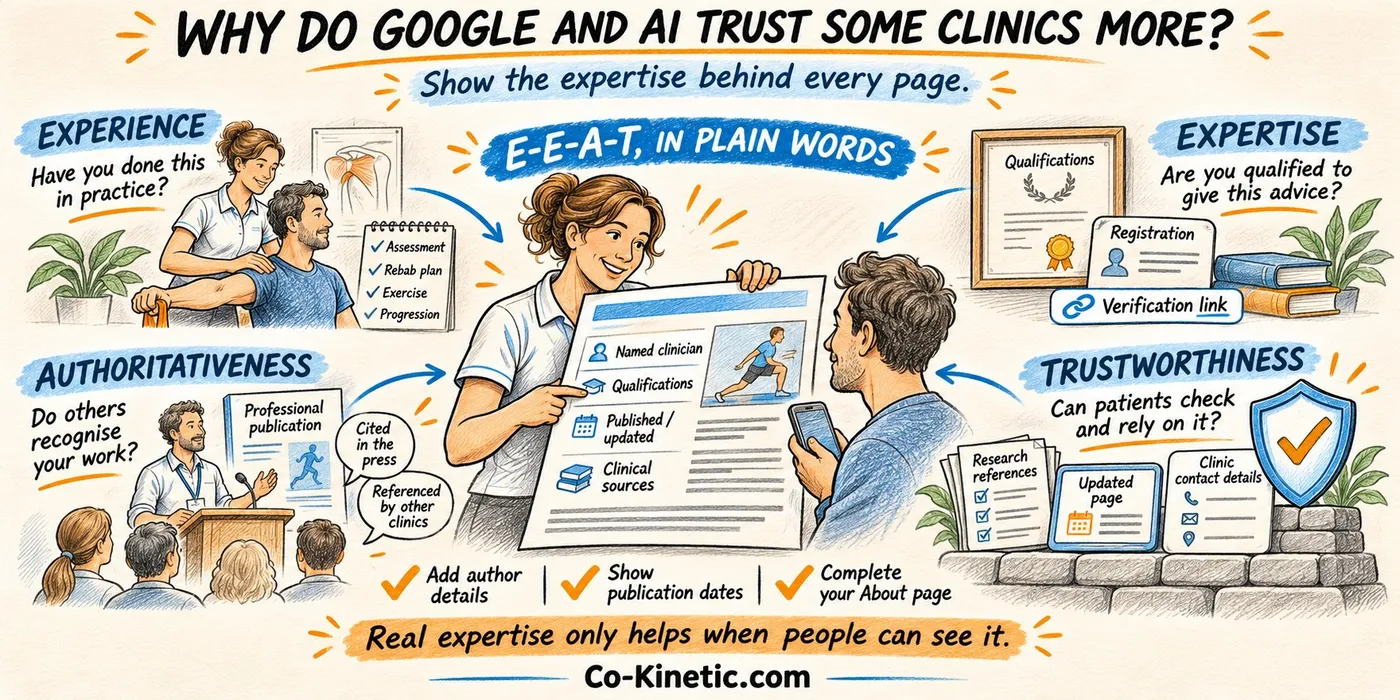
E-E-A-T stands for Experience, Expertise, Authoritativeness, and Trustworthiness. If you've been ignoring it because it seemed like SEO jargon, that's understandable. But it's not really about SEO tricks. In plain words, it's about whether patients, and Google, can see who wrote your content, that they've really done it, and that they can be trusted: that you're a qualified practitioner who knows what you're talking about.
If your website doesn't make these things clear, your expertise is invisible to the patients reading it, and you're falling short of what Google's own guidance asks of health content.
What's Actually Happening
When someone asks ChatGPT "where should I go for treatment for runner's knee in Bristol," it doesn't randomly pick clinics. It draws on the pages that explain that problem best, and on what it can find about the clinics behind them: what they treat, who they help and how they work.
Same with Perplexity. Same with Google's AI Overviews, which now appear on most health questions: BrightEdge tracking shows that by December 2025, 89% of the healthcare search terms it monitors triggered one, including 100% of treatment searches and 98% of pain-related searches (US data).
What the research shows is that evidence earns visibility: peer-reviewed research from Princeton and IIT Delhi (KDD 2024) tested 10,000 search queries across 25 subject areas, including health, and found that adding quotations, statistics and cited sources each lifted a page's visibility in AI-generated answers by roughly 25 to 28%, and by up to 40% in the best cases. For science and health questions, adding statistics was among the most effective changes, while keyword stuffing, the old SEO shortcut, didn't help at all. And AI can only pass on what it can find: if your website doesn't say what you treat and how, it has nothing to recommend you for.
This isn't theoretical. It's happening now. In the UK, 8% of adults already say AI tools are their first port of call for health information, rising to 13% of millennials (YouGov, July 2026, 2,100 UK adults). In the US, monthly use of AI chatbots for health information rose from 17% of adults (KFF, August 2024) to 29% (KFF, June 2026, 2,480 adults) in two years: same pollster, same question.
The content that does well with Google is largely the content that does well in Google's AI answers, because, as Google says, there's no separate set of rules.
Why This Matters for Your Clinic
You're a qualified practitioner. You've got the MSc, the MCSP or HCPC registration (if you're a physio), or the DO and GOsC registration (if you're an osteopath). You've treated hundreds of patients. You know what you're doing.
But if your blog posts don't have your name on them, if your qualifications aren't clearly displayed, if your content is published by "Admin" or has no author at all, patients can't see that you're qualified. So they book with someone whose website shows it.
This creates a frustrating situation. Your clinical knowledge is excellent. But the way your content is structured makes you look less authoritative than clinics with weaker expertise but better-presented websites.
That's what E-E-A-T addresses. It's not about gaming anything. It's about properly demonstrating the expertise you already have, in a way patients and Google can see straight away.
The Four Signals (And What They Actually Mean)
Experience
Patients (and Google's guidance) want to know: have you actually treated patients with this condition?
Not "do you know about it in theory", have you done it. When you write about treating frozen shoulder, readers are looking for signs that you've actually treated people with frozen shoulder.
What demonstrates experience:
- Your name attached to the article
- Specific treatment approaches you use
- What you typically see in clinic with this condition (anonymised, and never a named patient or their results)
- Photos or videos from your clinic showing actual treatment
Generic blog posts written by "Admin" about conditions don't demonstrate experience. Articles written by you, with your name and role clearly stated, do.
Expertise
Patients want to know: are you qualified to give this advice?
This is where your credentials matter. Your MSc. Your professional registration. Your specialist certifications. Google's guidance asks whether the person writing has the expertise to back it up, and patients look for exactly the same thing.
What demonstrates expertise:
- Full qualifications in your author bio (here's what a proper clinician bio page needs)
- Professional registration numbers visible
- Years of practice stated
- Specialist training or certifications listed
If this information isn't on your website, patients can only assume you don't have it.
Authoritativeness
The question here: are you recognised in your field?
This is harder for small clinics. It's not just about what you say on your own website. It's about whether other credible sources mention you, link to you, or reference your work (more on why mentions on other websites matter).
What demonstrates authoritativeness:
- Patient reviews on Google and other platforms
- Links from other healthcare professionals
- Professional association memberships
- Guest articles on recognised health sites
- Mentions in local press or health publications
You can't fake this one. You build it over time.
Trustworthiness
Patients want to know: is your information accurate and reliable? Google calls trust the most important of the four.
This is about evidence-based content, transparency about who you are, and clear ways for patients to contact you or verify your credentials.
What demonstrates trustworthiness:
- Evidence-based content with references to research
- Clear contact information and clinic address on every page
- Professional website (HTTPS security certificate)
- Transparent about qualifications and experience
- Content updated regularly with dates shown
Where Most Clinics Get This Wrong
If you've been publishing blog posts without dates, without author names, without credentials clearly displayed, patients have no way to tell your content from low-quality content, and it falls short of what Google's quality guidance looks for in health content.
It doesn't matter that the clinical information is good. Nothing on the page tells readers who stands behind it.
Here's what this looks like in practice:
What doesn't work:
- Blog post titled "Treatment for Lower Back Pain"
- Published by "Admin"
- No date visible
- No author bio
- Generic stock photo
What works:
- Same blog post
- Author: "Sarah Mitchell, MSc Physiotherapy, MCSP"
- Published: [clear date]
- Author bio at the end with qualifications, years of experience, photo
- Specific treatment protocols mentioned based on actual patient work
The clinical content could be identical. But the second version signals expertise. The first doesn't.
The Technical Bit (But Explained Simply)
Even when clinics add author bios and credentials, many wonder about the technical side.
This is called schema markup: a few lines of hidden code that tell search engines "this article was written by this specific person, who has these qualifications, about this health topic, published on this date."
Most website builders don't add this automatically. Think of it like this: your website shows your qualifications to human visitors, and schema markup is the machine-readable version of "yes, this person is qualified."
It's good housekeeping, and worth asking your web person about. But it isn't a magic switch: there's no good evidence that schema on its own makes AI tools more likely to recommend a clinic. When Ahrefs tracked 1,885 pages that added schema between August 2025 and March 2026, against 4,000 similar pages that didn't, their citations in Google's AI Overviews didn't rise (they dipped slightly, by 4.6%), and Google's own documentation says there's no special structured data you need to add. The words on the page, which patients and AI tools both read, matter far more. So don't let it distract you from the bigger job: putting your name, qualifications and clinical experience where patients can see them.
What This Means Practically
You need to check three things on your website:
1. Author information on every article
- Clear author name
- Full qualifications in bio
- Photo
- Years of experience and specialisation
- This needs to be on every blog post, every article
2. Publication and update dates
- Every article needs a clear publication date
- When you update content, show the update date
- Patients want to know your information is current
3. Professional signals throughout the site
- Contact information visible on every page
- Professional association logos (CSP, HCPC for physios; GOsC, iO for osteopaths)
- Clear about page explaining who you are
- Patient reviews visible and recent
- HTTPS security certificate (the padlock in the browser)
If you're missing any of these, start there. Don't try to fix everything at once. Pick one area and get it right.
The Bigger Picture
E-E-A-T isn't just about ranking in Google anymore. It's about being the clinic patients trust, whether they started with Google or with an AI tool.
And the shift is real. We're watching it in real time. In the UK, 69.5% of Google searches now end without a click to any website, the highest of the six countries studied, against 68% in the US (SparkToro analysis of Similarweb data, June 2026). More and more patients get their first answers before they ever reach a clinic's website.
If your content doesn't show who's behind it, the patients who do reach you have little reason to choose you.
The frustrating part? You already have the expertise. You're already qualified. You're already experienced, and that experience is now one of your biggest advantages online. You just need to make it visible on your website, where patients, Google and AI tools can all find it.
What We're Building
This is exactly why we built our Clinical Content System. It researches and writes articles under your clinicians’ names, with their credentials, publication dates, verified references and the structured data behind the scenes, built on up to 12 research steps from live clinical sources: super-high quality, evidence-based, clinical content.
You focus on the clinical knowledge. The system handles the E-E-A-T implementation.
Not everyone needs a full system, though. Sometimes you just need to understand what to fix, and that's what our Website & AI Visibility Review is for (more on that below).
But here's the reality: most clinics don't have time to become experts in schema markup, E-E-A-T signals, and how AI tools parse healthcare content. You're treating patients, managing admin, running a business.
That's the gap we fill.
What to Do This Week
Pick three things from the article and fix them. Don't try to tackle everything.
- Start with author information. If your blog posts don't have your name and qualifications attached, add them. That's the single biggest signal you can fix quickly.
- Then check publication dates.
- Then check your “about” page.
The shift to AI search isn't slowing down. The clinics that adapt to this now will be the ones patients find. The ones that don't will keep wondering why their excellent clinical work isn't translating into a steady flow of new patients.
If you want to see where you stand today, try our free AI visibility check. It takes a minute to request and tests real patient questions across ChatGPT, Google AI Overviews, Perplexity and Claude, then shows you who AI recommends instead and the three most impactful first steps. For the full picture, the Website & AI Visibility Review (£599, one payment) scores every page of your website against a research-grounded checklist and gives you a do-it-yourself list and a list for your web person. In the meantime, the checklist above is your starting point.
Tor
P.S. The quickest way to check if your content meets basic E-E-A-T standards is to look at your most recent blog post. Does it have your name on it? Your qualifications? A publication date? If you're answering "no" to any of these, that's your starting point.
Related reading
- Did You Know Experienced Clinicians Now Have a Superpower?: you've spent years losing out online to clinics with slicker social media. Now the tables have turned: Google and AI tools are looking for exactly what you have, real clinical experience. This shows why you now have the upper hand, and how to get your experience written down and visible so you use it.
- What Should Go on My Clinicians' Bio Pages?: your clinicians' experience is wasted if patients and AI can't see who wrote your pages. This shows exactly what a bio and byline need, so their expertise counts.
- Am I Too Old for All This AI Stuff? (Or Can I Just Ignore It?): if you've watched marketing fads come and go, this is the honest answer to whether you can sit this one out, and why your years in practice put you ahead if you don't.
- Why Can My Clinic Rank on Google but Not Get Recommended by AI?: why you can rank on Google and still be invisible when patients ask AI who to see, and the two things that close the gap.
References
- Google Search Central, AI features and your website, current as of December 2025. https://developers.google.com/search/docs/appearance/ai-features
- BrightEdge, healthcare and Google AI Overviews, three-year tracking 2023 to 2025, data to December 2025. https://www.brightedge.com/resources/weekly-ai-search-insights/healthcare-ai-evolution-google-2023-2025
- Aggarwal P. et al., Princeton University and IIT Delhi, GEO: Generative Engine Optimization, KDD 2024, 2024. https://arxiv.org/abs/2311.09735
- YouGov, AI is becoming part of UK adults' health information journey (2,100 UK adults), July 2026. https://yougov.com/en-gb/articles/55203-ai-is-becoming-part-of-uk-adults-health-information-journey
- KFF, KFF Health Misinformation Tracking Poll: artificial intelligence and health information, August 2024. https://www.kff.org/public-opinion/kff-health-misinformation-tracking-poll-artificial-intelligence-and-health-information/
- KFF, KFF Tracking Poll on Health Information and Trust: use of social media and AI for health information and advice (2,480 US adults), 17 June 2026. https://www.kff.org/public-opinion/kff-tracking-poll-on-health-information-and-trust-use-of-social-media-and-ai-for-health-information-and-advice/
- Ahrefs, matched-control study of 1,885 pages adding structured data, against 4,000 controls, pages tracked August 2025 to March 2026. https://ahrefs.com/blog/schema-ai-citations/
- SparkToro, six-country zero-click search study, analysing Similarweb clickstream data, 16 June 2026. https://sparktoro.com/blog/zero-click-searches-highest-in-the-uk-lowest-in-germany-and-france-has-the-most-efficient-searchers/
?Frequently Asked Questions
What does E-E-A-T stand for?
E-E-A-T stands for Experience, Expertise, Authoritativeness, and Trustworthiness. These qualities are essential for health content to ensure that patients and Google can recognize the qualifications and credibility of the content's author.
How can I demonstrate my expertise on my clinic's website?
To demonstrate your expertise, include your full qualifications, professional registration numbers, and years of practice in your author bio. Additionally, ensure that your articles are authored by you and reflect your specific treatment approaches.
Why is it important to have author information on every article?
Having author information on every article helps establish credibility and trust with patients. It allows readers to see who is behind the content and understand the qualifications of the author, which is crucial in the health sector.
What are some common mistakes clinics make regarding E-E-A-T?
Common mistakes include publishing content without author names, lacking publication dates, and not displaying credentials or contact information. These oversights can lead to a perception of low-quality content, making it difficult for patients to choose your clinic.
How does AI impact the visibility of health content?
AI tools like ChatGPT and Google's AI Overviews draw on the pages that answer a patient's question best. Peer-reviewed research (Princeton and IIT Delhi, KDD 2024) found that adding quotations, statistics and cited sources improved a page's visibility in AI answers by up to 40% in benchmark tests. A named, qualified author doesn't guarantee a recommendation, but it's what patients and Google's own quality guidance look for in health content.
What can I do this week to improve my clinic's E-E-A-T?
Start by adding your name and qualifications to your blog posts, ensuring each article has a clear publication date, and updating your 'about' page to reflect your credentials. Focusing on these areas can significantly enhance your perceived expertise and trustworthiness.