
Did You Know Experienced Clinicians Now Have a Superpower?
Why years in practice are now one of your biggest advantages online, and what needs to be on your website for patients, Google and AI to see it. For experienced clinicians who feel their reputation should be doing more for them.
Reviewed and updated: November 2026
If you've been in practice for ten years or more, AI search is the first time your clinical experience has actually counted as a marketing asset.
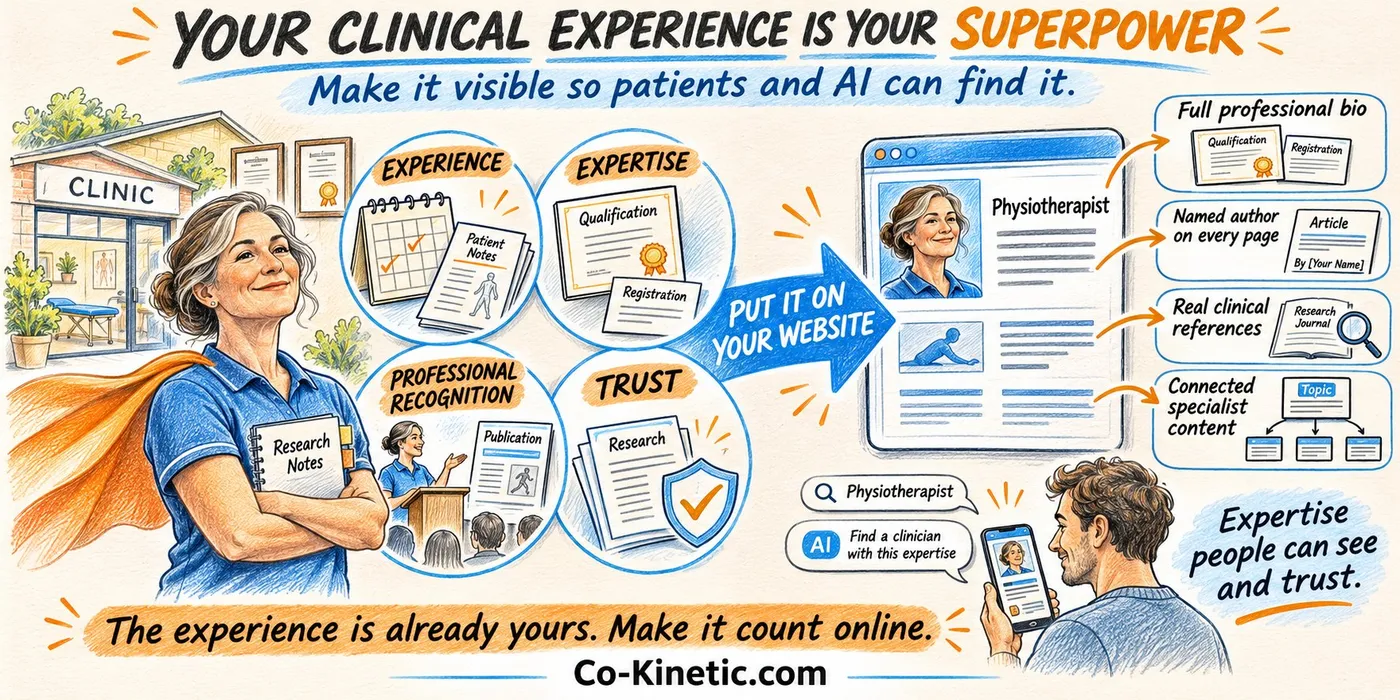
That's not hyperbole. Google judges health content against a quality standard called E-E-A-T: Experience, Expertise, Authoritativeness, Trustworthiness, in plain words, does this come from someone who really knows the subject and can be trusted? Google's AI Overviews draw on the same ranking systems: Google's own guidance says the best practices for SEO "remain relevant for AI features" (Google Search Central, December 2025). And AI tools like ChatGPT and Perplexity lean on sources that show genuine expertise. That standard maps almost perfectly onto what an established MSK clinic looks like. Your qualifications, years in practice, specialist focus, and professional standing are exactly what patients and Google are looking for. A newer clinic with a bigger budget and a better-looking website can't manufacture any of that quickly.
The catch is that your experience has to be visible in the right format for it to count. AI can't see the certificates on your wall or the reputation you've built locally; it can only read what's structured correctly on your website. That's the gap most established clinics have right now, and it's fixable. Here's what's actually going on, and what to do about it.
Why Marketing Has Always Beaten Experience Online, Until Now
For the past fifteen years, getting found online came down to how much you spent on backlinks, how many pages of content you had, and whether your agency knew what they were doing. Clinical experience was impossible to communicate to a search algorithm.
Google couldn't read your HCPC registration number. It couldn't measure a decade of specialist outcomes. It had no way to weigh your postgraduate training against a competitor who'd been in practice for two years. The algorithm was blind to the things that actually made you a better clinician.
So a newer clinic with a decent marketing budget and an active social presence could outrank you for searches you've been treating patients for since before they qualified. Better marketers beat better clinicians, every time.
To date, we've assessed more than 200 clinic websites (mostly in the UK), and the data shows this in both directions. Clinics with high SEO scores and polished websites that have low AI citation rates. And one clinic with a website health score that was genuinely one of the worst I'd seen, that had one of the highest AI citation rates I've measured!
The reason? She'd spent years building a very specific niche in children's physiotherapy. The AI knew exactly who she was, what she treated, and why she was the right recommendation for that query. Her clinical focus, built over a decade of practice, was doing more work for her than any SEO campaign could. It was definitely not her website design, and I doubt she'd ever spent anything on Google Ads.
Why the More Experience You Have, the Bigger Your Advantage
AI tools don't rank websites. They recommend sources they trust. In health, that trust leans towards established names, but not exclusively: BrightEdge's analysis of 47,500 healthcare citations in Google's AI Overviews (October 2025 to January 2026) found elite hospital systems took 33% and government sites 10%, with roughly half going to sources outside the big institutional groups (BrightEdge). That's the space an experienced independent clinician can earn. And the standard Google uses to judge trust in health content, E-E-A-T, maps almost perfectly onto what an established MSK clinic looks like.
What makes this genuinely useful for experienced practitioners is that the advantage isn't flat; it scales with seniority. A clinician with 15 years of practice has more of every single E-E-A-T signal than one with 10 years, who has more than one with 5 years. A clinic that opened two years ago, however good their Instagram looks, can't manufacture any of it quickly. Time in practice is something a marketing budget simply can't replicate.
Here's what each of those signals means in practice, and why seniority matters on every one:
Experience means first-hand, documented knowledge of the conditions you treat. The key is making it legible: named authorship on your content, specific clinical detail, patient-centred language that only comes from actually treating people over time. A newer clinic can write about shoulder rehabilitation. You can write about it with a depth and specificity that AI tools are increasingly able to distinguish.
Expertise means verifiable qualifications. Your BSc, MSc, MCSP, HCPC registration number, specialist training qualifications, any postgraduate certificates. These aren't just letters after your name; they're what tells a patient, and Google's quality guidance, that the person behind the content is qualified to write it. Google's guidance on helpful content asks whether it's "self-evident to your visitors who authored your content", and sets the highest bar for health topics. A newer practitioner has fewer of these, and the ones they have are more recent. The depth and seniority of your qualifications count.
Authoritativeness means recognition within your field. Professional memberships, postgraduate training, published work, CPD delivery, speaking, teaching—things experienced practitioners accumulate over years and almost never think to mention online. If you've been around long enough to have any of these, and most practitioners with a decade or more behind them have more than they realise, they're trust signals waiting to be used. A clinician who qualified three years ago simply doesn't have them yet.
Trustworthiness means transparency and a track record. Clinical citations from peer-reviewed research. Clear author attribution. An established domain with years of history behind it. These are genuinely harder for a newer clinic to replicate. You can't buy a ten-year-old domain or manufacture a professional reputation. Every year you've been in practice adds to this signal.
The clinics being recommended by ChatGPT, Perplexity, and Google AI Overviews right now aren't necessarily the ones with the best-looking websites. They're the ones whose online presence most clearly signals clinical authority. The newer clinic with the better marketing budget is playing the wrong game. The more years you have behind you, the more decisively you can win the right one.
The Catch: Your Experience Has to Be Visible to Count
Here's the problem. AI tools can't see the certificates on your wall, the reputation you've built locally, or the decade of patient outcomes in your notes. They can only read what's on your website, in your content, and in your structured data.
If your expertise isn't expressed in the right format, with the right signals, it's completely invisible to the AI tools, and a three-year-old clinic with a well-structured website can appear more authoritative than a practice with fifteen years of specialist experience behind it. That's where a lot of established clinics are losing the advantage they should have. The experience is real and deep. It's just not structured in a way the AI can find and reward.
That's a technical gap, which means it's fixable. Here's what needs to be in place:
A proper professional bio page. Not a one-paragraph 'about me' (here's exactly what a clinician bio page needs). A full page with your qualifications, your HCPC registration number with a link to verify it, your areas of specialism, your years in practice, and any research, publications, CPD delivery, or teaching you've done. The more years and credentials you have, the more powerful this page becomes, and the harder it is for a newer competitor to match.
Author bylines on every piece of content. Every blog post, every condition page, every treatment guide needs your name and credentials attached—not just your name, but your qualifications and a link to your full bio page. Patients follow that link to decide whether to trust you, Google's guidance asks that it's clear who wrote the content, and AI can only pass on what it can find.
Clinical citations in your articles. References to peer-reviewed research build patients' trust, and they're one of the few things with real evidence behind them: peer-reviewed research from Princeton and IIT Delhi (Aggarwal and colleagues, KDD 2024) tested 10,000 queries across 25 subject areas, including health, and found that adding expert quotations, statistics and cited sources each lifted a page's visibility in AI-generated answers by roughly 24 to 28% on the paper's main measure, with the best results reaching around 40% in benchmark tests. Aim for around five solid references per article from reputable journals. An experienced clinician who knows the literature is at a natural advantage here.
Hub and spoke content structure. A central pillar page for your specialism, with cluster articles covering different aspects of it, all linking back to the pillar. A tight cluster of five or six well-written articles on one specific topic will usually do far more for you than fifty disconnected general ones. Ahrefs' 2026 analysis found pages that also rank for the follow-up questions behind a search were 161% more likely to be cited in Google's AI Overviews (Ahrefs, 2026). Your specialism, built over years, is what makes this possible in a way a generalist newer clinic can't replicate.
Clear site navigation. AI tools crawl your site the way a new patient might browse it. If your areas of specialism, condition pages, and treatment information aren't logically structured and easy to find, the AI struggles to map what you actually do. Your navigation should reflect your clinical focus, not just generic menu labels. This matters more if you have a specialism because the AI needs to be able to follow the thread from your homepage through to the detailed content that demonstrates it.
Schema markup. Structured data in the background of your website that labels who you are, what you treat, and where you are. It's good housekeeping that helps search engines read your pages accurately, but it isn't what gets a clinic recommended on its own. When Ahrefs tracked 1,885 already-cited pages that added schema against 4,000 that didn't (August 2025 to March 2026), their Google AI Overview citations didn't rise; if anything they dipped slightly (Ahrefs, 2026). The content and credentials it describes are what count.
None of this requires necessarily rebuilding your website from scratch. For most established clinics, it means adding a layer of structure to expertise that already exists. The clinical substance is there, and the more of it you have, the more powerful the result when it's properly surfaced.
"Why Do You Need So Much Detail From Me?"
If you run a clinic, you'll hear this from your team. Someone is asked about their postgraduate courses, the conditions they see most, how they explain a problem to a patient, and the reply is some version of "Why on earth do they need all this?"
It's a fair question. Clinicians are busy, profiles feel like admin, and most good clinicians are modest about what they know. So here's the honest answer, kindly but firmly: the detail is the whole point. Everything in this post runs on it.
Part of the surprise is what they're used to. On most clinic websites, a clinician gets a photo and a short paragraph: where they trained, what they enjoy treating, maybe a hobby. It isn't enough for AI: a paragraph gives Google and AI almost nothing to verify and nothing to write from, so the clinician, and the clinic, stay invisible.
And if we're honest, it was never enough for patients either. Someone in pain who's deciding who to trust with their knee or their back wants to know the person who'll be treating them: what they've seen before, how they work, whether they've helped people like them. A short paragraph gives them nothing to relate to and nothing to build trust on. Picture a runner with a niggling Achilles. If they can see that one of your physios runs marathons, has a special interest in running injuries and works with the local running club, that's the thing that clinches the appointment. What AI is looking for now is exactly what patients have always been looking for. We just haven't given it to them.
Without the detail, any content written for your clinic can only say what every other clinic says. It ends up as the same article anyone could get from ChatGPT (here's why that leaves you to pot luck), and AI has nothing to choose you by. With it, every page carries something no competitor can copy: your clinician's real experience.
Here's what each kind of detail does:
- Qualifications, registration and specialist training make their expertise verifiable. This is the E-E-A-T evidence Google and AI look for.
- Years in practice and the conditions they see most let the writing show genuine experience, not textbook knowledge.
- How they explain things to patients, the advice they find themselves repeating, the misconceptions they correct every week: this is what makes a page sound like them, not like a template.
- Teaching, memberships, published work and local connections (the running club, the GP practice, the gym they work with) build authority and give other websites a reason to mention you.
Two things make it easier to ask for:
- It's done once. Twenty or thirty minutes now is used in every piece written under their name, for years.
- It doesn't have to be a form. A short conversation or recorded interview gets most of it far faster than typing (here's the faster way to fill in clinician profiles).
If you own the clinic, this is about your clinic
Here's the part that matters most for owners. These profiles aren't your clinicians' personal CVs. They're your clinic's evidence. When AI recommends a clinic, it's because of what it can see about the people who work there: their training, their experience, the conditions they're known for. Every detail a clinician gives makes your clinic more likely to be named.
Think about what you're paying for when you employ an experienced clinician: years of training, courses, the conditions they've treated hundreds of times. That experience is a big part of what your clinic sells. But AI can't see any of it unless it's written down. A thin profile means you're paying for expertise your website keeps hidden.
So it needs you behind it. Treat it the way you'd treat CPD or notes: part of the job, done in work time, with a date it's done by. Your team will take it as seriously as you do. If you're lukewarm, they will be too.
If you want a line to share with your team, use this one:
"The detail you give is what makes our content sound like you and not like every other clinic. Google and AI recommend clinicians whose real experience they can see. It's a 20 to 30 minute conversation, once, and it's used in everything written under your name."
So no, it isn't optional. A thin profile doesn't just produce weaker content; it produces exactly the generic content this whole post warns against. Your clinicians' experience is the superpower. The detail is how it gets out of their heads and onto the page.
The Window is Now: Most Clinics Haven't Moved Yet
The vast majority of MSK clinics are still running the same content strategy they had five years ago. They're optimising for Google rankings using the same approach their SEO agency has always used, unaware that the clicks those rankings deliver are shrinking as AI answers appear above them, and that a different game is already in play. Ahrefs measured the click-through rate for the top-ranked page on searches with an AI Overview falling from 7.3% in December 2023 to 1.6% in December 2025 (Ahrefs, February 2026). Meanwhile, YouGov found 8% of UK adults already go to AI first for health information, rising to 13% of millennials (YouGov, July 2026).
The depth that gets a clinic named builds over months, and every piece makes the next count for more, because each new page links into the ones before. A handful of well-structured articles, under your name and done properly, is where it starts to compound.
And here's the thing about compounding: the longer you've been in practice, the faster it works. You're not starting from zero. You're layering structure onto a foundation of genuine clinical authority that a newer competitor simply doesn't have yet. If you've been practising for 15 or 20 years, that foundation is deep. Get the structure right and it has a great deal to work with.
A competitor who starts publishing well-optimised content today will be ahead of you in three months and significantly ahead in twelve if you do nothing. The ones who wait will find the gap harder to close, not because the task gets harder, but because the competition gets stronger. The window is now, and the practitioners with the most to gain from it are exactly the ones who've been in practice long enough to feel like their clinical reputation should be doing more work for them online.
It can. It just needs to be pointed in the right direction.
Tor
Related reading
- Am I Too Old for All This AI Stuff? (Or Can I Just Ignore It?): if you've watched marketing fads come and go, this is the honest answer to whether you can sit this one out, and why your years in practice put you ahead if you don't.
- Why Do Google and AI Trust Some Clinics More Than Others?: why Google and AI trust some clinics' pages and not others, and the simple changes that put your team's experience and credentials where they can see them.
- What Should Go on My Clinicians' Bio Pages?: your clinicians' experience is wasted if patients and AI can't see who wrote your pages. This shows exactly what a bio and byline need, so their expertise counts.
- Will AI Replace Physios?: why hands-on clinicians are among the safest professions as AI takes over other work, and why being visible now matters more than being skilled.
- Why Can't I Just Use ChatGPT to Write My Clinic's Articles?: before you write another page with ChatGPT: the seven things it can't do for your clinic, from knowing which pages will move the needle to getting the references right, and why content that sounds like everyone else's leaves your chance of being found to pot luck.
- How Do I Get Other Websites to Mention My Clinic?: one of the most overlooked ways to get named by AI, and how to build it from relationships you already have: running clubs, gyms, local directories.
References
- Google Search Central. AI features and your website. Documentation, current as of December 2025. developers.google.com/search/docs/appearance/ai-features
- BrightEdge. Healthcare citations in ChatGPT and Google AI Overviews (47,500 AI Overview URL-prompt pairs, October 2025 to January 2026). www.brightedge.com/resources/weekly-ai-search-insights/healthcare-ai-citations-chatgpt-vs-google-trust
- Google Search Central. Creating helpful, reliable, people-first content. Documentation. developers.google.com/search/docs/fundamentals/creating-helpful-content
- Aggarwal P, et al. GEO: Generative Engine Optimization. KDD 2024 (Princeton University and IIT Delhi); benchmark of 10,000 queries across 25 domains. arxiv.org/abs/2311.09735
- Ahrefs. How to rank in AI Overviews: query fan-out and citation analysis. January 2026, updated May 2026. ahrefs.com/blog/how-to-rank-in-ai-overviews/
- Ahrefs. Schema markup and AI citations: matched-control study of 1,885 pages adding structured data vs 4,000 controls (August 2025 to March 2026). 2026. ahrefs.com/blog/schema-ai-citations/
- Ahrefs. AI Overviews and click-through rate, updated study of 300,000 keywords (December 2023 vs December 2025). 4 February 2026. ahrefs.com/blog/ai-overviews-reduce-clicks-update/
- YouGov. Survey of 2,100 UK adults on AI and health information (fieldwork 13 to 14 July 2026). July 2026. yougov.com/en-gb/articles/55203-ai-is-becoming-part-of-uk-adults-health-information-journey
?Frequently Asked Questions
How can my clinical experience improve my online visibility?
Your experience is exactly what patients and Google's quality guidance look for: first-hand knowledge, verifiable qualifications and standing in your field. AI tools can only pass on what they can find, so putting that experience on your website in depth, under your name, is what makes it count.
What is E-E-A-T and why is it important for my clinic?
E-E-A-T stands for Experience, Expertise, Authoritativeness and Trustworthiness. It's the standard Google uses to judge whether content comes from someone who really knows the subject, and the bar is highest for health. It matters because it plays straight to the strengths of experienced clinicians.
What specific steps can I take to enhance my clinic's SEO?
Create a full professional bio page with your qualifications and registration, put your name and credentials on every piece of content, include clinical citations from peer-reviewed research, and build a hub and spoke structure around your specialism. Schema markup is good housekeeping, but the content and credentials it describes are what count.
Why do newer clinics often outrank established clinics online?
For years, getting found online rewarded marketing budgets, backlinks and content volume rather than clinical experience. That is shifting, because Google's quality standard and the AI tools patients now use look for genuine first-hand expertise.
What is the 'window of opportunity' mentioned for clinics?
Most clinics haven't yet adapted to patients asking AI tools who to see. Clinics that put their experience online properly now can get ahead of local competitors who wait.
Why does my clinic's content need so much detail from our clinicians?
Because the detail is what makes the content theirs. Qualifications, years in practice, the conditions they see most and how they explain things to patients are what Google and AI look for when deciding whose content to trust, and they are what stops a page sounding like every other clinic. A 20 to 30 minute interview per clinician, done once, is the fastest way to gather it.