
Am I Too Old for All This AI Stuff? (Or Can I Just Ignore It?)
An honest answer for experienced clinicians who've seen marketing fads come and go: is AI visibility worth your time, and what happens if you ignore it? Why your years in practice are an advantage, if patients and AI can find them.
Reviewed and updated: November 2026
I've been doing this long enough to have watched a lot of marketing trends arrive with enormous fanfare and quietly disappear. SEO was going to transform everything. Then Google Ads. Then social media. Then video. Each one was urgent, unmissable, the thing you absolutely had to do right now.
So when AI visibility comes along, the reaction is understandable. Here we go again.
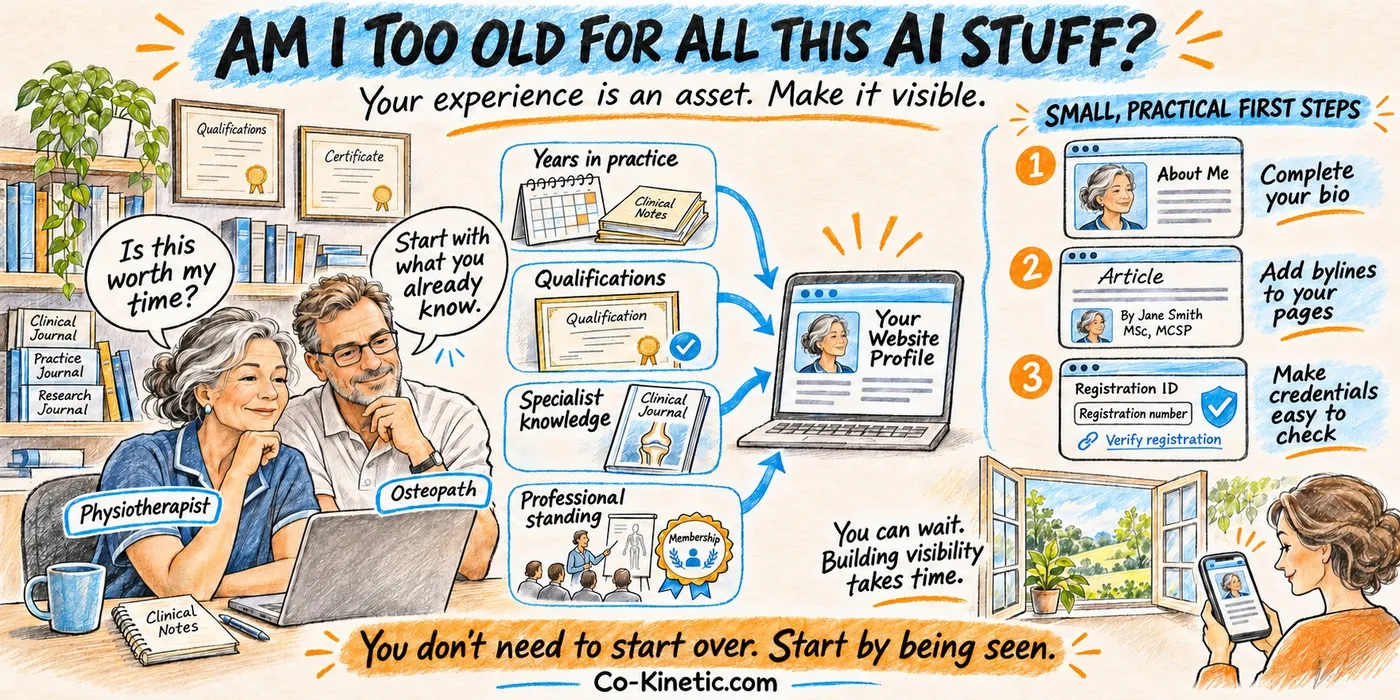
Here's why this one is worth a second look though, particularly if you've been in practice for a long time. AI search is the first channel where your clinical experience is a direct advantage rather than something the algorithm can't read. The longer you've been practising, the stronger that advantage is. The catch is that it only counts if your experience is structured in a way the AI can actually find. That's the fixable bit, and it's what this is about.
Why the Scepticism Makes Sense
If you've been in practice for 15 or 20 years, you've seen the cycle. Something new arrives, the marketing world tells you it's non-negotiable, you either invest time and money in it or feel guilty for not doing so, and then the landscape shifts again.
Social media is the obvious example. Huge amounts of energy went into building followings, posting consistently, learning algorithms, and for most MSK clinic owners the return on that investment has been, to put it generously, mixed. The clinics that grew weren't necessarily the ones with the biggest Instagram presence. They were the ones with good clinicians, strong word of mouth, and enough visibility to be found when someone was actively looking.
The scepticism that builds up over years of watching this is a reasonable response to a pattern that's been real. Most things marketed as urgent are not.
So I'm not going to tell you AI visibility is different because everyone says so, or because the numbers sound impressive. I'm going to tell you the specific reason it's different, and let you decide what to do with that.
Why This One Is Structurally Different
Every other digital marketing channel of the past fifteen years has had one thing in common: it rewarded output over substance. More content, more posts, more backlinks, more ad spend. Clinical experience was invisible to algorithms. The clinics that won online were often the ones with the biggest budgets (or who spent more time on their digital presence), not the best practitioners.
AI search tools work on a different logic entirely. They don't rank websites by volume or spend. They recommend sources they trust. The old spending doesn't carry over: Seer Interactive's study of 300,000 keywords found backlinks, the classic SEO purchase, had weak or no effect on whether AI tools mention a brand (Seer Interactive, January 2025). And you can't simply buy your way in: as of OpenAI's June 2026 advertising policy, ads from clinical care providers are not allowed in ChatGPT (OpenAI, June 2026), and Perplexity dropped advertising altogether in February 2026 (Campaign, reporting the Financial Times). And the standard Google uses to judge trust in health content, which it calls E-E-A-T (Experience, Expertise, Authoritativeness, Trustworthiness: in plain words, does this come from someone who really knows the subject?), is built around exactly the things established clinicians have spent years accumulating. Google's own guidance on helpful content says "trust is most important", and it sets the highest bar for health topics.
If you've been doing SEO for a while you may have come across E-E-A-T before. The difference is that traditional SEO treated it as one consideration among many, alongside backlinks, page speed, content volume and dozens of other factors. When a patient asks an AI tool who to see, it draws on the pages that explain their problem best and on what it can find about who's behind them. It's not a refinement of the old game, it's a different one.
Your HCPC registration number is a trust signal. Your postgraduate training is a trust signal. Your years of specialist practice, your professional memberships, your CPD delivery, the depth of your clinical focus: all of these are what patients look for when deciding who to trust, what Google's quality guidance asks to see, and what an AI tool can pass on to a patient, as long as it can find them.
A clinic that opened two years ago with a polished website and a good social media strategy can outrank you on Google. They can't fake a decade of specialist practice. That's the structural difference, and it's why this channel is worth a different kind of attention from an established clinician than from a newer one.
Am I Too Old for This?
At the risk of sounding rather blunt, I think this question often carries something underneath it that doesn't get said directly. It's not really about age. It's about whether the investment of time and energy is worth it at this point in a career, when you've already built something, when you're not starting from zero, when you have legitimate reasons to be tired of being told the ground is shifting again.
That's a fair question. And the honest answer is that the advantage in AI search isn't despite your experience, it's because of it. The longer you've been practising, the more E-E-A-T signals you have. A clinician with 20 years of practice has more of every single one of those signals than one with 5. The depth and seniority of your qualifications count. The professional standing you've built counts. The specialist focus you've developed over time counts.
What I keep seeing in the more than 200 clinic websites we've assessed is that the clinics with the strongest foundations are often getting the worst results, not because their clinical authority isn't there, but because it isn't visible. The experience is real and deep. It's just not structured in a way the AI can find and reward.
That's a much more fixable problem than not having the experience in the first place.
Can I Just Ignore It?
Yes. You can. And again I want to be honest about that rather than manufacture urgency that isn't real.
If your clinic has a strong enough local reputation, a steady referral base, and enough existing patients that you're not depending on new patient acquisition through search, then the immediate cost of ignoring AI visibility is low. You're not going to lose what you've built overnight as long as nothing breaks that status quo.
What you're giving up is a window. AI search is still relatively new, most MSK clinics haven't moved on it yet, and the practitioners who establish their visibility now will compound that advantage month on month as the channel grows. And it is growing fast: Ofcom counted 1.8 billion UK visits to ChatGPT in the first eight months of 2025, up from 368 million in the same months of 2024 (Ofcom Online Nation, December 2025), and YouGov found 8% of UK adults now go to AI first for health information (YouGov, July 2026). The ones who wait will find it's still doable, but the gap will be harder to close because competitors will have content with history behind it and citation rates that have had time to build.
The other thing worth knowing is that the fixes required aren't a major undertaking. For most established clinics it's not a rebuild, it's a layer of structure added to what already exists. A proper bio page. Author bylines on existing content. A registration verification link. A tighter content focus. None of these require starting from scratch.
So the question isn't really "can I ignore it" but "what am I comfortable giving up, and for how long." That's a reasonable calculation, and only you can make it.
If You've Decided It's Worth Looking At
The two blogs that cover the practical detail are here:
And the other covers author attribution specifically, which leads every page's grade in our research-grounded checklist and is the most common thing missing from clinic websites.
Neither of them requires you to commit to anything. They're just the clearest explanation I can give of what's actually going on and what the practical steps look like.
And if you'd simply like to know where you stand first, our free AI visibility check takes a minute to request. It tests real patient questions across ChatGPT, Google AI Overviews, Perplexity and Claude, and shows you whether your clinic is named.
With warm wishes as always
Tor
Related reading
- Did You Know Experienced Clinicians Now Have a Superpower?: you've spent years losing out online to clinics with slicker social media. Now the tables have turned: Google and AI tools are looking for exactly what you have, real clinical experience. This shows why you now have the upper hand, and how to get your experience written down and visible so you use it.
- Why Do Google and AI Trust Some Clinics More Than Others?: why Google and AI trust some clinics' pages and not others, and the simple changes that put your team's experience and credentials where they can see them.
- What Should Go on My Clinicians' Bio Pages?: your clinicians' experience is wasted if patients and AI can't see who wrote your pages. This shows exactly what a bio and byline need, so their expertise counts.
- Are Patients Asking AI Which Clinic to Go To?: patients now ask AI before they ever see your website. This shows what that means for your clinic in plain terms, and the five things that decide whether you're the one it names.
References
- Seer Interactive. What drives brand mentions in AI answers (300,000 keywords). January 2025. www.seerinteractive.com/insights/what-drives-brand-mentions-in-ai-answers
- OpenAI. Ad policies. Updated 4 June 2026. openai.com/policies/ad-policies/
- Campaign, reporting the Financial Times. Perplexity ends advertising, citing user trust. 20 February 2026. www.campaignlive.com/article/perplexity-pulls-plug-ads-citing-trust-concerns-ai/1949142
- Google Search Central. Creating helpful, reliable, people-first content. Documentation. developers.google.com/search/docs/fundamentals/creating-helpful-content
- Ofcom. Online Nation 2025. 10 December 2025. www.ofcom.org.uk/media-use-and-attitudes/online-habits/from-apps-to-ai-search-how-the-uk-goes-online-in-2025
- YouGov. Survey of 2,100 UK adults on AI and health information (fieldwork 13 to 14 July 2026). July 2026. yougov.com/en-gb/articles/55203-ai-is-becoming-part-of-uk-adults-health-information-journey
?Frequently Asked Questions
What is AI visibility and why is it important for established clinicians?
AI visibility is how easily AI tools can find your expertise and pass it on when patients ask who to see. It matters for established clinicians because, unlike earlier marketing trends that rewarded budgets and posting, it plays to first-hand clinical experience, as long as that experience is on your website.
How can established clinicians structure their experience to improve AI visibility?
Make your credentials and experience easy to find: a well-structured bio page, your name and qualifications on every piece of content, and a link to verify your professional registration. AI can only pass on what it can find, and patients look for the same things.
Am I too old to adapt to AI visibility strategies?
No. Age isn't the issue; the real question is whether the time is worthwhile. Experienced clinicians have more of exactly what patients and Google's quality guidance look for, which makes this shift work in their favour.
Can I ignore AI visibility if my clinic has a strong local reputation?
Yes, if your clinic has a solid local reputation and a steady patient base, the immediate cost is low. But you give up a window: most clinics haven't moved yet, and those that do now will be harder to catch later.
What are E-E-A-T signals and why do they matter for AI search?
E-E-A-T stands for Experience, Expertise, Authoritativeness and Trustworthiness. It's the standard Google uses to judge health content, and it's built around what established clinicians already have: years of first-hand practice, qualifications and professional standing.
What practical steps can I take to enhance my clinic's AI visibility?
Add a proper bio page, put author bylines on your existing content, make your registration easy to verify, and tighten your content focus. It isn't a complete overhaul, just putting the experience you already have where patients and AI tools can find it.