
Does My Clinic Website Need an FAQ Section?
Why an FAQ section that answers your patients' real questions is one of the quickest wins on a clinic website, and how to write one. For clinic owners looking for a simple, practical improvement this week.
Reviewed and updated: November 2026
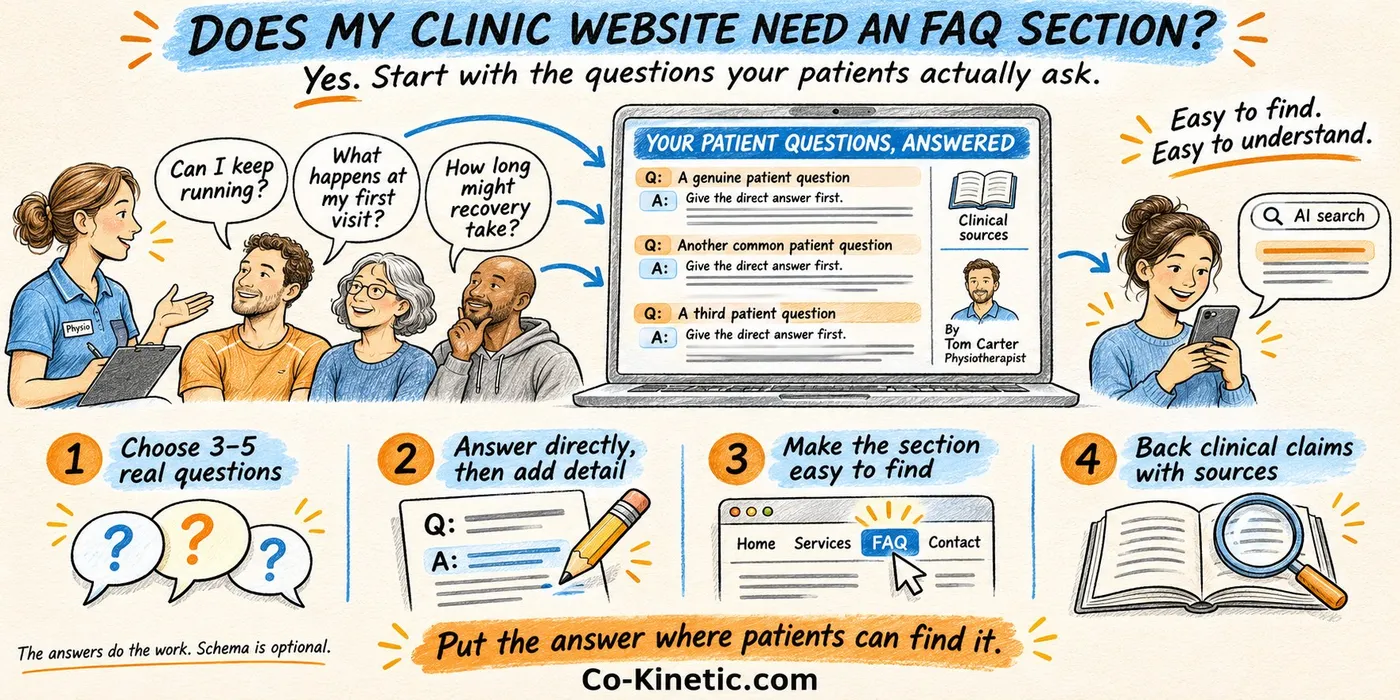
Adding an FAQ section to your most visited clinic pages is one of the simplest, most useful things you can do for your patients. It answers the exact questions they'd otherwise take somewhere else, in their own words, with the answer first. Answering patients' real questions clearly is what Google's guidance asks for, and it means that when an AI tool goes looking for an answer, there's a clear one on your page to find.
The reason it helps is straightforward. Patients think in questions, and so do the AI tools they ask. Questions are also where Google most often puts an AI answer at the top: a Washington University in St Louis study of 55,393 Google searches in spring 2026 found AI Overviews on 65% of question-style searches, against 9.5% of other searches (Montgomery, Iqbal and Xu, September 2026). When a patient types a query into ChatGPT or Perplexity, the AI is looking for content that directly answers that question. A page that puts clear questions and direct answers in front of the reader makes the answer easy to find, for the patient and for the AI tool reading the page. A page written as flowing prose, however well-written, makes everyone work harder to find it.
Most clinic websites are written as flowing prose. That's the gap, and it's one of the more fixable ones.
Why AI Thinks in Questions
When someone searches for help with a health problem, they're almost always asking a question, even if they don't phrase it that way. "Shoulder pain worse at night" is a question. "Physio near me for knee pain" is a question. "How long does a rotator cuff injury take to heal" is an explicit question.
When patients ask AI tools for help, they ask in questions and get a conversational answer back rather than a list of links. In the UK, YouGov's July 2026 survey of 2,100 adults found 16% had already used AI to understand symptoms (YouGov, July 2026). Content that answers the question directly, question first and answer immediately following, is simply easier to use: for the patient reading it and for the AI tool looking for a clear answer. Nobody can promise any format gets a page cited, but a page that never answers the question clearly gives an AI tool nothing to pass on.
This is a significant departure from how most clinic websites have been built. Traditional SEO content was written to contain keywords, to be comprehensive, and to signal topical authority through volume and coverage. AI visibility content needs to signal topical authority through depth and direct responsiveness to specific questions. The two approaches are related but meaningfully different.
What a Good FAQ Section Actually Looks Like
A useful FAQ section isn't a list of generic questions nobody actually asks. It's a carefully chosen set of three to five questions that genuinely reflect what patients search for and what they want to know about that specific condition or treatment.
For a page on rotator cuff rehabilitation, useful FAQ questions might be: How long does rotator cuff rehabilitation take? Can I continue working during rotator cuff rehab? What exercises should I avoid with a rotator cuff injury? When should I consider surgery instead of physiotherapy? What's the difference between a rotator cuff tear and tendinopathy?
Each of those matches a real patient query. Each of them gives a patient, and any AI tool answering them, a specific answer to find when that question is asked. The answers don't need to be long, 40 to 60 words is often enough to answer the question directly before going into more detail if needed. What matters is that the answer starts immediately after the question, not three paragraphs in. When Pillarbase analysed 15.7 million citations in Google's AI Mode, 80% of the passages quoted put the answer in their first sentence, and passages led by a question were reused about twice as often (Search Engine Land, July 2026).
The positioning on the page matters too. Patients want the answer early, and one large analysis of 18,012 verified ChatGPT citations, drawn from 1.2 million answers, found 44.2% came from the first 30% of a page (Kevin Indig, Growth Memo, via Search Engine Land, February 2026). An FAQ section buried at the very bottom, after 2,000 words of running text, is less useful than one placed earlier, at natural breaks in the content, or at minimum in a clearly signposted section readers can jump to quickly.
The Schema Piece
An FAQ section on its own does the real work. Schema markup is an optional finishing touch.
Schema markup is a small piece of structured code that sits in the background of a webpage and labels what type of content is on the page, so search engines can read it accurately. FAQ schema labels the questions and answers. It's tidy, but be wary of anyone who tells you it makes AI more likely to cite you: the evidence so far doesn't show that. When Ahrefs tracked 1,885 already-cited pages that added schema against 4,000 that didn't (August 2025 to March 2026), their Google AI Overview citations didn't rise; if anything they dipped slightly (Ahrefs, 2026). Google's own guidance says "there's also no special schema.org structured data that you need to add" to appear in its AI features (Google Search Central, December 2025), and Google stopped showing FAQ rich results altogether in May 2026 (more in our May 2026 AI search update). What matters is the quality of the questions and answers themselves.
If you do want to add it, FAQ schema sounds technical, and it does require either a developer or a plugin if you're on WordPress, but the process is straightforward. Any of the major AI tools will generate the correct schema code if you paste in your questions and answers and ask for it. Your developer can then add it to the page. It's a one-off task per page and it doesn't require rewriting any existing content.
So What Does This Actually Mean for Your Site?
Many clinic websites have a set of condition and treatment pages sitting there doing very little, not because the content is wrong, but because they don't answer the questions patients actually ask, clearly and early.
Adding FAQ sections to those pages, particularly the most visited ones, is one of the quickest, cheapest improvements most clinics can make right now. It doesn't require new content, a website rebuild, or a significant budget. It requires identifying the questions patients are actually asking about each condition and answering them clearly and directly. Where an answer makes a clinical claim, back it with a real source: peer-reviewed research from Princeton and IIT Delhi (Aggarwal and colleagues, KDD 2024) tested 10,000 queries across 25 subject areas, including health, and found that adding expert quotations, statistics and cited sources each lifted a page's visibility in AI-generated answers by roughly 24 to 28% on the paper's main measure, with the best results reaching around 40% in benchmark tests.
That's a realistic week's work for most clinics, and your patients get the benefit straight away.
Where to Start
The highest-value pages to tackle first are your most visited condition and treatment pages. You can find these in Google Analytics or Google Search Console. Pick the five pages that get the most traffic, add three to five genuine patient questions to each one with direct answers, and, if your website makes it easy, add FAQ schema behind each page as a finishing touch.
Tor
Related reading
- Which Pages on My Clinic Website Actually Bring In Patients?: stop spending hours on content nobody reads: the few pages that bring in most of your patients, and what to write first.
- How Should I Write a Blog Post So AI Actually Uses It?: a simple template that makes every post you write easier for patients to read and for AI to quote.
- Why Isn't AI Picking Up My Blog Posts?: if you've been writing short blog posts, this explains why AI skips them, and what a page needs so AI uses it.
- What Does My Clinic's Homepage Need?: a prioritised checklist so your homepage tells patients and AI in seconds who you are, where you are and why to trust you.
References
- Montgomery, Iqbal and Xu, Washington University in St Louis. Measurement study of 55,393 Google searches and 61,212 AI Overview citations (13 March to 21 April 2026). Published 2 September 2026; forthcoming at the ACM Internet Measurement Conference, October 2026. Preprint arXiv:2605.14021. https://arxiv.org/abs/2605.14021
- YouGov. Survey of 2,100 UK adults on AI and health information (fieldwork 13 to 14 July 2026). July 2026. yougov.com/en-gb/articles/55203-ai-is-becoming-part-of-uk-adults-health-information-journey
- Pillarbase, reported by Search Engine Land. Analysis of 15.7 million Google AI Mode citations. July 2026. searchengineland.com/what-15-7-million-ai-mode-citations-reveal-about-getting-quoted-by-google-483393
- Kevin Indig, Growth Memo, summarised by Search Engine Land. Analysis of 18,012 verified ChatGPT citations from 1.2 million answers. 18 February 2026. searchengineland.com/chatgpt-citations-content-study-469483
- Ahrefs. Schema markup and AI citations: matched-control study of 1,885 pages adding structured data vs 4,000 controls (August 2025 to March 2026). 2026. ahrefs.com/blog/schema-ai-citations/
- Google Search Central. AI features and your website. Documentation, current as of December 2025. developers.google.com/search/docs/appearance/ai-features
- Aggarwal P, et al. GEO: Generative Engine Optimization. KDD 2024 (Princeton University and IIT Delhi); benchmark of 10,000 queries across 25 domains. arxiv.org/abs/2311.09735
?Frequently Asked Questions
How do FAQ pages improve clinic visibility?
An FAQ section answers the exact questions patients ask, in their words, with the answer first. That helps patients straight away, it's what Google's guidance asks for, and it means an AI tool looking for an answer has a clear one on your page to find.
What should I include in my clinic's FAQ section?
Three to five genuine questions that reflect what patients commonly ask about that condition or treatment. Each question should be followed by a short, direct answer, backed by a real source where it makes a clinical claim.
How can I optimise my FAQ section for SEO?
Choose questions patients are actually asking, answer them clearly and directly, and back clinical claims with real sources. FAQ schema markup is an optional finishing touch that labels the questions and answers for search engines, but the quality of the answers is what matters.
Where should I place the FAQ section on my clinic's webpage?
Earlier rather than buried at the bottom: at natural breaks in the content or in a clearly signposted section readers can jump to. Patients want the answer early, and the key answer should always come first.
Is adding FAQ schema technical?
It sounds technical but it's manageable. An AI tool can generate the code from your questions and answers, and your developer or a WordPress plugin can add it to the page. It's optional: the questions and answers themselves do the real work.