
Clinic Marketing 101: A Clear, Connected Plan to Stop Wasting Time and Money
How content, Google, AI answers, your website, a free resource, your emails and your bookings fit together into one system, and why each piece struggles on its own. For clinic owners whose marketing feels like a pile of separate jobs.
Reviewed and updated: November 2026
Does your clinic's marketing feel a bit all over the place?
If you're anything like most of the clinic owners I speak to, you're stuck in the weeds. Posting on social media, fiddling with your website, running the odd Facebook ad, writing the occasional blog post, without ever stepping back to see how it all connects.
The result? Wasted time, wasted budget, and a diary that's quieter than it should be.
If you've ever wondered why your marketing isn't turning into bookings, the answer usually isn't that you're doing it wrong (although you might be). It's that you're doing it in isolation.
Marketing only works when it's connected
Here's the reality: one blog post won't fix a quiet diary. A single email won't fill your appointment book. An Instagram post won't get you fully booked.
Marketing works when every piece supports the others, in a system that consistently attracts, nurtures and converts the people who need you.
Think of it like the nervous system. Everything has to be connected. One faulty link, and the whole system suffers.
The connected system today
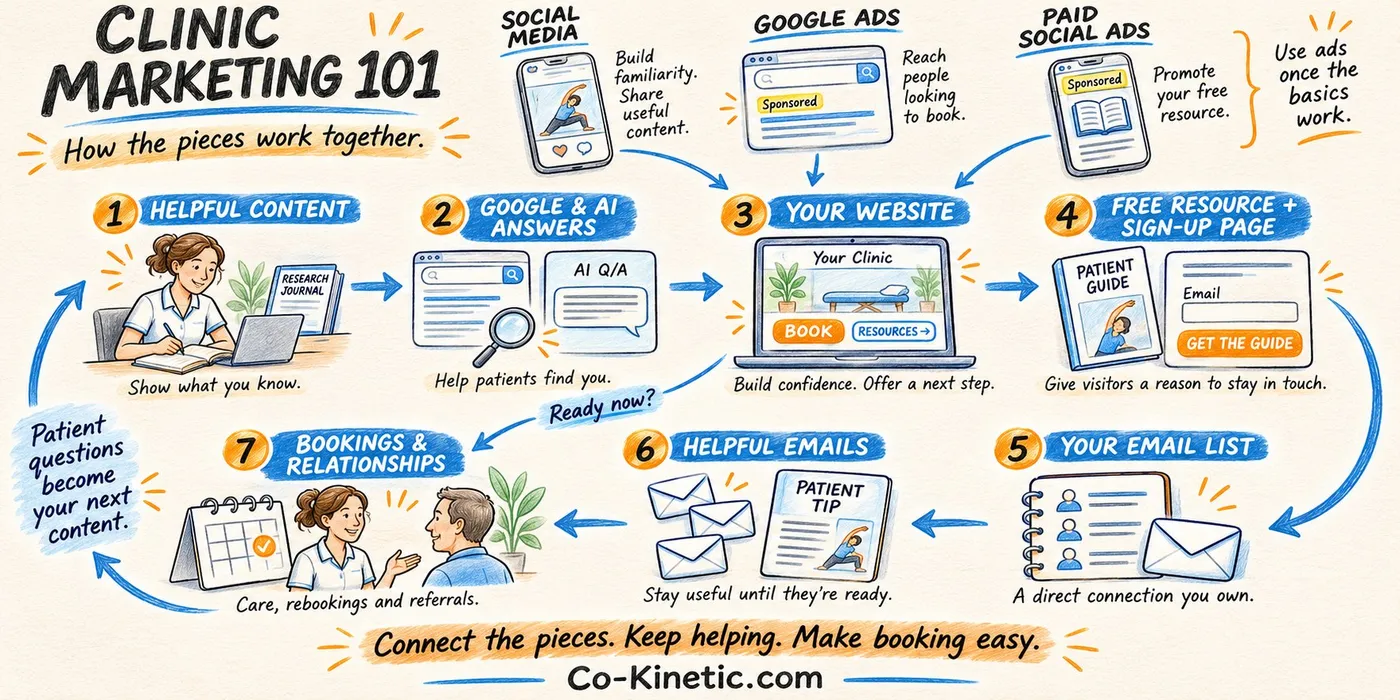
Good clinic marketing isn't about perfecting individual tactics. It's a system where each part feeds the next:
- Content shows patients, Google and AI tools what your clinic knows.
- Google and AI answers bring people to you. There are now two front doors, not one.
- Your website gives them a reason to take the next step, often a useful free resource.
- That builds your email list.
- Your emails keep you in mind while they decide.
- When they're ready, bookings happen naturally. Then rebookings, reviews and referrals feed straight back into the loop, and the questions those patients ask become your next pieces of content.
This isn't a funnel. It's a loop that keeps working while you're busy treating patients.
What's changed: AI answers before anyone clicks
The second step is the one that has moved most in the last two years.
Google is still enormous. Ofcom's Online Nation report found 82% of UK adults use Google, with around 3 billion UK searches a month [1]. But around 30% of those searches now show an AI-generated summary at the top, and UK visits to ChatGPT went from 368 million to 1.8 billion in the first eight months of 2025, almost five times as many in a year [1]. In July 2026, YouGov found 8% of UK adults already go to an AI tool first for health information, rising to 13% of millennials [2].
That matters because people click less when an AI summary appears. Pew Research Center tracked 68,879 real Google searches by 900 US adults: people clicked a normal result on 8% of visits when an AI summary appeared, against 15% when it didn't, and clicked a link inside the summary just 1% of the time [3].
So your content now has two jobs. It still has to be found. And it has to be the source an AI tool trusts enough to use when it answers a patient's question. The encouraging news: in a peer-reviewed study of 10,000 queries across 25 subject areas, including health, adding real sources, statistics and expert quotations to a page made it up to about 40% more visible in AI-generated answers [4]. Clinicians are good at exactly that. (More on this in the AI search shift, and why your clinic needs to pay attention now.)
Most people aren't ready to book yet
This one is a rule of thumb from sales, not a measurement of physio patients, but it changes how you think about marketing. The late sales trainer Chet Holmes called it the buyer's pyramid [5]: at any moment, only about 3% of the people you could help are ready to buy now. About 7% are open to it. The other 90% aren't thinking about it yet.
For a clinic, it looks something like this:
- 3%: "I've hurt myself. I need treatment. Who can I book with today?"
- 7%: "Something's not right. I'm looking into it. Maybe I'll get it checked."
- 90%: "It's been bothering me for a while, but I'm not doing anything yet", through to "I've no idea I'll need a physio in the next six months."
Most clinics only ever market to the 3%. The connected system is how you reach the rest: they find your content while they're looking into it, they join your list, and your emails are there when the niggle becomes a problem.
Five key parts of a connected system
1. Content that builds trust
Your content isn't just marketing material. It's your trust engine. Every helpful page, video or guide shows your expertise before someone walks through your door.
The key is content that's selfless, not selfish. Instead of writing about your clinic, your team or your services, answer the questions your ideal patients are already asking, in depth, under the name of the clinician who knows that area best.
Good content:
- answers real questions patients ask, with the answer up front;
- shows you understand their problem;
- names its sources and uses real figures (the kind of detail AI tools favour [4]);
- builds trust without asking for anything in return.
A short post on everything rarely does that. Why Isn't AI Picking Up My Blog Posts? explains what works instead.
2. Being found, on Google and in AI answers
Being found still matters enormously, but it isn't a silver bullet. It's how people reach your front door. What they find there is just as important.
Google searches grew by about 21.6% in 2024, to more than 5 trillion a year [6], so this isn't about abandoning Google. It's about recognising that for health, the answer increasingly comes first: BrightEdge found 89% of the US healthcare searches it tracks now show an AI summary [7].
What helps, on both front doors:
- helpful content that answers real questions;
- clear page topics and proper headings;
- a fast website that works well on a phone;
- a complete Google Business Profile for local searches;
- a website that lets AI tools in (some sites block them without the owner knowing).
Why Isn't My Website Bringing In Patients? covers the most common ways clinics lock patients out.
3. A free resource that starts the conversation
Most website visitors aren't ready to book. A free resource offered in exchange for an email address (marketers call it a lead magnet) bridges the gap.
Good ones for MSK clinics include:
- free guides: "5 mistakes that make back pain worse";
- checklists: "Is it safe to keep running with knee pain?";
- self-assessments: "What's causing your shoulder pain?";
- short email courses: "7 days to better sleep".
The goal isn't an immediate sale. It's the start of a relationship with someone who has shown they care about the problem you solve.
4. Your email list: the asset you own
Your email list isn't a nice-to-have. It's your most valuable marketing asset. Social media is rented space: the platform decides who sees your posts. Your list belongs to you.
Think of it as the golden goose. Feed it regularly with helpful, non-salesy emails, and it lays golden eggs: appointments, rebookings and referrals, again and again.
Our rule of thumb is about nine helpful emails for every one that asks for a booking. Every useful email is a deposit in the trust bank.
5. Nurture that keeps you in mind
Not everyone on your list will book soon. Nurture emails keep you in mind, and keep giving value, until the moment they need you.
Good nurture content includes:
- tips they can act on straight away;
- links to useful patient resources;
- what recovery typically looks like (within your professional body's advertising rules);
- reassurance that their problem is common and treatable;
- a gentle reminder of how to book when they're ready.
Practical steps you can take today
Start with the basics (no budget)
- Get clear on who you help best. Specialisation gives everything else focus.
- Create one strong free resource: specific and immediately useful.
- Put it on your website: a simple form, an email address, automatic delivery.
- Start your email list: even one email a month beats none.
- Post consistently on social media: helpful, encouraging and real.
Build visibility (small budget)
- Turn the questions patients ask you into pages and posts on your website.
- Leave printed guides at local gyms, cafés and community centres.
- Run free workshops at community venues.
- Answer questions helpfully in local community groups.
Speed things up (larger budget)
- Invest in professionally researched content.
- Run targeted social ads that promote your free resource.
- Consider Google Ads for people searching to book now.
- Automate your nurture emails.
Social media and paid ads: where they fit
Social media: your trust amplifier
Social media isn't your booking engine. It's your trust amplifier. It won't fill your diary directly, but it makes everything else work better by:
- building credibility;
- showing your expertise;
- making you familiar through steady, consistent presence;
- supporting the rest of your marketing.
Paid ads: fuel for a system that already works
Paid ads speed up what's already working. They don't rescue what isn't. And they've got dearer: WordStream's benchmarks show the average US Google Ads cost per click more than doubled between 2016 and 2026, from $2.32 to $5.42 [8]. And you can't buy your way into ChatGPT's or Perplexity's answers: as of its June 2026 policy, OpenAI doesn't allow ads from clinical care providers, and Perplexity wound down its advertising in 2026, citing user trust [9][10]. (Are you wasting your Google Ads budget? goes into the detail.)
So hold off on ads until the basics are solid:
- your website turns visitors into enquiries;
- you have a free resource worth signing up for;
- you're emailing your list regularly.
Then ads make financial sense, because you're sending people to something that works.
Why most marketing fails
The biggest mistake clinic owners make is trying to be everything to everyone. It dilutes your message, muddles your marketing and makes you forgettable.
Specialisation creates traction. It gives your content clarity, your website focus and your message power. It even helps with AI: "rotator cuff problems in overhead athletes" gives an AI tool something to match to a patient's question in a way "shoulder pain" never will. You become known for solving specific problems exceptionally well.
Simple rule: generalists struggle, specialists scale.
Common objections (and why they're holding you back)
"I don't want to be salesy." You're not hustling; you're helping people find the care they need.
"I don't have time." Marketing prevents future panic. Make time now, or make a crisis later.
"I'm not techy." Start simple, use friendly tools, and ask for help when you need it.
"I can't afford it." Many of the steps above cost nothing but time.
The blunt truth: you can't run a clinic without marketing it. After your clinical care, marketing is the most important thing you do. Arguably it comes first, because without patients there's nothing to deliver.
Where Co-Kinetic fits
We built Co-Kinetic around this loop, because it's the part busy clinicians struggle to keep going.
- The Clinical Content System does the first two steps: in-depth pages researched from live clinical sources and written under your clinicians' names, so patients, Google and AI tools can see your team's expertise.
- The Clinic Growth Hub does the rest: ready-made patient resources and sign-up pages, emails and campaigns that run themselves, and social posting, all connected to your bookings.
If you'd like to see where your clinic stands at step two, the free AI visibility check takes a minute to request and shows whether AI tools recommend your clinic when patients ask.
Building your connected system
Growth isn't about doing everything. It's about doing the right things, connected, consistently, and in the right order.
Start with the foundation: specialisation, content and a way to capture interest. Build your email list steadily. Nurture relationships genuinely. Then, and only then, think about speeding up with paid ads.
Your clinic deserves more than random tactics that drain your budget. It deserves a system that works while you do what you do best: helping patients recover.
Ready to build your connected system?
This post is the overview. The full Clinic Marketing 101 resource gives step-by-step guidance on each part of the system, from creating a free resource people want to writing nurture emails that bring people back.
Explore the complete Clinic Marketing 101 resource →
Stop guessing. Stop spending on disconnected tactics. Start building a marketing system that works for your clinic.
Related reading
- Should My Clinic Run a Black Friday Offer?: how to fill your quiet January and February now, with offers that don't feel salesy, and a simple timeline.
- March Campaign Ideas for Your Clinic: a ready-made March campaign you can run in a busy week, so the diary doesn't dip.
- April Campaign Ideas for Your Clinic: a ready-made April campaign you can run in a busy week, so the diary doesn't dip after Easter.
- May Campaign Ideas for Your Clinic: a ready-made May campaign you can run in a busy week, so the diary doesn't dip.
- June Campaign Ideas for Your Clinic: a ready-made June campaign you can run in a busy week, so summer doesn't go quiet.
- Are Patients Asking AI Which Clinic to Go To?: patients now ask AI before they ever see your website. This shows what that means for your clinic in plain terms, and the five things that decide whether you're the one it names.
References
- Ofcom. Online Nation 2025. 10 December 2025. www.ofcom.org.uk/media-use-and-attitudes/online-habits/from-apps-to-ai-search-how-the-uk-goes-online-in-2025
- YouGov. Survey of 2,100 UK adults on AI and health information (fieldwork 13 to 14 July 2026). July 2026. yougov.com/en-gb/articles/55203-ai-is-becoming-part-of-uk-adults-health-information-journey
- Pew Research Center. Google users are less likely to click on links when an AI summary appears in the results (900 US adults, 68,879 searches, March 2025). 22 July 2025. www.pewresearch.org/short-reads/2025/07/22/google-users-are-less-likely-to-click-on-links-when-an-ai-summary-appears-in-the-results/
- Aggarwal P. et al. GEO: Generative Engine Optimization. KDD 2024 (10,000-query benchmark across 25 domains). arxiv.org/pdf/2311.09735
- Holmes C. The Ultimate Sales Machine. Portfolio, 2007 (the "buyer's pyramid").
- SparkToro and Datos. New research: Google search grew 20%+ in 2024. March 2025. sparktoro.com/blog/new-research-google-search-grew-20-in-2024-receives-373x-more-searches-than-chatgpt/
- BrightEdge. Healthcare and AI Overviews: three-year evolution, 2023 to 2025 (US, BrightEdge's tracked keyword set). www.brightedge.com/resources/weekly-ai-search-insights/healthcare-ai-evolution-google-2023-2025
- WordStream. Google Ads benchmarks 2026 (13,474 US campaigns). 19 May 2026. www.wordstream.com/blog/2026-google-ads-benchmarks
- OpenAI. Ad policies (updated 4 June 2026). openai.com/policies/ad-policies/
- Campaign (reporting the Financial Times). Perplexity pulls plug on ads, citing trust concerns. 20 February 2026. www.campaignlive.com/article/perplexity-pulls-plug-ads-citing-trust-concerns-ai/1949142
?Frequently Asked Questions
What is a connected marketing system for a clinic?
It's a loop where each piece feeds the next: helpful content gets you found on Google and in AI answers, your website offers a useful free resource, that builds your email list, your emails keep you in mind, and bookings follow when people are ready. Each piece on its own does little; together they keep working while you're treating patients.
Do I still need SEO now that patients are asking AI?
Yes. Google is still where most people search: Ofcom found 82% of UK adults use it. But AI answers now sit on top of many searches and inside tools like ChatGPT, so your content has two jobs: to be found, and to be the source an AI tool uses when it answers a patient's question.
Why is an email list so valuable to a clinic?
Because you own it. Social media reach can change overnight; your list stays yours. Most people aren't ready to book the day they find you, and regular, genuinely helpful emails keep you in mind until they are.
Should I run Google Ads before I have a system in place?
No. Ads speed up something that already works. If your website doesn't turn visitors into enquiries and you aren't following up by email, ads just pay for visits that go nowhere. And you can't buy your way into ChatGPT's or Perplexity's answers, so the content work has to happen either way.
Where should a small clinic start with no budget?
Get clear on who you help best, create one genuinely useful free resource for those patients, put it on your website with a simple sign-up form, and start emailing your list regularly. Then turn the questions patients ask you into pages on your website.