
Why Isn't My Website Bringing In Patients?
Why isn't your clinic website bringing in patients? Six mistakes from more than 200 clinic websites assessed, and a ten-minute check you can do yourself.
Reviewed and updated: November 2026
Usually it comes down to one of two things. Either patients can't find you when they search Google or ask AI, or they find you and can't quickly see why they should choose you, or how to book. In building our platform, I've assessed more than 200 clinic websites, and I see the same six mistakes behind this again and again, and each one quietly costs clinics patients.
None of this is about design taste. These are practical problems you can spot yourself, and most of them are quick to fix. At the end there's a ten-minute check so you can see which ones apply to your site.
Here's what I keep seeing.
1. A bad booking or enquiry journey
Patients judge your website on how quickly and easily they can do the one thing they came to do. In healthcare, that is almost always booking an appointment.
The problem? Most clinic websites bury their booking buttons, hide them in navigation menus, or require far too many clicks to get to the actual booking page.
The solution is simple: If someone lands on your homepage and within five seconds can't clearly see how to book, you've already lost them. Your call-to-action (CTA) should be visible above the fold (no scrolling needed), ideally in bold, contrast colour, and repeated logically on service pages. (Here's what else a clinic homepage needs.)
2. No Google Reviews strategy
Many clinics have no reviews. Or they have two reviews from years ago. Or they have okay-ish reviews, but no recent ones.
Patients trust other patients. If someone searches for a physio clinic and your competitor has 40 recent 5-star reviews while you have four, your competitor will look like the obvious choice, and Google itself says the number and score of your reviews play a part in local search results. Aim for a steady flow of genuine reviews, with some from the past few months, rather than a burst once in a while.
Yes, getting reviews takes effort. But it's one of the most powerful trust signals you can build, and it directly impacts your Google Maps visibility. That map still matters as AI changes search: BrightEdge's tracking shows Google has pulled AI Overviews back from healthcare "near me" searches, from 100% of them in 2023 to between 0% and 14% across 2024 and 2025, and shows the local map listings instead.
3. Slow page load times
Speed is not a nice-to-have. Google openly uses it as a ranking factor. When I audit clinic websites, I frequently find load times of 5-8 seconds or more, pages that freeze briefly when scrolling, and render-blocking scripts that delay everything.
Patients won't wait and neither will Google. Someone in pain, looking you up on their phone, will simply tap back and choose the next clinic.
Fix this by compressing images, removing unnecessary plugins, using a faster host, and asking your web developer to properly optimise your code. If they can't, it might be time to find someone who can.
4. Outdated or thin service pages
A lot of clinic websites list their services, but barely say anything about them. One paragraph on back pain. A line or two on sports rehabilitation.
A patient deciding where to take their bad back wants to know you understand it. A paragraph doesn't tell them that, and it gives AI tools nothing to recommend you for.
These pages signal to Google (and to patients) that you haven't taken the time to explain what you actually do. Now that AI tools draw their answers from websites, content is critical: BrightEdge found that by December 2025, 100% of the treatment searches it tracks triggered a Google AI Overview (US data). Each major service you offer deserves a page that genuinely answers your patients' questions: what it is, who it helps, what to expect and how long it usually takes, in your clinicians' own words, with what they typically see in clinic and a named author so patients know who is behind it. Service pages are also how patients and AI tools follow the path from symptom to booking.
Depth matters more than word count: when Ahrefs analysed 1.68 million pages cited in AI Overviews (December 2025 data), it found almost no link between word count and being cited. Real sources help too: peer-reviewed research from Princeton and IIT Delhi (KDD 2024), testing 10,000 search queries across 25 subject areas, found that adding cited sources, statistics and expert quotations each lifted a page's visibility in AI-generated answers by roughly a quarter, and by up to 40% in the best cases.
5. Broken links and site errors
This sounds basic but you'd be amazed how often I find 404 pages, redirects going nowhere, and buttons that simply don't work. Every broken element on your site creates friction for users and tells Google your site may not be trustworthy. A patient who taps "Book now" and lands on an error page may not try again.
Check for them with a free tool such as Google Search Console and fix them as soon as you can.
6. No structured data
Structured data (also called schema: a few lines of hidden code that label key facts such as your clinic's address, opening hours and who wrote each page) helps Google read those facts reliably. Without it, you're relying on search engines to work them out for themselves.
Most clinic websites I see have zero structured data. It's quick for your web person to add, and it can help your clinic's details show up properly in Google. Just don't expect miracles from it on its own: there's no good evidence that schema by itself gets a clinic recommended by AI. When Ahrefs tracked 1,885 pages that added it (August 2025 to March 2026, against 4,000 similar pages that didn't), their citations in Google's AI Overviews didn't go up, and Google's own guidance says no special structured data is needed to appear in its AI features. Google also dropped FAQ rich results altogether in May 2026 (here's what that means for clinics). The words on your pages matter far more.
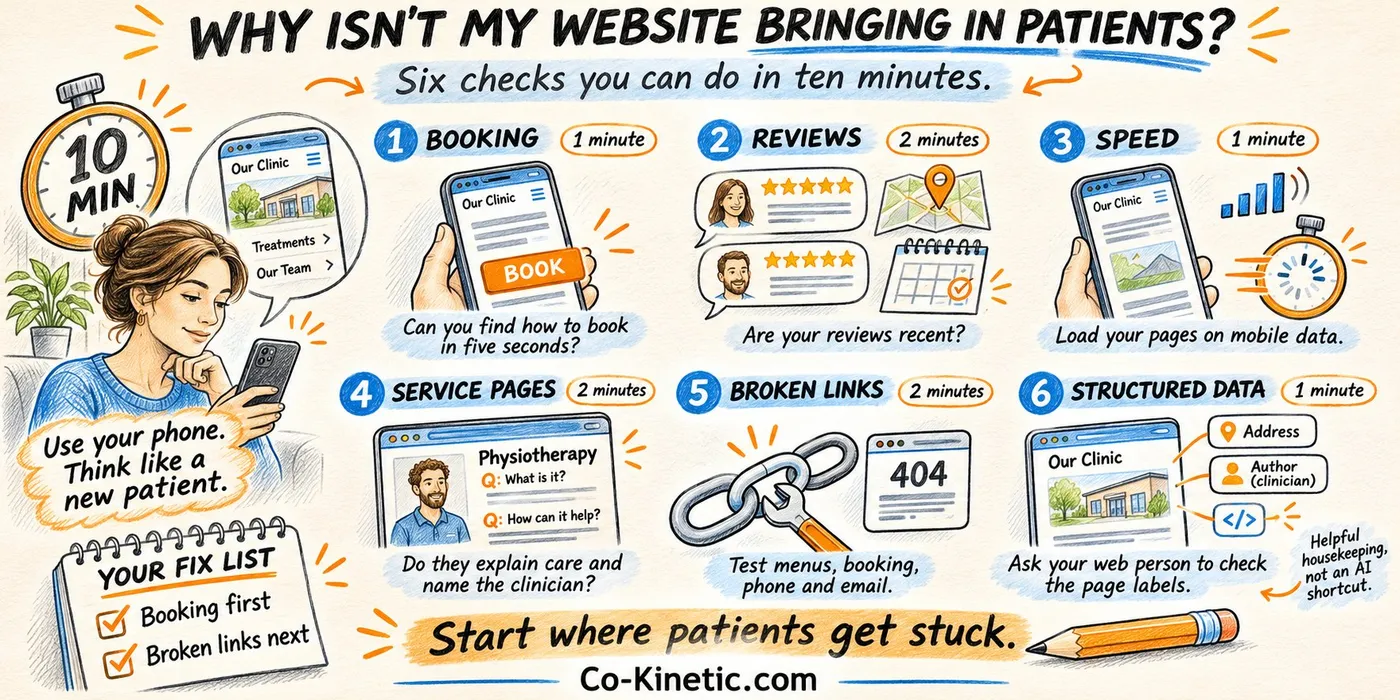
Check your website in ten minutes
You don't need any special tools for this, just your phone, a browser and a timer. Do it as if you were a new patient who has never heard of you.
- Booking (one minute). Open your homepage on your phone and start the timer. Can you see how to book or enquire within five seconds, without scrolling? Then open one service page and check the booking button is there too. Count the taps it takes to reach the actual booking form.
- Reviews (two minutes). Search your clinic's name on Google and look at your Google Business Profile. How many reviews do you have, and when was the most recent one? Then search for a physio near you and compare yourself with the other clinics on the map.
- Speed (one minute). Switch your phone to mobile data rather than Wi-Fi and load your homepage and a service page. Count the seconds until you can read the page and tap the booking button. If you find yourself waiting, so are your patients.
- Service pages (two minutes). Open the page for the condition or service you see most. Does it explain what it is, who it helps, what to expect and how long it usually takes? Does it say which clinician wrote it? If it's a paragraph or two, it's thin.
- Broken links (two minutes). Click every item in your main menu, your booking button, your phone number and your email link. Note anything that goes to an error page, the wrong place or nowhere at all.
- Structured data (one minute). Paste your homepage address into the free Schema Markup Validator (validator.schema.org) and see whether it finds anything. If it finds nothing, add it to your web person's list, or simply ask them whether your site has any.
Whatever you noted down is your fix list. Start with booking and broken links: they cost you patients who have already chosen you.
These issues are solvable. Most of them don't require a complete redesign, just targeted fixes and a willingness to take your visibility seriously.
If you're curious about where your own site stands, try our free AI visibility check. It takes a minute to request and tests real patient questions across ChatGPT, Google AI Overviews, Perplexity and Claude, then shows you who AI recommends instead and the three most impactful first steps. No sales pitch attached, just a clear picture of what's working and what's not. And if you want every page of your site scored, with exactly what to fix, that's what our Website & AI Visibility Review (£599, one payment) is for.
Related reading
- What Does My Clinic's Homepage Need?: a prioritised checklist so your homepage tells patients and AI in seconds who you are, where you are and why to trust you.
- Should I Rebuild My Clinic Website from Scratch for AI Search?: before anyone talks you into a rebuild: why the website and pages you already have are an asset a new site can't buy, and how to make them work for AI.
- How Do I Get Other Websites to Mention My Clinic?: one of the most overlooked ways to get named by AI, and how to build it from relationships you already have: running clubs, gyms, local directories.
- Which Pages on My Clinic Website Actually Bring In Patients?: stop spending hours on content nobody reads: the few pages that bring in most of your patients, and what to write first.
References
- BrightEdge, healthcare and Google AI Overviews, three-year tracking 2023 to 2025, data to December 2025. https://www.brightedge.com/resources/weekly-ai-search-insights/healthcare-ai-evolution-google-2023-2025
- Ahrefs, study of word count and AI Overview citations (560,346 AI Overviews, 1.68 million cited pages), December 2025 data. https://ahrefs.com/blog/short-vs-long-content-in-ai-overviews/
- Aggarwal P. et al., Princeton University and IIT Delhi, GEO: Generative Engine Optimization, KDD 2024, 2024. https://arxiv.org/abs/2311.09735
- Ahrefs, matched-control study of 1,885 pages adding structured data, against 4,000 controls, pages tracked August 2025 to March 2026. https://ahrefs.com/blog/schema-ai-citations/
- Google Search Central, AI features and your website, current as of December 2025. https://developers.google.com/search/docs/appearance/ai-features
?Frequently Asked Questions
Why isn't my clinic website bringing in patients?
Usually because patients can't find you, or they find you and can't quickly see why to choose you or how to book. Six mistakes cause most of it: a poor booking journey, too few recent Google Reviews, slow pages, thin service pages, broken links and no structured data.
How can I check my clinic website myself?
In about ten minutes with your phone and a browser: time how long it takes to find the booking button, look at your Google Reviews, load your site on mobile data, read your main service page, click every menu link and the booking button, and check for structured data with the free Schema Markup Validator.
What are common visibility mistakes on clinic websites?
Common visibility mistakes include a poor booking journey, no Google Reviews strategy, slow page load times, outdated or thin service pages, broken links, and no structured data. These issues affect how easily potential patients find and interact with your clinic online.
How can I improve the booking journey on my clinic website?
To improve the booking journey, ensure that the booking button is prominently displayed above the fold on the homepage and easily accessible from service pages. It should be in a bold, contrasting color and require minimal clicks to reach the booking page.
Why are Google Reviews important for clinic visibility?
Google Reviews build trust with potential patients, and Google says review count and score play a part in local search results, including Google Maps. A steady flow of genuine, recent reviews helps you hold your own against nearby clinics.
What can I do to speed up my clinic website's loading time?
To speed up your website, compress images, remove unnecessary plugins, and ensure that your hosting provider is efficient. Additionally, consult with a web developer to optimize your site's code and eliminate any render-blocking scripts.
How much content should be on my clinic's service pages?
Enough to genuinely answer your patients' questions: what the treatment is, who it helps, what to expect and how long it usually takes, written by a named clinician drawing on what they see in clinic. Depth and real sources matter more than hitting a word count.
What is structured data and why is it important for my clinic website?
Structured data, also called schema, is a few lines of hidden code that label key facts on your pages, such as your address, opening hours and who wrote each page, so Google can read them reliably. It's worth adding, but it isn't a shortcut into AI answers: the words on the page matter far more.