
What Changed in AI Search: Q2 2026
What changed in AI search in spring 2026 for MSK clinics, including Google dropping FAQ rich results, and what genuinely helps a clinic's pages get used in AI answers. For clinic owners who want the practical takeaways.
Reviewed and updated: November 2026
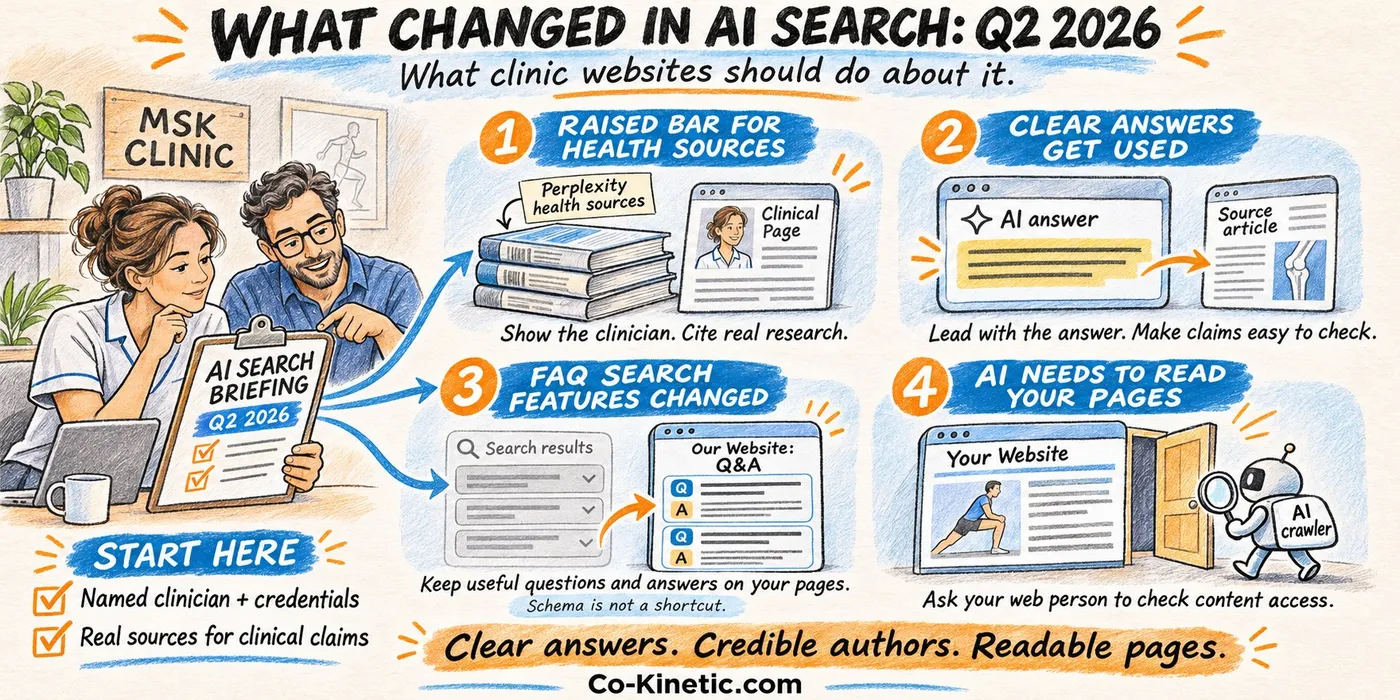
The AI search landscape shifted materially in spring 2026, and the bar for clinical content was raised significantly this quarter. If you run an MSK clinic, the most important development is Perplexity's launch of Premium Health Sources, which effectively creates a two-tier system for health citations. Alongside changes to Google's AI Overviews and the removal of FAQ rich results, the rules for getting your clinic cited have tightened. Here is exactly what has changed and what you need to do about it.
What Is the Perplexity Premium Health Sources Update?
On 5 May 2026, Perplexity integrated BMJ Journals, BMJ Best Practice, and the New England Journal of Medicine directly into its answer engine. This means that for clinical queries, Perplexity now relies on a top tier of peer-reviewed, professionally governed medical literature. As a local clinic, your website cannot compete directly with the BMJ. You are competing on the open-web tier, which means your content must now prove its clinical authority more rigorously than ever to be cited alongside these premium sources.
To compete on the open-web tier, you must stop writing generic "what is physiotherapy" pages and start proving your clinical experience. The approach with the strongest evidence behind it is content that answers specific questions directly and cites primary sources (like NICE guidelines or Cochrane reviews) inline: peer-reviewed research from Princeton and IIT Delhi (Aggarwal and colleagues, KDD 2024) tested changes to web pages across 10,000 search queries in 25 subject areas, including health. Adding expert quotations lifted a page's visibility in AI-generated answers by around 27 to 28%, adding statistics by 25 to 26% and citing sources by 24 to 25%, with gains of up to about 40% in the best cases. For science and health questions, clear, readable writing and statistics did best. Clear attribution to a specific, credentialled practitioner matters too, because it is what patients look for before they trust health advice.
How Have Google AI Overviews Changed?
Independent measurement firms Similarweb and Semrush estimate that by mid 2026, AI Overviews appeared on 43 to 48% of US Google searches, up from around 15% a year earlier (Search Engine Roundtable, July 2026). Healthcare is higher still: BrightEdge tracking found 89% of the healthcare search terms it monitors triggered an AI Overview by December 2025, up from 59% two years earlier, including 100% of treatment queries and 98% of pain-related queries (US data). That makes clear, self-contained sentences, each answering one question, more valuable than ever: they are the easiest thing for an AI answer to quote.
Content that answers a specific question clearly, up front, is easier for AI to quote than content that buries the answer in flowing prose. Large analyses of what AI tools cite keep finding the same pattern: a question-led heading, then a short, self-contained paragraph that gives the answer in its first sentence. Pillarbase's study of 15.7 million citations in Google's AI Mode (reported July 2026) found 80% of the passages quoted put the answer in their first sentence, the typical passage was about 117 words long, and question-led passages were reused about twice as often. One large analysis of 18,012 ChatGPT citations (Kevin Indig, February 2026) found 44.2% came from the first 30% of the page. Write so that every key clinical claim can stand on its own if it is quoted.
What Happened to FAQ Rich Results?
Google removed FAQ rich results (the expandable Q&A accordions in search results) in May 2026. The visible question-and-answer content on your pages is a different matter, and it is still worth having: a clear question followed by a clean, self-contained answer is easy for patients to scan and easy for AI tools to read.
You should continue to write FAQ sections on condition and treatment pages, because they answer the questions patients actually ask. Existing FAQ schema markup in your website's code does no harm, but don't expect it to win AI citations. Google says there's "no special schema.org structured data that you need to add" to appear in its AI features, and when Ahrefs tracked 1,885 pages that added schema against 4,000 similar pages that didn't (August 2025 to March 2026), their AI Overview citations didn't rise (they dipped slightly, by 4.6%).
Why Is Server-Side Rendering Now Non-Negotiable?
Many AI crawlers fetch the raw HTML of a page and may not run JavaScript the way a browser does. If your website relies on client-side JavaScript to load its core clinical content, AI crawlers may see a blank page or incomplete information. Server-side rendering ensures that all your content is present in the initial HTML payload that the crawler receives. Access comes first for a reason: one 2026 synthesis of 54 AI-citation studies ranked plain crawler accessibility as the single strongest factor in whether content gets cited by AI search engines, scoring it 9.5 out of 10.
This is no longer just a performance optimisation, it is a fundamental requirement for discoverability. If your condition pages, treatment pages, or practitioner profiles require JavaScript to render, they are effectively invisible to many AI search engines.
Frequently Asked Questions
Does the Perplexity update mean my clinic won't be cited anymore?
No, but it means the standard has been raised. Perplexity will still cite open-web sources for local or specific queries, but your content needs to earn its place: answer the specific question well, back up clinical claims with real, cited sources, and show who wrote it and why to trust them. Google calls this E-E-A-T (experience, expertise, authoritativeness and trust): in plain terms, can a reader see who is behind this advice and why it is reliable?
Should I delete the FAQ schema from my website?
There's no need to. It does no harm, and it's part of a tidy website. But don't keep it in the hope of being cited: there's no good evidence that FAQ schema makes AI more likely to use your page. What AI tools read is the visible question-and-answer content on the page itself, so put your effort there.
How do I know if my website is server-side rendered?
The easiest way to check is to view the page source (right-click and select "View Page Source" or similar in your browser). If you can see your main text content in the raw HTML code, it is server-side rendered. If you only see a few lines of code and a lot of script tags, it is likely relying on client-side JavaScript.
What is the single most important thing I can do this quarter?
Ensure every clinical page on your site has a named clinician author with their credentials clearly stated, ideally with a link to their full bio page, and that its clinical claims are backed by real, cited sources. Anonymous, unsourced healthcare content is hard for patients to trust, and Google's own quality guidance asks exactly these questions: who wrote this, what is their experience, and where does the information come from?
Related reading
- Are Patients Asking AI Which Clinic to Go To?: patients now ask AI before they ever see your website. This shows what that means for your clinic in plain terms, and the five things that decide whether you're the one it names.
- Why Can My Clinic Rank on Google but Not Get Recommended by AI?: why you can rank on Google and still be invisible when patients ask AI who to see, and the two things that close the gap.
- Does My Clinic Website Need an FAQ Section?: one of the quickest wins on your website this week: answering the questions patients actually ask, so your pages become the ones AI quotes.
References
- Aggarwal P, et al. GEO: Generative Engine Optimization. KDD 2024. https://arxiv.org/abs/2311.09735
- Search Engine Roundtable. Report on Similarweb and Semrush AI Overview tracking (43 to 48% of US searches). 30 July 2026. https://www.seroundtable.com/half-google-searches-ai-overviews-41780.html
- BrightEdge. Healthcare and AI Overviews: three-year evolution, 2023 to 2025 (data to December 2025). https://www.brightedge.com/resources/weekly-ai-search-insights/healthcare-ai-evolution-google-2023-2025
- Search Engine Land. What 15.7 million AI Mode citations reveal about getting quoted by Google (Pillarbase data). July 2026. https://searchengineland.com/what-15-7-million-ai-mode-citations-reveal-about-getting-quoted-by-google-483393
- Search Engine Land. ChatGPT citations content study (Kevin Indig, Growth Memo). 18 February 2026. https://searchengineland.com/chatgpt-citations-content-study-469483
- Google Search Central. AI features and your website (current as of December 2025). https://developers.google.com/search/docs/appearance/ai-features
- Ahrefs. Schema markup and AI citations: a matched-control experiment (data August 2025 to March 2026). 2026. https://ahrefs.com/blog/schema-ai-citations/
- PPC Land. 23 factors that actually get your content cited by AI search engines (summary of Cyrus Shepard's 54-study review). May 2026. https://ppc.land/23-factors-that-actually-get-your-content-cited-by-ai-search-engines/
- Google Search Central. Creating helpful, reliable, people-first content. https://developers.google.com/search/docs/fundamentals/creating-helpful-content
?Frequently Asked Questions
What does the Perplexity Premium Health Sources update mean for my clinic?
It raises the bar for clinical content. To be cited alongside top medical journals, your pages need to answer specific patient questions well, cite real sources inline, and show which clinician wrote them and why to trust them.
How have Google AI Overviews changed and what should I do about it?
Google AI Overviews now show their citations inline, next to the sentence they support. Structure your content so each key clinical claim stands on its own: a question-led heading, then a short paragraph that gives the answer in its first sentence.
Is it still important to keep FAQ schema on my website?
It does no harm to keep it, but don't rely on it. Google says no special structured data is needed to appear in its AI features, and research so far finds schema makes no significant difference to whether AI cites a page. The visible questions and answers on the page are what patients and AI tools actually read.
How can I check if my website is server-side rendered?
You can verify this by viewing the page source of your website. If the main text content appears in the raw HTML, it is server-side rendered; if only script tags are visible, it likely relies on client-side JavaScript.
What is the most important action I should take for my clinic this quarter?
Make sure every clinical page on your site shows a named clinician author with their credentials, and backs up its clinical claims with real, cited sources. That is what patients look for before trusting health advice, and it is what Google's own quality guidance asks for.