
Should I Rebuild My Clinic Website from Scratch for AI Search?
Whether to rebuild your clinic website for AI search or improve what you already have, and why your existing domain and pages are usually worth keeping. For clinic owners who've been told to start again.
Reviewed and updated: November 2026
If your clinic website is not performing and someone has told you to start again, the answer is: it depends entirely on what you already have. In most cases, your domain is worth keeping. What changes is the strategy for everything built on top of it. Before spending any time or money, you need to know which situation you are actually in. If you'd like a second pair of eyes, our Website & AI Visibility Review gives you a checked diagnosis of your site, with a do-it-yourself list and a list for your web person.
What Is a Domain, and Why Does It Matter?
Your domain is your web address, the www.yourclinicname.co.uk part that patients type into a browser or click from a search result. It is not the same as your website. Your website is everything built on top of it: the pages, the content, the design, the structure. Your domain is simply the address those pages live at. You can rebuild your website completely and keep your domain, and search engines will treat it as a continuation of what was already there.
Does the Age of My Domain Actually Affect AI Search Visibility?
It matters, though not quite in the way it's often described. There's no good evidence that AI tools reward a domain simply for being old. What an established domain usually has is history with Google: pages that already rank, and trust built up over years. That matters for AI too. Independent studies find Google rank is the single strongest predictor of whether AI tools cite a page. A February 2026 study by Fischman, which looked at 730 citations in ChatGPT and Gemini (a preprint, not yet peer-reviewed), found the page in position 1 on Google was cited for 43% of questions, against 5% for the page in position 7. In healthcare, BrightEdge found 75.3% of Google AI Overview citations went to pages that also rank on Google, the highest of any industry, and Search Engine Land puts it at nearly 80% (both data to September 2025). A new domain starts with none of that history. A domain that has been live for three years already has some, even if the content needs updating.
This is roughly what people mean by domain authority: the trust and history a website has built up. The internet has already noticed your domain. None of that transfers if you abandon your domain and start fresh on a new one.
What Is URL Structure and Why Does It Matter for AI?
A URL is the full address of a specific page on your site, for example www.yourclinic.co.uk/conditions/back-pain/. A logical structure makes it easy for patients, search engines and AI tools to see how your content is organised, what you treat and how different topics relate to each other. A flat or disorganised structure makes that much harder to see, however good the content is.
Which Situation Are You In?
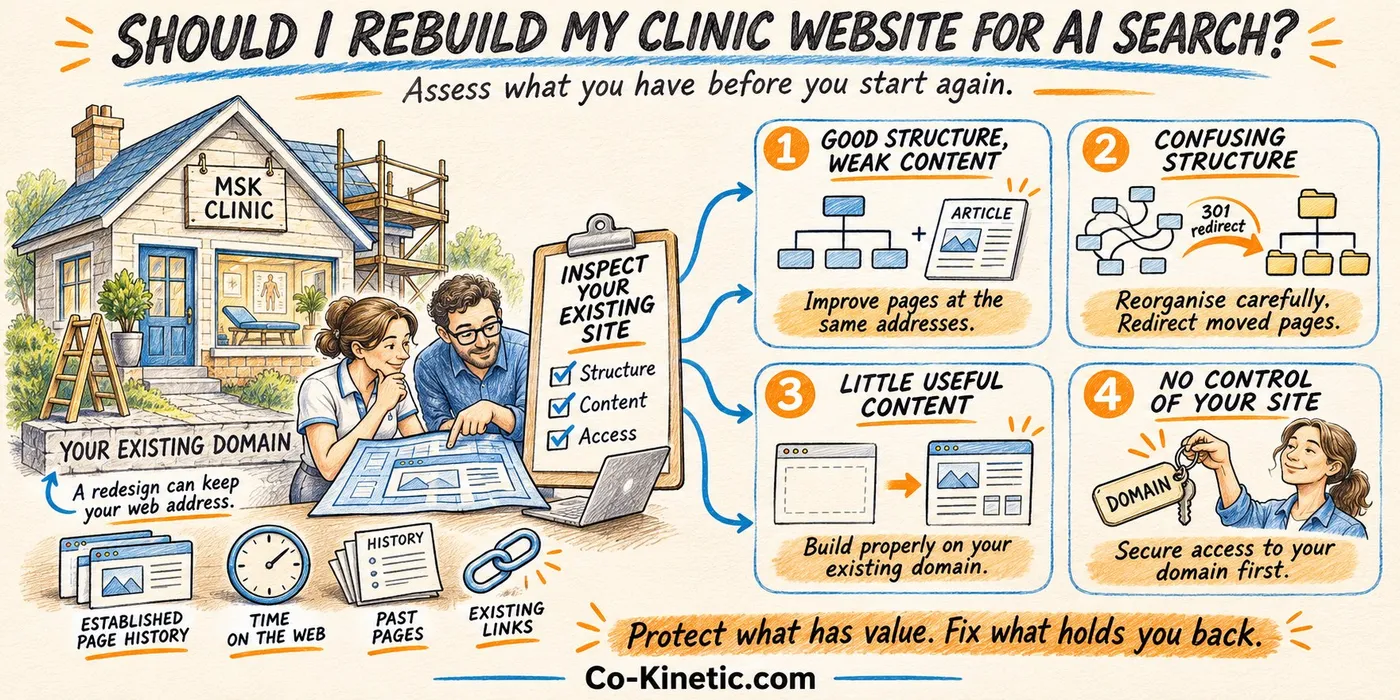
You Have a Good URL Structure but Weak Content
If your website already has a logical URL structure but the content is thin or outdated, you are in the best position. Rewrite the content in place. Do not delete the pages or change the URLs. When you rewrite, back up what you say: peer-reviewed research from Princeton and IIT Delhi (the GEO study, KDD 2024), tested on 10,000 questions across 25 subject areas including health, found that adding cited sources, statistics and expert quotations each lifted a page's visibility in AI answers by roughly 25 to 40% in benchmark tests, while stuffing in keywords did not help. A rewrite on the same URL inherits all of the accumulated history. A new URL starts at zero.
A well-structured MSK clinic site looks something like this:
/conditions/back-pain/
/treatments/manual-therapy//treatments/acupuncture/
/services/physiotherapy//services/osteopathy/
/blog/
Each section has a clear purpose. Condition pages sit under /conditions/, treatment pages under /treatments/, service pages under /services/. A patient, a search engine, or an AI crawler can look at any URL on the site and immediately understand what type of content it is and how it relates to everything else. That logical hierarchy makes your depth on each topic easy to see.
You Have a Bad URL Structure, Whatever the Content
If your content is sitting on flat, generic URLs or is disorganised, the structure needs addressing before the content is worth investing in. This does not mean starting from scratch. When you move a page to a new URL, a 301 permanent redirect from the old URL to the new one passes virtually all of the accumulated authority across. It is a controlled migration, not a fresh start, but it is a bigger job than most people expect.
You Have Little or No Meaningful Content
If your website has very little real content, there is no accumulated authority worth protecting on those pages. In this case, building properly from scratch on the same domain, with a clean URL structure and an AI-first approach from day one, is not just acceptable, it is the right call.
You Have No Control Over Your Site
If you cannot edit your own website because your developer is unresponsive or has locked you out, the content question is moot until that is resolved. Getting control of your domain registrar (the company your web address is registered with) is the first priority, because that is the one asset you cannot afford to lose.
Is There an Advantage to Building AI-First from Scratch?
Yes, and it is a meaningful one. A site built AI-first from the ground up, with the right URL structure, the right page types, AI tools allowed in, and in-depth content that genuinely answers patients' questions, can overtake a patched-up legacy site surprisingly quickly. "Allowed in" matters more than most people realise: OpenAI's own documentation says sites that opt out of its search crawler "will not be shown in ChatGPT search answers". The legacy site has a head start on domain age, but if the content and structure are poor, that head start is not doing much work for you.
The clinics that will have a genuine advantage in the next two to three years are not necessarily the ones with the oldest domains. They are the ones that get the structure and content right earliest, whether that means fixing what they have or building something new that is designed for the way AI search actually works.
Frequently Asked Questions
If I rebuild my website on a new platform, do I lose my domain authority?
No, provided you keep the same domain. Your domain authority is tied to your web address, not the platform your site runs on. You can move from one website builder to another, redesign everything, and your domain authority stays intact as long as the domain remains the same and you redirect any changed URLs correctly.
What is a 301 redirect and do I really need one?
A 301 redirect is an instruction that tells search engines and AI crawlers that a page has permanently moved to a new address. If you restructure your URLs without setting up 301 redirects, every old URL becomes a dead end and you lose the authority those pages had accumulated. Done correctly, a 301 redirect passes that authority to the new URL. If you are restructuring your site, redirects are not optional.
How do I know if my URL structure is a problem?
Look at your site's URLs. If your condition pages, treatment pages, and blog posts are all sitting in the same folder or at the root level with no logical grouping, that is a structural problem. A well-organised site has clear, consistent paths: /conditions/, /treatments/, /services/, /blog/. If yours does not, it is worth addressing before investing heavily in new content.
Does it matter which platform I build my new site on?
From an AI search perspective, what matters is that your site is server-side rendered, meaning the content is present in the HTML that AI crawlers receive, not loaded afterwards by JavaScript. Many modern website builders handle this well. The platform itself is less important than the structure and content you build on top of it.
Warm wishes
Tor 🥰
Related reading
- What Does My Clinic's Homepage Need?: a prioritised checklist so your homepage tells patients and AI in seconds who you are, where you are and why to trust you.
- Why Isn't My Website Bringing In Patients?: six mistakes that quietly cost clinics patients, from more than 200 websites assessed, and how to check yours in ten minutes.
- Which Pages on My Clinic Website Actually Bring In Patients?: stop spending hours on content nobody reads: the few pages that bring in most of your patients, and what to write first.
- Should I Write a Page for Every Condition I Treat?: why a post for every condition can make your own pages compete against each other, and the structure that makes them win together.
References
- Fischman, SSRN preprint on what predicts citation in ChatGPT and Gemini (730 citations), February 2026. https://papers.ssrn.com/sol3/papers.cfm?abstract_id=6284518
- BrightEdge, AI Overview rank overlap after 16 months, September 2025. https://www.brightedge.com/resources/weekly-ai-search-insights/rank-overlap-after-16-months-of-aio
- Search Engine Land, AI Overviews and YMYL topics (guide), June 2026. https://searchengineland.com/guide/ai-overviews-ymyl
- Aggarwal et al. (Princeton and IIT Delhi), "GEO: Generative Engine Optimization", KDD 2024, 2024. https://arxiv.org/abs/2311.09735
- OpenAI, OpenAI crawlers documentation (OAI-SearchBot), undated documentation page. https://developers.openai.com/api/docs/bots
?Frequently Asked Questions
Why is the age of my content important for AI visibility?
Not because AI rewards age for its own sake. Established pages have often built up history with Google, such as where they rank, and Google rank is one of the strongest predictors of whether AI tools cite a page. A brand-new page or domain starts without that history.
What is legacy URL value and how does it affect my website?
Legacy URL value is the history an existing web page has built up with search engines over time, such as where it ranks on Google. Rewriting a page on the same web address keeps that history, while a brand-new address starts from zero. Because Google rankings feed into what AI tools cite, it's worth protecting.
How can I improve my existing content for better AI visibility?
Rewrite it in place so it genuinely answers the questions patients ask, with the key answer first and clear question-based headings. Back up what you say with real sources, statistics and expert insight: peer-reviewed research (the GEO study, KDD 2024) found these improved visibility in AI answers by up to about 40% in benchmark tests. Name the clinician who wrote it and their experience, because that helps patients trust the page and is what Google's quality guidance asks for.
What types of pages should I prioritize for updates?
Focus on updating condition and treatment pages first, as these show patients, Google and AI what you treat. Blog posts can be valuable but should be addressed after improving your most visited condition and treatment pages.
How do I find out which pages on my site need updates?
Use Google Search Console to identify your most visited pages over the past year. Look for those that are getting impressions, and prioritise the top five condition and treatment pages for your updates.
Can I simply create new pages instead of updating existing ones?
You can, but a new page starts with no history. If an existing page is already ranking or getting impressions on Google, it's usually better to rewrite it on the same web address so it keeps what it has built up.