
How AI is Changing Everything for Massage Therapists (And Why I Think You Need to Know About It)
Why massage therapy is a safe job in an AI world, but the way clients find you is changing fast. For massage therapists who want to stay visible as more people ask AI who to see.
Reviewed and updated: November 2026
You'd have to be living under a rock not to have heard all the talk about AI taking people's jobs. The headlines, the job stats, the predictions, the general anxiety about what the future holds.
Here's the great news (and trust me, I've invested a lot of time researching this because my business depends on it!): Thankfully I’m pretty confident that massage therapists are in one of the most resilient, AI-resistant professions out there. Machines simply cannot replicate what we do. The intuition we bring to a treatment, the way we read someone's body, the therapeutic relationship we build, the healing that comes from human touch, none of that can be automated. Your job is fundamentally safe.
However… and this is a very important “however”, the way people find you is changing dramatically. And that's what I want to talk to you about.
Following a short career as a physio, I've spent the last 27 years creating content for the physiotherapy and massage therapy world, both professional educational content and patient-facing materials. I've also been building technology platforms throughout that time, from content management systems to marketing platforms, so I've had a front-row seat to every shift in how healthcare practitioners connect with patients. And honestly, I can’t overstate the change that AI is bringing to our industry.
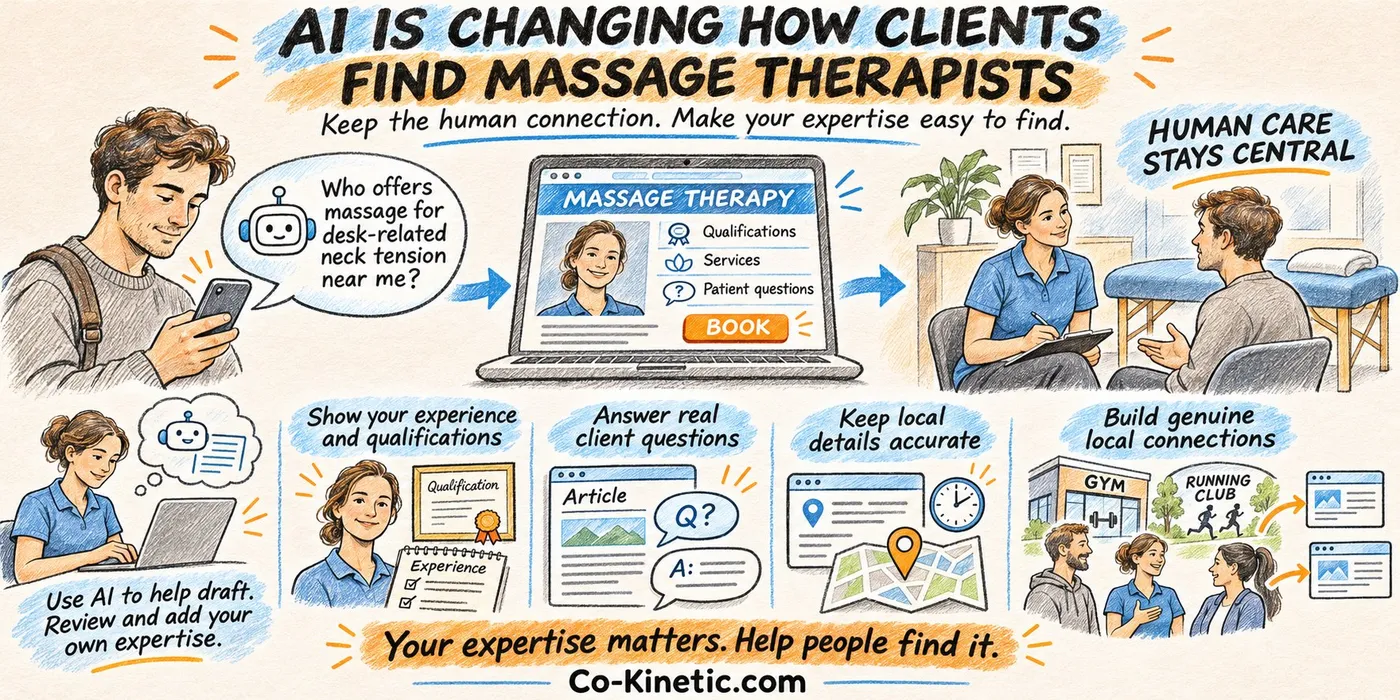
Here's what we know now: when someone has a health issue these days, they're increasingly likely to ask an AI assistant for help as well as, or instead of, typing into Google, and even if they’re typing into Google, Google is using AI to answer it! (Ofcom found around 30% of UK Google searches now carry an AI-generated summary, and BrightEdge's US tracking found 98% of the pain-related health searches it monitors triggered one by December 2025.) They're asking questions like:
- "What type of massage would help my neck pain caused by sitting at a desk all day?"
- "I'm pregnant, is massage safe and who should I see nearby?"
- "I need lymphatic drainage after surgery, can you recommend someone close to [postcode]?"
And here's the reality: if you're not visible to these AI systems, you simply won't be part of that conversation. It doesn't matter how skilled you are, how experienced, how wonderful your results are. If AI doesn't know you exist, neither will a huge portion of your potential clients.
Now, I'm actually quite excited about this. Yes, it's a challenge, but it's also a genuine opportunity for the therapists who act on it. Because I know exactly how to build platforms and systems that solve this problem, and I'm seeing the therapists who've started building their digital presence already gaining real momentum.
The sooner you get your content out there, the sooner you start building visibility, so will that visibility compound over time. The therapists who started six months ago already have a huge advantage. The ones who start today will have an advantage over those who wait.
What I'd like to do in this article is walk you through what's actually happening, why it matters, and what you might want to think about for your own practice. Not in a "you must do this now" way, but in a clear, honest conversation about what's shifting and what your options are.
Because the truth is, the massage therapists who will thrive in the next few years won't be the most skilled, they'll be the most visible. And visibility, thankfully, is something you have far more control over than you might think.
The Fundamental Shift
Here's what you need to understand: in the UK, Ofcom found 54% of adults now use AI tools, rising to 79% of 16 to 24 year olds (April 2026). Deloitte's May 2026 survey of 4,156 UK adults found a quarter of those who use generative AI have asked it for health advice, and 38% of them believe the health information it gives is always accurate, which raises the stakes on whose expertise those answers draw on. YouGov found 8% of UK adults already go to AI first for health information (July 2026). In the US, KFF found monthly use of AI chatbots for health information rose from 17% of adults in 2024 to 29% in May 2026, and BrightLocal's 2026 survey of 1,002 US adults found 45% now use AI tools for local business recommendations, up from 6% a year earlier. People are having conversations with AI assistants about their health concerns, and the path from problem to practitioner has fundamentally changed. Word of mouth is still valuable, but more and more of the journey now starts with a question to AI.
What AI Systems Actually Look For
It's also not just about keywords anymore, it's about demonstrating real authority and expertise. Patients, Google and AI tools all look for signs of credibility and trustworthiness. Google's own quality guidance calls this E-E-A-T: experience, expertise, authoritativeness and trust.
Here's what matters:
Educational content that demonstrates expertise: Content about the specific conditions you treat, written in a way that shows you genuinely understand them. Whether it's sports massage, pregnancy massage, or lymphatic drainage, AI systems favour practitioners who've proven their knowledge through content. Peer-reviewed research (the GEO study, KDD 2024, 10,000 test questions across 25 subject areas) found that adding cited sources, statistics and expert quotations lifted a page's visibility in AI answers by roughly 25 to 40% in benchmark tests.
Patient-facing resources: Blogs, FAQs, treatment guides, self-care advice that show you're actively educating patients, not just treating them.
Authority signals: Your qualifications, training, specialisations, professional memberships, certifications, and years in practice, clearly stated. They help patients trust you, and showing who wrote a page and why to trust them is exactly what Google's quality guidance asks for.
Consistency and currency: Regular, current content that shows patients you're an active, engaged practitioner.
Technical structure: A clear, well-organised website that AI tools are allowed to read (some sites quietly block AI tools without the owner knowing, and OpenAI's own documentation says sites that opt out of its search crawler "will not be shown in ChatGPT search answers"), with your services, conditions and specialisms clearly connected. Schema markup (behind-the-scenes labels that describe a page to search engines) is good housekeeping, but it's no shortcut: when Ahrefs tracked 1,885 pages that added it between August 2025 and March 2026, against 4,000 similar pages that didn't, their Google AI Overview citations didn't go up.
Connections and partnerships: Links from gyms, sports clubs, wellness centres, local health organisations. These collaborations signal trust and create additional pathways for people to discover you.
Your digital footprint: When your practice appears on your website, Google Business Profile, professional directories, and social media, and is mentioned by partner organisations, it gives patients and AI more places to find consistent, accurate information about you.
The key insight: AI systems are looking for specialists who've demonstrated specific expertise through content and professional relationships.
Why Partnerships and Collaborations Matter More Than Ever
Something I don't think gets talked about enough is how important local connections have become. When patients weigh you up, they're not just looking at what you say about yourself, they're looking at who else vouches for you.
Partnerships with local gyms, sports clubs, yoga studios, wellness centres, corporate wellness programmes with local employers, these all show you're embedded in your community, trusted by other organisations, actively involved in the local health ecosystem.
This isn't just about SEO, it's about genuine collaboration. And when a partner's website describes what you do and who you help, that's one more place your expertise can be found, by patients and by AI. Ahrefs' study of 75,000 brands found that mentions of a brand across the web were the factor most closely linked to appearing in Google's AI Overviews (a correlation of 0.66), well ahead of backlinks (0.22). It's why mentions on other websites are worth building.
Here's What Really Excites Me
The same AI technology that's changing how people find therapists can actually help you create the content you need to stay visible. That's the bit I find genuinely exciting.
Creating 20 or 30 pieces of quality, properly structured educational content whilst running a busy practice sounds completely unrealistic. For most therapists, it is, which is exactly why so few manage it (and why I’m building a solution to it).
Now, I know what some of you might be thinking: doesn't Google penalise AI-generated content? This is one of the biggest myths out there. Google doesn't penalise AI content, it penalises low-quality, unhelpful content.
Google's own guidance is clear: it rewards helpful, high-quality content however it's produced, and its spam policies target mass-produced pages made to game search results. What matters is whether the content is useful, accurate, and demonstrates genuine expertise. Using AI to help you write content that you then review, refine, and add your clinical experience to? That's absolutely fine. In fact, it's smart.
Modern AI tools can help you create professional, personalised educational content at a scale that would have been impossible even two years ago. I'm building platforms specifically to solve this problem, because I've seen how powerful it can be when done properly.
The therapists who thrive won't be the most tech-savvy necessarily, they'll be the ones who recognise that building digital authority matters and find practical ways to make it happen without burning out.
Where to Start
Creating the content you need while running a practice is a lot. That's exactly why most therapists don't do it, and why those who do, have such a significant advantage.
Start by understanding where you stand with our free AI visibility check, built specifically for MSK clinics. It's free, takes a minute to request, and tests real patient questions across ChatGPT, Google AI Overviews, Perplexity and Claude. Then ensure your Google Business Profile is properly set up. List the conditions you most commonly treat and start creating educational content about them, one piece at a time in priority order. Include FAQs answering the questions patients actually ask you, in their words, with the key answer first. Use AI to help you draft and structure content.
We'll be covering all of this in practical detail on our YouTube channel, with specific techniques, examples, and answers to your questions.
Take note: the therapists who start now will have real advantages within six months. Those who wait will find it harder and harder to catch up, the longer they leave it.
Where This Leaves Us
Your expertise is valuable. But people need to be able to find you first.
The massage therapists who continue to thrive will be those who adapt to these changes, who recognise that digital visibility has become essential, and who take consistent action to build their presence online.
The window for gaining an early advantage is still open. I'd encourage you to start with a visibility assessment, understand where you stand, and then make an informed decision about what makes sense for your practice.
The best massage therapists will survive. But the visible ones will thrive, and they'll be the ones who reach the people who need their help most.
Further Resources and Where to Find Me
If you'd like to dive deeper into this topic and get practical guidance on building your visibility, here's where you can find me:
[Free AI Visibility Check](https://content.co-kinetic.com/ai-visibility-light) - Start here to understand exactly where you stand right now and where your opportunities are.
[YouTube Channel](https://www.youtube.com/@co-kinetic) - We'll be covering all of this in practical detail, with specific techniques, examples, and answers to your questions.
[Resources](https://co-kinetic.com/blog/) - Detailed articles and guides on content creation, SEO, and building your digital presence as a healthcare practitioner.
[LinkedIn](https://www.linkedin.com/company/co-kinetic/) - Professional insights and updates on how the digital landscape is evolving for healthcare practitioners.
[Instagram](https://www.instagram.com/co_kinetic/) - Behind-the-scenes content, quick tips, and ongoing discussions about practice growth and visibility.
Tor Davies is a physiotherapy-trained publisher and platform developer who has spent 27 years serving MSK professionals. She founded and published the peer-reviewed Co-Kinetic Journal for 25 years (100 issues, 1999 to 2024), and has built content management systems, membership platforms, and marketing tools specifically for MSK practices across the UK, Australia, New Zealand, and North America.
Tor speaks internationally on AI's role in healthcare marketing and lectures sports therapy students on business growth. Obsessed with business efficiency, she spends her time immersed in cutting-edge AI developments, watching emerging technologies unfold and translating them into practical solutions. She created the Clinical Content System, an AI-powered content system designed to dramatically reduce the time and cost practitioners spend on marketing whilst creating highly optimised content for online visibility.
Related reading
- Did You Know Experienced Clinicians Now Have a Superpower?: you've spent years losing out online to clinics with slicker social media. Now the tables have turned: Google and AI tools are looking for exactly what you have, real clinical experience. This shows why you now have the upper hand, and how to get your experience written down and visible so you use it.
- Are Patients Asking AI Which Clinic to Go To?: patients now ask AI before they ever see your website. This shows what that means for your clinic in plain terms, and the five things that decide whether you're the one it names.
- How Do I Get Other Websites to Mention My Clinic?: one of the most overlooked ways to get named by AI, and how to build it from relationships you already have: running clubs, gyms, local directories.
References
- Ofcom, Online Nation 2025, 10 December 2025. https://www.ofcom.org.uk/media-use-and-attitudes/online-habits/from-apps-to-ai-search-how-the-uk-goes-online-in-2025
- BrightEdge, Healthcare and AI Overviews: three-year evolution, 2023 to 2025, data to December 2025. https://www.brightedge.com/resources/weekly-ai-search-insights/healthcare-ai-evolution-google-2023-2025
- Ofcom, Adults' Media Use and Attitudes 2026, 2 April 2026. https://www.ofcom.org.uk/media-use-and-attitudes/media-habits-adults/passive-social-media-use-ai-companionship-and-online-side-hustles-uk-adults-media-and-online-lives-revealed
- Deloitte UK, Digital Consumer Trends: over a third of consumers believe gen AI health advice is always accurate (press release), 6 July 2026. https://www.deloitte.com/uk/en/about/press-room/digital-consumer-trends-over-a-third-of-consumers-believe-gen-ai-health-advice-is-always-accurate.html
- YouGov, AI is becoming part of UK adults' health information journey, July 2026. https://yougov.com/en-gb/articles/55203-ai-is-becoming-part-of-uk-adults-health-information-journey
- KFF, KFF Tracking Poll on Health Information and Trust: use of social media and AI for health information and advice, 17 June 2026. https://www.kff.org/public-opinion/kff-tracking-poll-on-health-information-and-trust-use-of-social-media-and-ai-for-health-information-and-advice/
- BrightLocal, Local Consumer Review Survey 2026: AI and trust, 10 March 2026. https://www.brightlocal.com/research/lcrs-ai-trust/
- Aggarwal et al. (Princeton and IIT Delhi), "GEO: Generative Engine Optimization", KDD 2024, 2024. https://arxiv.org/abs/2311.09735
- OpenAI, OpenAI crawlers documentation (OAI-SearchBot), undated documentation page. https://developers.openai.com/api/docs/bots
- Ahrefs, Schema markup and AI citations: a matched-control experiment, 2026. https://ahrefs.com/blog/schema-ai-citations/
- Ahrefs, AI Overview brand correlation study (75,000 brands), May 2025. https://ahrefs.com/blog/ai-overview-brand-correlation/
- Google Search Central, Creating helpful, reliable, people-first content, current guidance. https://developers.google.com/search/docs/fundamentals/creating-helpful-content
?Frequently Asked Questions
How is AI impacting the massage therapy profession?
AI is changing how potential clients find massage therapists, with many now turning to AI assistants for health advice. This shift means that therapists need to enhance their digital visibility to be discovered, as traditional methods like word of mouth are becoming less dominant.
What should massage therapists focus on to improve their visibility?
Therapists should create educational content that demonstrates their expertise, maintain a well-structured website, and establish partnerships with local health organizations. Consistency and quality in content creation are crucial for building authority and trust with both AI systems and potential clients.
Can AI-generated content be beneficial for my practice?
Yes, using AI to assist in creating content can be beneficial as long as the content is high-quality and useful. Google rewards helpful content regardless of how it is produced, so using AI to draft and structure your content can save time while enhancing your online visibility.
What is the E-E-A-T principle and why is it important?
E-E-A-T stands for Experience, Expertise, Authoritativeness, and Trustworthiness. It is a guideline from Google that assesses the credibility of content and is crucial for therapists to demonstrate their qualifications and knowledge, which helps in gaining visibility in search results.
How can I start building my digital presence?
Start by assessing your current visibility with tools like the free AI visibility check. Then, ensure your Google Business Profile is updated, create educational content addressing common patient questions, and leverage AI to streamline content creation as needed.
What are the advantages of establishing partnerships in my community?
Partnerships with local gyms, wellness centers, and health organizations can enhance your visibility and credibility. These connections not only provide additional pathways for potential clients to find you but also signal trust to AI systems and search engines.