
How Much Should Clinic Content Cost?
How much should clinic content cost? What agencies charge, why two blog posts a month no longer keep you visible, and what to ask before you sign.
Reviewed and updated: November 2026
If you’ve asked an agency to quote for your clinic’s content, you may have been offered something like two blog posts a month for £240 to £640, or a package somewhere between £850 and £3,000 a month. So how much should clinic content cost?
My honest answer: judge it by what you get, not by how many posts you’re promised. A couple of short blog posts a month no longer keeps a clinic visible, however reasonably priced. What’s worth paying for is a plan, in-depth pages under your clinicians’ names, and someone measuring whether patients and AI can find you.
I once spent an entire afternoon researching what UK agencies charge physiotherapy clinics for creating blogs, social posts, and website content. Not because I was looking to hire one, but because I wanted to know if what we’re building at Co-Kinetic was actually solving a real problem.
The numbers I found didn’t surprise me. What surprised me was the gap between what it costs to be visible online and what most small clinics can actually afford to spend. Here’s what I found, why the usual package falls short now that patients ask AI, and what it actually takes, so you can judge any quote before you sign or renew.
What Do Agencies Really Charge Clinics for Content?
Here’s what UK agencies or copywriters charge for this work:
Blog Writing
- Basic blog posts: £60-£250 each
- Professional, evidence-based healthcare blogs: £120-£320 each
- Two posts a month: £240-£640
“It’s Not Rocket Science” Tip: The cheaper they are, the weaker and less impactful they are!
Social Media Management
- Basic (2-3 posts per week, simple graphics): £250-£500/month
- Professional (regular posting, custom graphics, some video): £750-£1,200/month
Treatment Pages / Website Content
- Professional copywriting per page: £150-£400
- Full website content refresh: £1,500-£3,000
Full-Service Packages
I found agencies offering “complete” packages starting at £850/month (one blog post + social repurposing). Others quoted £1,500-£3,000/month for comprehensive content.
Here’s what a typical “doing it properly” monthly quote adds up to:
- 2 blog posts per month: £240-£640
- Social media (2-3 posts/week): £250-£500
- Email to patients (quarterly campaigns): £100-£150/month averaged
- Total: £590-£1,290 per month
For a small practice with 2-3 clinicians, that’s a part-time salary. It’s simply not realistic.
So what happens? You don’t do it. Or you try to do it yourself late at night. Inconsistently. With results that reflect the skill-gap.
And here’s the harder truth: even if you can afford it, a couple of short posts a month won’t keep you visible any more.
Why Don’t Two or Three Blog Posts a Month Keep You Visible Any More?
Because the way patients look for a clinic has changed, and so has what gets a clinic found.
As well as typing “physiotherapist near me” into Google, more and more patients are now asking ChatGPT: “Where can I get treatment for my bad back in Manchester?” Or they’re using Perplexity to ask “Best physiotherapist for sports injuries in London.” That’s no longer a niche habit: BrightLocal’s 2026 survey of 1,002 US adults found 45% now use AI tools for local business recommendations, up from 6% a year earlier, and in the UK, YouGov found 8% of adults already go to AI first for health information (July 2026). Your Google Business Profile still matters, though: BrightEdge found healthcare “near me” searches went from showing an AI Overview 100% of the time in 2023 to rarely by 2025 (BrightEdge’s own series range from 0% to 14%), with Google showing its map listings instead.
These AI tools don’t just return a list of links. They give recommendations. They cite clinics. They explain why someone should book with you.
But here’s the critical bit: AI tools only recommend clinics they can find evidence about.
And the evidence they look for is depth. AI tools and Google now favour in-depth pages that genuinely answer patients’ questions, built topic by topic under named clinicians: the conditions you treat, the treatments you use and the services you offer, each explained properly and linked together. That’s how they judge whether a clinic knows a subject well enough to recommend.
Two or three short posts a month don’t build that. They add volume, one topic at a time on whatever came up, but not depth on any one subject. After a year you can have two dozen posts and still no page that properly explains the condition patients ask about most.
If you don’t have blog posts about sports injuries, treatment pages about back pain, or content explaining your approach, you simply don’t exist in AI search results. You’re invisible.
We built our free AI visibility check to measure this. It plays out real patient questions on ChatGPT, Google AI Overviews, Perplexity and Claude, checks whether your clinic is named, and gives you a score. It’s free and takes a minute to request.
Having assessed more than 200 clinic websites, what we see again and again is that most clinics are named far less often than they’d expect, and AI sends patients to someone else instead.
What It Actually Takes To Be Visible
The good news is that it isn’t about posting more often. You don’t need to be on social media every day or publish a blog every week. Here’s what you do need:
In-depth pages that answer patient questions. Condition guides, treatment pages and service pages about what you treat most. Back pain, sports injuries, post-surgery rehab, the things patients are actually asking about, each covered properly under the name of the clinician who knows it best.
Built topic by topic, to a plan. Not random posts on whatever comes to mind, but a plan that works out which conditions, treatments and services matter most for your clinic and builds your depth on each one, piece by piece, with every page linked to the next. Four to seven in-depth pieces every four weeks, written to a plan, is what we see working. That’s more depth, not more volume.
Evidence-based and credible. Peer-reviewed research from Princeton and IIT Delhi (the GEO study, presented at KDD 2024) tested 10,000 questions across 25 subject areas, including health: adding expert quotations lifted a page’s visibility in AI answers by about 27%, statistics by about 25% and cited sources by about 24%, with gains of up to about 40% in the best cases. Clear explanations and clinical references also help patients trust what they read. Random social posts don’t cut it anymore.
Optimised for the questions patients ask. This isn’t traditional SEO. It’s about matching the way people phrase questions to AI assistants. Questions are exactly where AI answers turn up most: researchers at Washington University in St Louis found Google showed an AI Overview on 65% of question-style searches, against 9.5% of other searches (55,393 searches, spring 2026). “Where can I get treatment for…” not just “sports physiotherapy London.”
Measured. Someone should be checking what AI tools and Google actually say about your clinic, so you know whether it’s working.
That’s what it takes. And that’s exactly what most clinics can’t keep up with, not because they don’t want to, but because they don’t have time or budget.
What Being Invisible Actually Costs You
This is where the maths gets uncomfortable.
Nobody can honestly promise that a page will bring in a set number of patients, and we won’t. But it’s worth doing the sums for your own clinic.
Say one in-depth page on a condition you treat brings in just one extra new patient a month, and a course of care is worth around £300 to your clinic. That’s £3,600 a year.
That’s one piece of content. One treatment page. Written once.
Now think about 10 topics: ten treatment pages or blog posts covering the main conditions you treat. The cost to create those 10 pages through a copywriter or agency? £1,500-£4,000 total. It doesn’t take many extra patients a year for that to pay for itself.
The ROI is obvious. But most clinics still can’t afford the upfront cost or ongoing work to maintain visibility.
The Reality Check
Here’s what frustrates me about all of this:
The cost isn’t unreasonable. Agencies charge what quality content actually costs to produce. Research takes time. Evidence-based writing takes expertise. SEO and AI optimisation requires skill.
The problem isn’t that agencies are expensive. It’s that small clinics can’t afford what being visible online actually costs now.
And now, with AI search fundamentally changing how patients find clinics, the gap between visible practices and invisible practices is getting wider.
Clinics with consistent, quality content are being recommended by AI tools. They’re building enquiry pipelines. They’re converting searches into bookings.
Clinics without content? They’re simply not in the conversation.
Five Things You Should Know
Before you decide what to do about this, here’s what’s worth understanding:
- The shift to AI search is accelerating faster than most people realise. OpenAI reported ChatGPT passed 900 million weekly users in February 2026. In the UK, Ofcom found visits to ChatGPT nearly quintupled in a year, from 368 million to 1.8 billion in the first eight months of 2025. And independent trackers Similarweb and Semrush estimate Google’s AI Overviews now appear on 43 to 48% of US searches (mid 2026), up from around 15% a year earlier. For health specifically, KFF found monthly use of AI chatbots for health information in the US rose from 17% of adults in 2024 to 29% in May 2026. This isn’t a future trend: it’s happening now.
- Sporadic posting doesn’t build the depth AI looks for. One blog post from six months ago doesn’t show patients, or AI, that you know a condition inside out. What does is a connected set of pages that genuinely answers the questions patients ask, added to steadily. Ahrefs found that pages ranking for the follow-up questions around a topic were 161% more likely to be cited in Google’s AI Overviews (2026 data).
- Evidence-based content takes longer than you think. You want your content to cite research, use current best practices, and position you as credible. That’s not a 30-minute social post. It’s 2-3 hours of research and writing per piece, minimum.
- DIY looks cheap but often isn’t. Sure, a design app is about £10/month. But if you’re spending 8 hours a month creating content, and your clinical time is worth £75/hour, that’s £600 in opportunity cost. Plus the mental load of “I really should post something.”
- Most clinics don’t have a content problem: they have a budget and time problem. You know you need this. You just can’t afford to do it well. That’s not your fault. It’s just reality.
Before You Commit To Anything
If you’re considering any approach to getting found online, whether that’s hiring an agency, doing it yourself, or using a platform like ours, ask yourself these questions:
✅ Can I afford this consistently for 6-12 months minimum? Content visibility isn’t a one-month project.
✅ Will this free up my time or add to my workload? Be honest.
✅ Is the content evidence-based and credible enough that AI tools will cite it? Random posts won’t cut it anymore.
✅ Can I create content on any topic when I need it? Not just pre-written templates for conditions you don’t treat.
✅ Does this solution scale if my practice grows? More clinicians = more content needs.
✅ Am I paying for content creation or just content scheduling? Posting tools aren’t the same as writing tools.
✅ Am I paying for depth or just volume? Ask how in-depth each piece is, how it’s researched and whose name goes on it.
✅ Will this show up in AI search results, not just traditional Google? That’s the new measure of visibility.
So How Much Should Clinic Content Cost?
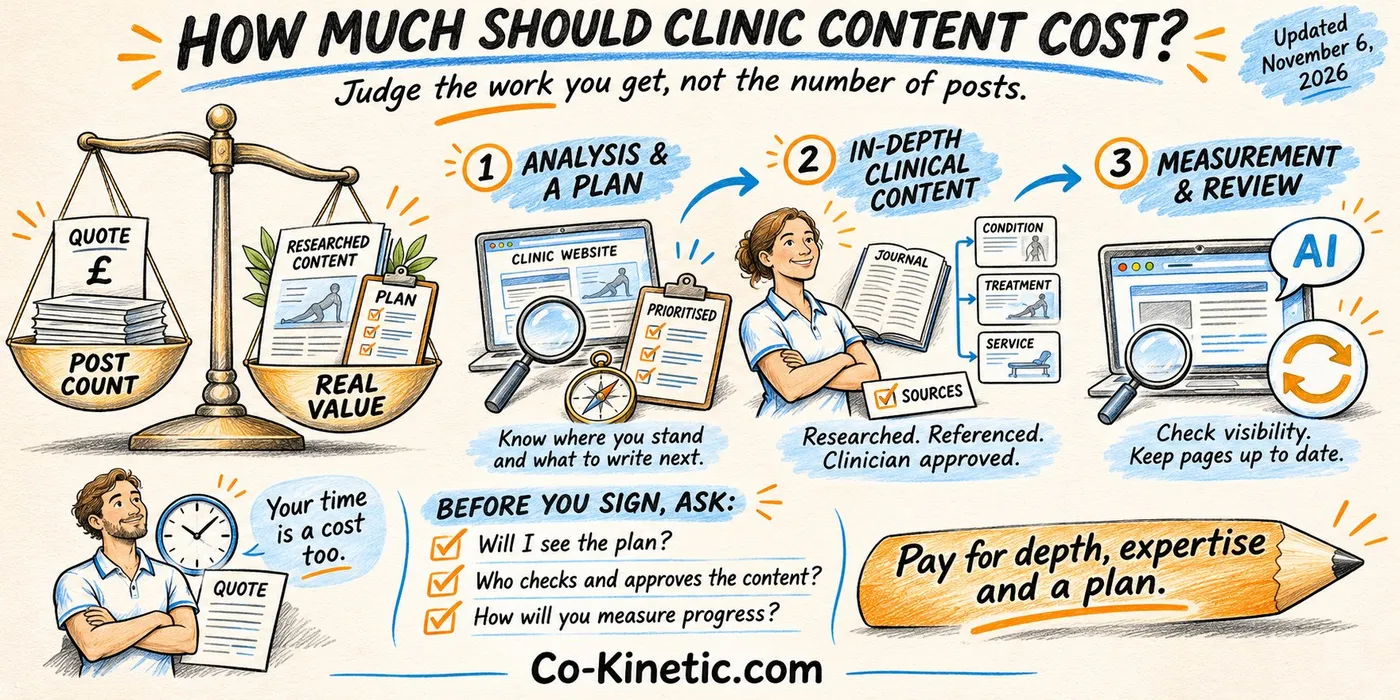
There isn’t a single right number. But there is a right way to judge one. Whatever you’re quoted, for any approach, here’s what you should be getting for the money:
- Analysis and a plan. A clear picture of where your clinic stands with Google and AI, and a plan for which conditions, treatments and services to cover first, and why.
- In-depth, researched pieces under your clinicians’ names. Condition guides, treatment pages and service pages that genuinely answer patients’ questions, with real references that have been checked, read and approved by the clinician whose name is on them.
- Measurement. Regular checks on what AI tools and Google say about your clinic, so you can see whether the work is paying off, with your pages kept reviewed and up to date.
If a quote buys you a set number of short posts and nothing else, it’s expensive at any price. If it buys you all three, it’s worth paying properly for.
Before you sign or renew a contract, ask:
- What analysis will you do of my clinic before you write anything, and will I see the plan?
- How in-depth is each piece, how is it researched, and how are the references checked?
- Whose name goes on the content, and does my clinician approve it before it’s published?
- Will you cover the conditions, treatments and services we actually offer, built topic by topic?
- How will you measure what AI tools and Google say about my clinic, and how often will I see it?
- What’s the minimum contract, and what happens to the content if I leave?
For comparison, here’s where we landed. Our Clinical Content System is £599 every four weeks, VAT included for UK customers, with no contract. For that you get the analysis and plan, plus four to seven in-depth pieces every four weeks under your clinicians’ names: condition guides, treatment pages, service pages and blog posts. Every piece goes through up to 12 research steps, every reference is checked to be real, and your clinician reads and approves it before it’s published. It keeps measuring what AI says about your clinic, and keeps your pages reviewed and up to date.
I’m not saying this replaces a full-service agency for every clinic. Some practices want the completely hands-off approach and have the budget for it. That’s fair. Whichever route you choose, hold it to the same standard.
The Uncomfortable Truth
Here’s what I’ve realised building this tool and running these numbers:
Your practice deserves to be found by patients who need you. You’ve trained for years. You’re good at what you do. You help people get better.
But being good at physiotherapy and being visible online are two completely different skills. With AI search accelerating, doing nothing isn’t a neutral option any more. It’s falling further behind.
If you want to see what your clinic’s AI visibility actually looks like, start with our free AI visibility check. It’s free, takes a minute to request, and tests real patient questions across ChatGPT, Google AI Overviews, Perplexity and Claude.
Because the reality is this: you shouldn’t have to choose between being found by patients and keeping your practice financially sustainable.
Tor
P.S. If you’re currently paying £1,000+ per month for content services, I’d genuinely love to know what you’re getting and whether it’s showing up in AI search results yet. Not to judge. Honestly, I just want to understand what the market looks like from your side. And if it’s working well for you, that’s great. But if you’re not sure, it might be worth checking your AI visibility score. The shift is happening faster than most agencies are adapting.
Related reading
- Are Patients Asking AI Which Clinic to Go To?: patients now ask AI before they ever see your website. This shows what that means for your clinic in plain terms, and the five things that decide whether you're the one it names.
- Is My SEO Agency Still Worth the Money?: find out what your SEO and ads money is really buying now that patients ask AI, so you can move it to where patients actually are.
- Why Can't I Just Use ChatGPT to Write My Clinic's Articles?: before you write another page with ChatGPT: the seven things it can't do for your clinic, from knowing which pages will move the needle to getting the references right, and why content that sounds like everyone else's leaves your chance of being found to pot luck.
- Which Pages on My Clinic Website Actually Bring In Patients?: stop spending hours on content nobody reads: the few pages that bring in most of your patients, and what to write first.
References
- BrightLocal, Local Consumer Review Survey 2026: AI and trust, 10 March 2026. https://www.brightlocal.com/research/lcrs-ai-trust/
- YouGov, AI is becoming part of UK adults' health information journey, July 2026. https://yougov.com/en-gb/articles/55203-ai-is-becoming-part-of-uk-adults-health-information-journey
- BrightEdge, Healthcare and AI Overviews: three-year evolution, 2023 to 2025, data to December 2025. https://www.brightedge.com/resources/weekly-ai-search-insights/healthcare-ai-evolution-google-2023-2025
- Aggarwal et al. (Princeton and IIT Delhi), "GEO: Generative Engine Optimization", KDD 2024, 2024. https://arxiv.org/abs/2311.09735
- Montgomery, Iqbal and Xu, Washington University in St Louis, measurement study of how well Google AI Overviews are grounded in their cited sources (55,393 searches, 13 March to 21 April 2026; arXiv:2605.14021; forthcoming at the ACM Internet Measurement Conference, October 2026), published 2 September 2026. https://arxiv.org/abs/2605.14021
- TechCrunch (reporting OpenAI), ChatGPT reaches 900M weekly active users, 27 February 2026. https://techcrunch.com/2026/02/27/chatgpt-reaches-900m-weekly-active-users
- Ofcom, Online Nation 2025, 10 December 2025. https://www.ofcom.org.uk/media-use-and-attitudes/online-habits/from-apps-to-ai-search-how-the-uk-goes-online-in-2025
- Search Engine Roundtable (reporting Similarweb and Semrush data), Report on AI Overview prevalence in US searches (Similarweb 43%, Semrush about 48%), 30 July 2026. https://www.seroundtable.com/half-google-searches-ai-overviews-41780.html
- KFF, KFF Tracking Poll on Health Information and Trust: use of social media and AI for health information and advice, 17 June 2026. https://www.kff.org/public-opinion/kff-tracking-poll-on-health-information-and-trust-use-of-social-media-and-ai-for-health-information-and-advice/
- Ahrefs, How to rank in AI Overviews (query fan-out study), January 2026, updated May 2026. https://ahrefs.com/blog/how-to-rank-in-ai-overviews/
?Frequently Asked Questions
How much should clinic content cost?
Judge it by what you get, not by the number of posts. Agencies typically charge £240 to £640 a month for two blog posts, and £850 to £3,000 a month for packages. Whatever the price, you should be getting analysis and a plan, in-depth researched pieces under your clinicians' names, and measurement of what AI and Google say about your clinic.
What is the AI Visibility tool and how does it work?
The AI Visibility tool is a free resource that assesses how well your clinic appears in AI search results. It uses AI assistants like ChatGPT and Google AI to simulate patient questions and checks if your clinic is mentioned, providing a visibility score based on the findings.
Why is content important for physiotherapy clinics in 2026?
Content is crucial because patients are increasingly using AI tools for searches rather than traditional Google queries. To be visible in these AI-driven searches, clinics must have relevant, evidence-based content that answers the specific questions patients are asking.
How often should clinics publish new content?
It's less about frequency than depth. A couple of short posts a month no longer keeps a clinic visible. What works is in-depth pages built topic by topic to a plan, covering the conditions you treat, your treatments and your services under named clinicians. Four to seven in-depth pieces every four weeks is what we see working.
What are the costs associated with creating quality content for clinics?
The costs can vary widely, with basic blog posts ranging from £60 to £250 each, while professional evidence-based blogs can cost £120 to £320. For a small practice aiming for consistent content, monthly expenses could total between £590 and £1,290.
What unique features does Co-Kinetic’s Clinical Content System offer?
Co-Kinetic’s Clinical Content System provides a streamlined approach to content creation, offering in-depth, evidence-based articles written under clinicians' names. It includes up to 12 research steps for each piece and ongoing measurement of AI visibility, all for £599 every four weeks.
What should clinics consider before investing in content creation?
Clinics should evaluate whether they can afford consistent content creation for 6-12 months, assess the credibility of the content, and ensure it meets the needs of AI search engines. Additionally, they should consider the potential time savings versus added workload.